Fiber Connect 2026 Puts Quantum on the Infrastructure Map
Key Highlights
- Quantum computing is increasingly viewed as a critical layer of digital infrastructure, impacting fiber networks, cybersecurity, and edge computing strategies.
- ARPA-E’s significant investment underscores federal commitment to applied quantum technologies, fostering industry and academic collaborations.
- Early adopters like EPB in Chattanooga are deploying quantum networks and creating local ecosystems for quantum applications and security.
- Quantum security, especially quantum key distribution, is a major driver, influencing network design and fiber deployment strategies.
- Future data centers will integrate smaller, rack-sized quantum systems alongside traditional accelerators, transforming infrastructure design and operational models.
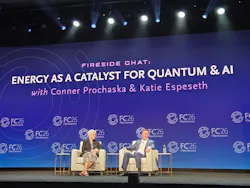
Fiber Connect 2026 revealed how seriously the broadband and infrastructure industries are beginning to treat quantum computing.
The signal was not limited to one vendor presentation or futuristic keynote. Across multiple sessions in Orlando, quantum computing was increasingly discussed as an emerging infrastructure issue tied to fiber networks, cybersecurity, edge computing, timing and synchronization, workforce development, and future data center architectures.
The seriousness of that shift was underscored by the presence of the Department of Energy’s Advanced Research Projects Agency-Energy (ARPA-E), which used the conference to spotlight its growing focus on applied quantum computing. Speaking at Fiber Connect, ARPA-E leadership noted that the agency had launched its first applied quantum computing program in DOE history, marking a significant expansion of federal interest in quantum technologies.
The scale of that commitment was notable: after spending roughly $134 million on fusion research over 12 years, ARPA-E is now allocating approximately $135 million toward fusion and quantum initiatives over just 18 months.
That broader backdrop gave added weight to two Fiber Connect sessions featuring IonQ’s Ryan Harring alongside fiber, edge, and infrastructure leaders. Together, the discussions framed quantum less as a distant laboratory science and more as an emerging layer of the digital infrastructure stack with implications for telecom networks, AI infrastructure, security, and distributed computing.
For data center operators and digital infrastructure providers, that was the signal. Quantum is still early. But the industry conversation is beginning to shift from whether quantum will matter to where it will profitably sit in the infrastructure stack.
From Science Project to Infrastructure Planning
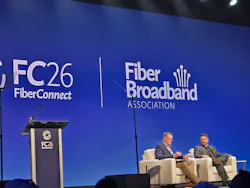
In a fireside chat with Dell’Oro Group’s Jeff Heynen, Harring began with the basics: quantum computing is built around principles such as superposition, interference and entanglement.
But the more important message for the Fiber Connect audience was practical. Quantum technologies, Harring said, are “closer than most think,” and will touch nearly every major industry vertical.
That proximity matters because quantum is not arriving as a standalone technology. It is coming alongside a broader ecosystem of quantum networking, sensing, photonic interconnects, satellite communications and security appliances.
For broadband providers, that means the physical network becomes part of the quantum story.
“Quantum technologies rely on timing and synchronization in a big way,” Harring said. “We’ve got to figure out ways that we can integrate these technologies into fiber strands.”
That comment captured the larger theme of the discussion. Quantum computing may begin with specialized machines, but quantum infrastructure will depend on fiber, timing, security and distributed network architectures.
EPB as the Early Model
The clearest example is EPB in Chattanooga.
Harring described EPB as IonQ’s largest customer and partner in the Southeast and across the country. The utility and broadband provider has already deployed what Harring described as the nation’s first commercially available quantum network using IonQ quantum networking equipment.
EPB is also installing an IonQ Forte Enterprise quantum computer. The goal is not simply to host an advanced machine. It is to create a local ecosystem for quantum computing, quantum networking, grid security and next-generation applications.
“They want to be in the infrastructure space,” Harring said. “They want to be able to provide these quantum computing technologies, these quantum networking infrastructures to their community.”
That model is important for the data center sector because it looks familiar. Like AI infrastructure, quantum infrastructure is emerging through regional clusters that combine power, fiber, academic partnerships, workforce development and early commercial use cases.
EPB and IonQ have also launched a fellowship program that brings 10 individuals into EPB’s environment to study computationally challenging problems and learn how quantum systems might apply to grid and fiber operations.
The Security Driver: Q-Day
Quantum’s first major infrastructure driver may not be compute acceleration. It may be security.
Harring pointed to “Q Day,” the point at which quantum computers become powerful enough to threaten RSA encryption, which underpins large portions of banking, healthcare, government and private-sector cybersecurity.
“Not trying to be an alarmist,” he said, “but once quantum computers get to a certain place from their computational perspective, then you start risking RSA being able to be cracked.”
That concern gives fiber providers a near-term reason to pay attention. IonQ is working on quantum key distribution appliances, including entanglement-based QKD. Harring noted that some quantum security approaches can work over aerial fiber, while more advanced entanglement distribution may require underground fiber because of polarization requirements.
The distinction matters. It suggests that quantum readiness may eventually influence network design, route selection, undergrounding strategies and service offerings.
Quantum as a Data Center Accelerator
For Data Center Frontier readers, Harring’s most important comments came when the discussion turned to data center architecture.
IonQ’s current trapped-ion systems still occupy meaningful physical space. Harring said one current deployment footprint is roughly 20 42U racks. But the company’s objective is to shrink that footprint dramatically.
“As quantum computers scale, they’re going to get smaller and smaller,” Harring said.
He described a future in which quantum computers become rack-sized systems sitting alongside GPUs, CPUs and FPGAs.
“A quantum computer will just be another accelerator that sits in the data center,” Harring said.
That is a significant framing. It places quantum within the same accelerated-computing trajectory that has reshaped data center design around GPUs and AI workloads.
The distinction, Harring noted, is that quantum is not simply a faster classical processor. It represents a different method of calculation. But from an infrastructure standpoint, the direction is clear: quantum systems are moving toward data center-ready form factors.
The Edge Use Case
The second Fiber Connect session expanded that point.
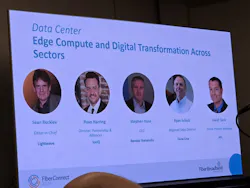
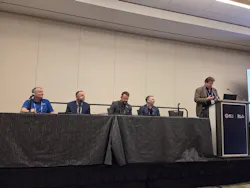
In a panel moderated by Lightwave Editor Sean Buckley on edge compute and digital transformation, Harring described quantum processing units as part of a hybrid compute model.
The idea is not that quantum computers replace classical systems. Instead, a classical bitstream may encounter a difficult computational problem, offload that portion to a QPU, receive the answer, and continue processing.
That makes quantum especially relevant for optimization, chemistry, material science and other workloads where even small gains can create large economic value.
It also raises an edge infrastructure question. If a quantum workload must travel to a distant data center, latency may limit its usefulness. Harring said IonQ wants to shrink systems into 4U, 5U or 6U footprints that could support edge deployments and reduce reliance on long-haul fiber for every calculation.
That is where quantum begins to intersect with the next phase of edge infrastructure.
Semiconductor Scaling Is the Pivot
The path to that future is not just physics. It is manufacturing.
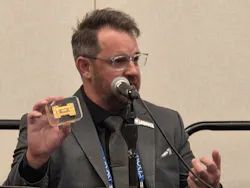
Harring said IonQ is moving away from laser-table systems toward semiconductor electronic-control qubits, helped by its work with SkyWater and Oxford Ionics. The objective is to make quantum systems more repeatable, efficient and compact.
That may be the most important infrastructure point of all. Quantum’s data center future depends on packaging, controls, manufacturing and repeatability as much as theoretical capability.
In other words, quantum is beginning to face the same industrialization challenge that every major data center technology must eventually solve.
Edge Networks as “Many Universes”
The edge panel also made clear that quantum will arrive inside a much broader operational transformation.
Steve Rose, CEO of Render Networks, described future edge environments as “many universes” requiring a shift from centralized operations to highly decentralized systems. Edge compute will require local equipment staging, telemetry-rich operations, real-time service-level commitments, outage management integration and AI-enabled operating systems.
Those systems, Rose said, will need to operate across secure shared data environments and sovereign data-sharing models.
That observation matters because quantum, AI and edge infrastructure all point in the same direction: more distributed compute, more sensitive workloads, more local orchestration and more operational complexity.
Fiber Scale Becomes the Physical Foundation
The panel grounded that future in the realities of fiber deployment.
AFL’s David Tanis said fiber counts have grown dramatically, with some deployments now reaching 6,912 fibers. Dura-Line’s Ryan Schick said middle-mile routes are commonly seeing 432- and 864-count fiber, while hyperscale environments can push much higher.
Those numbers are not just impressive. They reflect the physical foundation required for data center campuses, edge sites, distributed compute and future quantum networking.
Testing speed is also becoming critical. Tanis said OTDR testing that once took 30 seconds to a minute per fiber can now be reduced to less than a second through algorithm tuning.
That compression reflects the new construction reality. Data center projects that once took three to five years are now being delivered in less than a year, leaving fiber contractors and test teams under intense schedule pressure.
Power, Fiber and Workforce Converge
The panel also tied quantum and edge infrastructure to two familiar data center constraints: power and labor.
Rose said telecom infrastructure and energy infrastructure are now “wholly interdependent,” especially as AI and data center projects move from financial models into real communities. Schick noted growing joint builds between broadband and power companies, often using the same trench or right-of-way.
Workforce development is another constraint. AFL, Dura-Line, Meta, Equinix and IonQ were all cited as examples of companies building training programs for a market that needs more technicians, engineers and infrastructure specialists.
Harring emphasized that quantum will require more than physicists. It will need application developers, engineers, sales teams, customer success, legal expertise and business development.
That may be one of the clearest signs of quantum’s transition from research topic to industry sector.
Why Fiber Connect Mattered
The most important takeaway from Fiber Connect 2026 was not that quantum computing is fully mature. It is not.
The takeaway is that quantum is now being discussed inside the infrastructure venues where fiber providers, data center builders, utilities, equipment suppliers and workforce developers are making long-term plans.
AI may be driving today’s infrastructure buildout. But quantum is beginning to appear as the next layer of complexity: part compute accelerator, part security challenge, part networking problem and part workforce-development mandate.
At Fiber Connect, quantum moved closer to the ground.
It entered the trench, the rack, the edge node and the network planning cycle.
At Data Center Frontier, we talk the industry talk and walk the industry walk. In that spirit, DCF Staff members may occasionally use AI tools to assist with content. Elements of this article were created with help from OpenAI's GPT5.
Keep pace with the fast-moving world of data centers and cloud computing by connecting with Data Center Frontier on LinkedIn, following us on X/Twitter and Facebook, as well as on BlueSky, and signing up for our weekly newsletters using the form below.
About the Author
 Matt Vincent
Matt Vincent
Matt Vincent is Editor in Chief of Data Center Frontier, where he leads editorial strategy and coverage focused on the infrastructure powering cloud computing, artificial intelligence, and the digital economy. A veteran B2B technology journalist with more than two decades of experience, Vincent specializes in the intersection of data centers, power, cooling, and emerging AI-era infrastructure. Since assuming the EIC role in 2023, he has helped guide Data Center Frontier’s coverage of the industry’s transition into the gigawatt-scale AI era, with a focus on hyperscale development, behind-the-meter power strategies, liquid cooling architectures, and the evolving energy demands of high-density compute, while working closely with the Digital Infrastructure Group at Endeavor Business Media to expand the brand’s analytical and multimedia footprint. Vincent also hosts The Data Center Frontier Show podcast, where he interviews industry leaders across hyperscale, colocation, utilities, and the data center supply chain to examine the technologies and business models reshaping digital infrastructure. Since its inception he serves as Head of Content for the Data Center Frontier Trends Summit. Before becoming Editor in Chief, he served in multiple senior editorial roles across Endeavor Business Media’s digital infrastructure portfolio, with coverage spanning data centers and hyperscale infrastructure, structured cabling and networking, telecom and datacom, IP physical security, and wireless and Pro AV markets. He began his career in 2005 within PennWell’s Advanced Technology Division and later held senior editorial positions supporting brands such as Cabling Installation & Maintenance, Lightwave Online, Broadband Technology Report, and Smart Buildings Technology. Vincent is a frequent moderator, interviewer, and keynote speaker at industry events including the HPC Forum, where he delivers forward-looking analysis on how AI and high-performance computing are reshaping digital infrastructure. He graduated with honors from Indiana University Bloomington with a B.A. in English Literature and Creative Writing and lives in southern New Hampshire with his family, remaining an active musician in his spare time.
Related
Voices of the Industry
 Source: Getty Images, courtesy of Schneider Electric
 Source: Nimbus Advanced Process Cooling