From Components to AI Factories: Peter Panfil Says the Future of Data Centers Is All About Integration at Scale
Key Highlights
- Data centers are transitioning from standalone systems to tightly integrated, factory-assembled modules to accelerate deployment and scalability.
- Speed of deployment and operational agility are now critical economic factors, influencing design choices and construction methods.
- AI workloads are causing a fundamental inversion in data center design, with infrastructure now comprising the majority of the facility's focus due to higher rack densities.
- New metrics like tokens per watt are emerging to better measure AI infrastructure efficiency and business impact, replacing traditional PUE standards.
- Behavioral modeling and digital twins enable dynamic thermal management, optimizing cooling and electrical systems for fluctuating AI workloads.
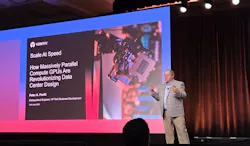
ORLANDO, Fla. — For years, the data center industry optimized individual systems: power distribution, cooling, racks, UPS equipment, and mechanical infrastructure. In the AI era, according to Vertiv Distinguished Engineer and Vice President of Technical Business Development Peter Panfil, that approach is no longer sufficient.
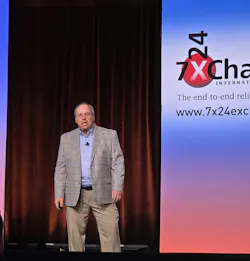
Speaking during Wednesday morning’s keynote at the 2026 7x24 Exchange Spring Conference, Panfil presented a vision in which the data center itself becomes a single, tightly orchestrated computing appliance—truly an “AI factory” whose success depends less on standalone components than on the seamless interaction between them.
Throughout his presentation, titled “Scale at Speed: How Massively Parallel Compute GPUs Are Revolutionizing Data Center Design,” Panfil repeatedly returned to a single imperative: the AI infrastructure race is increasingly defined by execution velocity.
“If you think you’re going big enough, go bigger,” he told attendees. “If you think you’re going fast enough, you’re going to have to go faster.”
For an industry gathered under the conference’s overarching theme of future-proofing AI infrastructure, Panfil’s message suggested something subtly different. Rather than trying to predict the future, operators should build systems capable of adapting to it.
“I would much rather be future ready,” he said, “than future proof.”
Speed Becomes the New Competitive Metric
One of the keynote’s recurring themes was that deployment speed has become an economic variable in its own right.
Panfil argued that hyperscalers and AI providers increasingly view time-to-capacity as directly tied to business value, making delays in construction or commissioning far more expensive than traditional infrastructure inefficiencies.
“The cost of speeding up has real benefits right now,” he observed.
That urgency is changing the way facilities are assembled. Rather than coordinating numerous independent contractors and subsystem vendors on-site, Panfil described an emerging model built around highly standardized, factory-produced HAC [hot aisle containment] modules—or “hacks”—that arrive largely complete and require only connection rather than construction.
“These days of disconnected pieces are over,” he said. “The systems now have to be tightly woven together because they are all dependent on each other.”
He emphasized that failures often occur not within products themselves but “at the seams,” where equipment, organizations, or project phases intersect. Eliminating those seams through repeatable building blocks and integrated design, he argued, is becoming a prerequisite for scaling AI deployments.
From 1.5 MW Pods to 6 MW—and Soon 12 MW
Among the most striking examples Panfil shared was the rapid evolution of AI infrastructure modules.
Just a year ago, he said, Vertiv was designing approximately 1.5-megawatt integrated compute units. Following NVIDIA’s updated GPU roadmap, those designs have expanded dramatically.
“We’re putting into a hack what we used to put into an entire room,” he said.
Current deployments now reach approximately 6 megawatts per integrated module, with discussions already underway around 12-megawatt configurations.
These modules are increasingly assembled and tested in factories—including full fluid charging and capacity validation—before being transported to site, craned into place, connected to power and liquid, and rapidly commissioned.
The shift reflects a broader manufacturing philosophy Panfil repeatedly described as normalization rather than standardization: performing the same operations repeatedly to improve speed, quality, and scalability.
AI Changes the Infrastructure Equation
Panfil argued that one of AI's least appreciated effects is how dramatically it changes the composition of the modern data center itself.
"In the cloud world, we were 20% infrastructure and 80% compute because we were dealing with 10-kilowatt racks," he told the audience. "Now that we're dealing with 100-plus-kilowatt racks, it's completely flipped. Twenty percent of the data center now is the compute. Eighty percent is the physical infrastructure."
That inversion carries profound design implications. As rack densities continue climbing toward several hundred kilowatts and eventually beyond, the supporting ecosystem of electrical distribution, liquid cooling, coolant distribution units, pumping, heat rejection, and power conversion increasingly dictates facility architecture.
For Panfil, this shift explains why thermal management and power delivery can no longer be treated as supporting systems. They have become the primary engineering challenge around which next-generation AI facilities must be designed.
Tokens May Replace PUE as the Industry's North Star
Perhaps Panfil's boldest prediction concerned the metrics by which AI facilities will ultimately be judged.
For decades, Power Usage Effectiveness (PUE) has served as the industry's shorthand for efficiency. Panfil argued that AI economics will increasingly shift attention toward a more outcome-oriented measure.
"It's my opinion that tokens per dollar per watt is going to replace PUE," he said, reflecting a future in which infrastructure is evaluated not merely by minimizing overhead but by maximizing economically useful AI output generated from every unit of power consumed.
An Audience Challenge Sharpens the Argument
One of the keynote's most revealing moments came during the audience Q&A, when James Coe, Syska Hennessy Group's Critical Facilities Director and a Senior Principal, offered a thoughtful refinement to Panfil's thesis.
While agreeing that token production would become the defining economic lens for AI infrastructure, Coe suggested that the ordering should be reversed. Rather than "tokens per dollar per watt," he proposed "tokens per watt per dollar," arguing that data center operators directly control power and cooling efficiency while GPU vendors determine computational efficiency.
"My opinion is we are going to start measuring tokens per watt per dollar," Coe argued, noting that AI service providers already monetize their offerings in tokens while infrastructure teams optimize the physical environment supporting those workloads.
Rather than defending his original phrasing, Panfil immediately embraced the refinement.
"You're spot on," he replied, adding that the industry ultimately needs a kind of "decoder ring" capable of translating familiar metrics like PUE into measures that reflect AI productivity and business value.
The exchange underscored a broader evolution underway: efficiency is becoming less about reducing overhead for its own sake and more about maximizing useful computation, and ultimately business outcomes, from every watt delivered to the facility.
Behavioral Modeling Emerges as a Core Engineering Discipline
Much of Panfil’s technical discussion centered on behavioral modeling and digital twins.
Rather than designing around static peak loads, Vertiv has increasingly modeled the dynamic operating characteristics of GPU clusters, whose workloads can swing dramatically in seconds as AI training cycles ramp between idle and full utilization.
Those oscillations create consequences throughout the facility.
In one example, Panfil described modeling a 6 MW AI module transitioning rapidly from approximately 30% to full load. Without additional thermal buffering, coolant temperatures in the immediate loop increased by roughly nine degrees Celsius. Introducing relatively modest buffer capacity reduced that excursion to approximately three degrees, allowing operators to raise source temperatures while maintaining acceptable chip temperatures and improving overall efficiency.
Such modeling, he argued, enables operators to optimize cooling infrastructure, improve PUE, and ultimately devote a greater share of available electrical capacity to compute rather than facility overhead.
Utilities Want Stable Data Centers, Not Just Large Ones
Panfil also devoted considerable attention to the interaction between AI campuses and the electric grid.
Modern GPU workloads can create highly dynamic power signatures, rapidly oscillating between significantly different load levels. When multiplied across hundreds of megawatts (or eventually gigawatt-scale campuses) those fluctuations become a utility concern.
Rather than allowing demand to rise and fall abruptly, Panfil described an emerging role for UPS systems as active power converters and smoothing devices that present utilities with far steadier load profiles.
Similarly, he discussed fault ride-through, in which facilities remain connected through short-duration voltage disturbances rather than disconnecting and introducing even larger instability onto the grid.
The message reflected a broader shift: AI facilities must increasingly function as cooperative grid participants rather than passive consumers of electricity.
BYOP Evolves from Sustainability Strategy to Business Necessity
Panfil has long championed Bring Your Own Power (BYOP) concepts, but he noted that the rationale has evolved.
Originally discussed primarily through a sustainability lens, on-site generation is increasingly driven by simple market realities: power availability often determines whether AI projects can proceed at all.
“The hunt,” he said, “is for land that has power, that has fiber access.”
Natural gas generation, battery storage, future small modular reactors, and other localized energy resources may all play roles in bridging lengthy utility interconnection timelines while enabling faster deployment of AI capacity.
Community Acceptance May Become Another Infrastructure Requirement
The keynote concluded with a discussion extending beyond engineering.
Responding to questions about community opposition to data center development, Panfil acknowledged that technical excellence alone will not ensure successful projects.
“We have to be good citizens,” he said, arguing that operators must demonstrate tangible benefits for surrounding communities, whether through grid support, waste heat reuse, or other forms of partnership.
His comments echoed a growing industry recognition that social license and public trust are becoming as important to AI expansion as power availability or cooling technology.
Designing for the Next GPU Generation—and the One After That
Perhaps the clearest takeaway from Panfil’s presentation was that infrastructure lifecycles are diverging from compute lifecycles.
GPU performance may improve by orders of magnitude over successive generations, but facilities must accommodate those advances without requiring wholesale redesign. Panfil urged owners to engineer for multiple future hardware generations simultaneously, emphasizing adaptability over optimization for today’s specifications alone.
In that sense, his keynote offered a broader philosophy for the AI era: the winning facilities may not be those with the most advanced individual components, but those whose integrated systems can absorb relentless technological change while continuing to scale.
For an industry racing toward ever larger AI deployments, the challenge is no longer simply building data centers. It is building platforms that can keep evolving as fast as the compute they contain.
At Data Center Frontier, we talk the industry talk and walk the industry walk. In that spirit, DCF Staff members may occasionally use AI tools to assist with content. Elements of this article were created with help from OpenAI's GPT5.
Keep pace with the fast-moving world of data centers and cloud computing by connecting with Data Center Frontier on LinkedIn, following us on X/Twitter and Facebook, as well as on BlueSky, and signing up for our weekly newsletters using the form below.
About the Author
 Matt Vincent
Matt Vincent
Matt Vincent is Editor in Chief of Data Center Frontier, where he leads editorial strategy and coverage focused on the infrastructure powering cloud computing, artificial intelligence, and the digital economy. A veteran B2B technology journalist with more than two decades of experience, Vincent specializes in the intersection of data centers, power, cooling, and emerging AI-era infrastructure. Since assuming the EIC role in 2023, he has helped guide Data Center Frontier’s coverage of the industry’s transition into the gigawatt-scale AI era, with a focus on hyperscale development, behind-the-meter power strategies, liquid cooling architectures, and the evolving energy demands of high-density compute, while working closely with the Digital Infrastructure Group at Endeavor Business Media to expand the brand’s analytical and multimedia footprint. Vincent also hosts The Data Center Frontier Show podcast, where he interviews industry leaders across hyperscale, colocation, utilities, and the data center supply chain to examine the technologies and business models reshaping digital infrastructure. Since its inception he serves as Head of Content for the Data Center Frontier Trends Summit. Before becoming Editor in Chief, he served in multiple senior editorial roles across Endeavor Business Media’s digital infrastructure portfolio, with coverage spanning data centers and hyperscale infrastructure, structured cabling and networking, telecom and datacom, IP physical security, and wireless and Pro AV markets. He began his career in 2005 within PennWell’s Advanced Technology Division and later held senior editorial positions supporting brands such as Cabling Installation & Maintenance, Lightwave Online, Broadband Technology Report, and Smart Buildings Technology. Vincent is a frequent moderator, interviewer, and keynote speaker at industry events including the HPC Forum, where he delivers forward-looking analysis on how AI and high-performance computing are reshaping digital infrastructure. He graduated with honors from Indiana University Bloomington with a B.A. in English Literature and Creative Writing and lives in southern New Hampshire with his family, remaining an active musician in his spare time.
Voices of the Industry
 Source: Shutterstock, courtesy of nVent Data Solutions