Phillip Koblence on AI Infrastructure, Inference Demand, and the Industry’s Growing Visibility
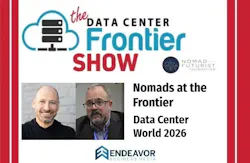
At Data Center World 2026, one message echoed consistently across the conference halls: whatever the industry was worried about last year, it is now worried about even more intensely.
Power. Workforce. Deployment speed. Community resistance. Supply chain execution.
The themes haven’t changed. The scale has.
“That’s the vibe here,” said Data Center Frontier Editor in Chief Matt Vincent during a live recording of Nomads at the Frontier, the ongoing podcast collaboration between Data Center Frontier and the Nomad Futurist Foundation. “Everything the industry has been talking about for the last three years, but even more.”
Vincent was joined at the conference by Phillip Koblence, COO and co-founder of NYI and one of the founders of Nomad Futurist, for a wide-ranging discussion examining the state of the digital infrastructure industry as AI workloads accelerate demand across power systems, interconnection hubs, workforce pipelines, and community engagement efforts.
And while public conversations outside the industry continue to question whether AI infrastructure growth is sustainable, Koblence said the mood inside Data Center World suggested something very different.
“There’s no doubt that the appetite for digital infrastructure continues to grow,” Koblence said. “If the measure of whether this industry’s staying power exists is the representation and how many people are coming to these conferences, we haven’t even scratched the surface yet. It is just continuing to grow at this exponential pace.”
He pointed to the continuing growth of major industry gatherings including PTC, DCD, and Data Center World itself as evidence that demand for digital infrastructure remains extraordinarily strong.
Still, Koblence acknowledged that portions of the AI ecosystem remain overhyped.
“There are certainly some elements of our industry that are overhyped,” he said. “I think there are bubble-ish qualities to it. But usually the people inside the bubble don’t talk about the bubble.”
Community Engagement Moves to the Forefront
One of the strongest themes emerging at Data Center World this year was the industry’s increasing focus on community engagement and public perception.
Moratoriums and zoning resistance have become recurring issues across major and emerging data center markets alike, from Maine and Illinois to Virginia and Arizona. According to Koblence, the industry is beginning to recognize that its historically low-profile operating model no longer works at hyperscale growth rates.
“We as a data center industry have always been fairly insular because nobody really knew we existed while they were using the internet,” Koblence said. “And now it’s growing at such a hyper-fast pace that to the general population outside the bubble, it feels like it came out of nowhere.”
Vincent noted the sharp disconnect between perceptions inside and outside the conference venue.
“All week people have been talking about the people outside on the curb,” Vincent said, referring to demonstrators protesting data center development near the event. “The discrepancy couldn’t really be any larger because we all follow the mainstream news. We all know what they think the story of data centers and the data center industry is.”
At the same time, Vincent observed that many executives inside the conference appeared deeply aware of public criticism and increasingly concerned about improving communication with local communities.
“I’m not sure if the people on the curb know just how much the people inside the building are thinking about them,” Vincent said.
Koblence argued that the solution is not confrontation, but transparency, education, and inclusion.
“It’s really about giving voice to the legitimate concerns that communities have,” he said. “Making sure people have a seat at the table and ultimately a stake in the outcome.”
At the same time, he noted that misinformation surrounding data centers has become increasingly common as AI infrastructure enters mainstream political and public conversations.
“The easiest possible thing to say anytime you have disruption is, ‘No, I don’t want that,’” Koblence said.
But he believes the industry increasingly needs to articulate the economic role modern digital infrastructure now plays.
“Instead of factories manufacturing physical goods, you’re talking about AI factories,” he said. “And the amount of productivity coming out of these data centers has fundamental economic benefits that result in increases in workforce, increases in job opportunities, increases in tax base — just not in the same way they did in the 1960s, ’70s, and ’80s.”
Power Challenges Become More Sophisticated
The discussion at Data Center World also reflected a growing understanding that AI infrastructure challenges are becoming more operationally complex as deployments mature.
Koblence pointed to one keynote session featuring a former Microsoft executive now working at NVIDIA who discussed the increasing importance of power storage and workload balancing strategies.
“He was really talking about the value associated with power storage,” Koblence said. “Not just getting power and understanding you need to be part of the grid, but figuring out ways to mitigate the dynamism of the workloads.”
That shift reflects how AI deployments are moving beyond theoretical planning exercises into operational realities.
“The more we get mature with these workloads, the more a lot of these issues that were theoretical start to bubble up to the surface,” Koblence said. “And we’re having to solve them in real time.”
The comments mirror broader conversations across the industry about fluctuating AI power demand profiles, dynamic GPU utilization patterns, and the increasing importance of energy orchestration technologies alongside raw generation capacity.
The Inference Inflection Point Arrives
The conversation also turned toward one of the defining infrastructure shifts now underway across AI deployments: the movement from model training toward inference.
Vincent referenced NVIDIA CEO Jensen Huang’s declaration at GTC 2026 that the market had entered an “inference inflection point,” arguing that the shift is already beginning to reshape infrastructure planning decisions.
“People are starting to build for it,” Vincent said. “And along with the inference uptick, people are taking a harder look at enterprise data science centers and interconnection.”
For Koblence, the shift toward inference represents another iteration of the data center industry’s longstanding cycle between workload aggregation and distribution.
“The cyclical nature of our industry has always been aggregation of workloads and disaggregation of workloads,” he said. “The cloud was going to displace the data center. Then you had cloud repatriation.”
AI workloads, he argued, are now entering a similar phase as enterprises begin operationalizing large language models for practical business use cases.
“As data is generated at the edge — on our fingers, on our watches, with autonomous vehicles and IoT devices — that data needs to be manipulated and inferenced at the edge,” Koblence said.
That dynamic, he added, is driving renewed interest in highly interconnected urban facilities positioned close to population centers and latency-sensitive applications.
“There’s going to be a big swing back to these highly interconnected Tier One NFL cities,” he said.
Why Interconnection Hubs Matter Again
For companies like NYI, which operate within major interconnection ecosystems, the inference transition could significantly elevate the strategic importance of carrier-dense urban facilities.
But deploying AI infrastructure in major cities introduces a completely different set of operational constraints compared to greenfield hyperscale campuses.
“You have logistical issues associated with legacy infrastructure and legacy buildings,” Koblence explained. “At 60 Hudson Street, which is probably the most interconnected building in New York City, the building was built in the 1920s for Western Union. The floor loads are what they are. The floor-to-ceiling heights are what they are.”
As rack densities continue climbing, those realities become increasingly important.
“You’re not going to find 150-kilowatt deployments that you can easily put into major cities,” Koblence said.
The result, he argued, is a growing recognition that the future data center market will not converge around a single dominant architecture.
“There is no one type of data center,” Koblence said. “It is a large spectrum of applications and workloads.”
Vincent agreed, noting that despite the AI frenzy, traditional cloud infrastructure demand continues to rise as well.
“Phil Lawson-Shanks made the point upstairs that the cloud is still growing,” Vincent said during the discussion. “It’s still what everybody uses. It’s what everything relies on.”
The Workforce Cliff
Beyond power and AI, workforce shortages remained another defining topic throughout the conference.
Koblence pointed to a widely cited industry statistic highlighting the severity of the challenge.
“For every three people that leave the industry, we only have one coming in,” he said.
That shortfall is particularly acute across skilled trades and engineering disciplines critical to AI infrastructure deployment.
To address the issue, Nomad Futurist partnered with Infrastructure Masons and I Am The Armed Forces at Data Center World to host a workforce development initiative designed to expose students, veterans, and career changers to opportunities within digital infrastructure.
“We’re trying to remove the veil of secrecy our industry has been hidden behind,” Koblence said.
Part of the challenge, he noted, is that traditional educational systems still struggle to explain what careers in digital infrastructure actually look like.
“If you ask people at their kitchen tables what they want to do for a living, they’ll still say doctor, lawyer, firefighter, finance,” he said. “The education system simply hasn’t kept pace with the evolution of digital infrastructure as a career path.”
Yet Koblence emphasized that the industry ecosystem now extends far beyond servers and facilities alone.
“There is no vertical, there is no job that does not have a place within digital infrastructure,” he said.
That point became visibly apparent on the Data Center World expo floor itself, where exhibitors ranged from electrical infrastructure providers and cooling specialists to logistics firms, workforce housing companies, and even industrial coatings manufacturers.
“Every element of everything within the data center has a full sub-vertical industry associated with it,” Koblence said.
Vincent pointed to the sheer diversity of exhibitors as evidence of how expansive the ecosystem has become.
“Sherwin-Williams has a booth in there and they are jamming,” Vincent observed. “There’s a catering company in there that does catering just for data centers.”
Koblence added that the supply chain footprint now stretches even further.
“You have actual temporary housing for construction workers being represented on that hall,” he said. “People would be surprised how large of an ecosystem is involved in creating the digital economy that exists today.”
An Industry Becoming Increasingly Visible
If there was one underlying theme connecting the conversation, it was the idea that the data center industry has entered a fundamentally different phase of public visibility.
For decades, digital infrastructure largely operated out of sight. Now, hyperscale AI demand, power consumption, and rapid construction activity have moved the industry directly into mainstream economic, political, and community conversations.
That transition is creating friction.
But it is also forcing the industry to mature publicly in real time.
“The issues that used to be theoretical are now bubbling up to the surface,” Koblence said. “And we’re having to solve them in real time.”
For an industry increasingly responsible for powering AI, cloud computing, and the digital economy itself, invisibility may no longer be an option.
At Data Center Frontier, we talk the industry talk and walk the industry walk. In that spirit, DCF Staff members may occasionally use AI tools to assist with content. Elements of this article were created with help from OpenAI's GPT5.
Keep pace with the fast-moving world of data centers and cloud computing by connecting with Data Center Frontier on LinkedIn, following us on X/Twitter and Facebook, as well as on BlueSky, and signing up for our weekly newsletters using the form below.
About the Author
 Matt Vincent
Matt Vincent
Matt Vincent is Editor in Chief of Data Center Frontier, where he leads editorial strategy and coverage focused on the infrastructure powering cloud computing, artificial intelligence, and the digital economy. A veteran B2B technology journalist with more than two decades of experience, Vincent specializes in the intersection of data centers, power, cooling, and emerging AI-era infrastructure. Since assuming the EIC role in 2023, he has helped guide Data Center Frontier’s coverage of the industry’s transition into the gigawatt-scale AI era, with a focus on hyperscale development, behind-the-meter power strategies, liquid cooling architectures, and the evolving energy demands of high-density compute, while working closely with the Digital Infrastructure Group at Endeavor Business Media to expand the brand’s analytical and multimedia footprint. Vincent also hosts The Data Center Frontier Show podcast, where he interviews industry leaders across hyperscale, colocation, utilities, and the data center supply chain to examine the technologies and business models reshaping digital infrastructure. Since its inception he serves as Head of Content for the Data Center Frontier Trends Summit. Before becoming Editor in Chief, he served in multiple senior editorial roles across Endeavor Business Media’s digital infrastructure portfolio, with coverage spanning data centers and hyperscale infrastructure, structured cabling and networking, telecom and datacom, IP physical security, and wireless and Pro AV markets. He began his career in 2005 within PennWell’s Advanced Technology Division and later held senior editorial positions supporting brands such as Cabling Installation & Maintenance, Lightwave Online, Broadband Technology Report, and Smart Buildings Technology. Vincent is a frequent moderator, interviewer, and keynote speaker at industry events including the HPC Forum, where he delivers forward-looking analysis on how AI and high-performance computing are reshaping digital infrastructure. He graduated with honors from Indiana University Bloomington with a B.A. in English Literature and Creative Writing and lives in southern New Hampshire with his family, remaining an active musician in his spare time.
Related
Voices of the Industry
 Source: SNEHIT PHOTO/Shutterstock.com
 Source: Matthew G Eddy/Shutterstock.com