Aeroderivative Turbines Move to the Center of AI Data Center Power Strategy
Key Highlights
- Aeroderivative turbines offer rapid start-up times and high power density, making them ideal for bridging utility delays in data center deployments.
- Trailerized, modular designs enable faster installation and scalability, aligning with hyperscale construction philosophies and reducing critical path timelines.
- Regulatory and environmental considerations are increasingly influencing turbine deployment, with a focus on emissions controls and permitting for sustained operation.
- Hybrid architectures combining turbines with energy storage are emerging to provide long-duration support and enhance grid resilience for AI data centers.
- Next-generation turbines, like Boom’s Superpower, aim to operate efficiently in hot climates and without water cooling, addressing key operational constraints.
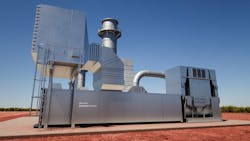
Data centers have stockpiled diesel generators for decades. But the AI-era power crunch is putting a more unusual machine on “backup power” shortlists: repurposed jet-engine cores; specifically, aeroderivative gas turbines built around retired aircraft-engine technology. In plain terms, you take the heart of a widebody turbofan, package it to spin a generator instead of making thrust, and you get tens of megawatts of fast-start electricity in a footprint and on a delivery timeline that can look almost implausible by conventional power-plant standards.
This shift isn’t driven by novelty. It’s driven by collision: interconnection queues stretching out, transformer lead times ballooning, turbine backlogs deepening, and local permitting fights intensifying at the same moment AI infrastructure economics make uptime and time-to-energize existential. In that environment, an aeroderivative turbine - especially a mobile, trailerized unit - functions less like standby backup and more like a schedule-saving bridge: a way to turn land and gas service into usable power now, while the utility timeline catches up.
What “Repurposing Jet Engines” Actually Means
Most of the solutions now being discussed are not intact jet engines dragged from a boneyard and wired into a switchboard. They are industrial generator sets built around aircraft-derived cores; specifically the compressor, combustor, and turbine “gas generator” that decades of aviation engineering have refined.
These cores are then paired with a power turbine (or equivalent shaft-power section), gearbox if required, generator, controls, filtration, enclosure, and emissions systems suitable for stationary duty.
One of the best-known examples is GE Vernova’s LM6000, derived from the CF6-80C2 aircraft engine and long positioned as a high-output aeroderivative solution in a compact package. Another data-center-adjacent platform is Mitsubishi Power’s FT8 MOBILEPAC, an aeroderivative package engineered for rapid delivery and small footprint, historically used for peaking, grid support, and temporary power.
The “repurposed” angle attracting the most attention involves companies taking retired commercial jet engine cores and converting them into generator sets. ProEnergy, for example, has reported offerings that retrofit CF6-80C2 cores into packages capable of delivering roughly 50 MW per unit, including modifications such as expanded turbine sections to convert thrust into shaft power, along with new mounting structures and control systems.
The headline framing around “jet engines” is not wrong but the engineering reality is more nuanced. These are aeroderivative turbines with aircraft DNA, increasingly packaged into mobile, modular solutions now being actively targeted at data center power requirements.
Why Data Centers Want Jet-Engine Technology
1) Speed to Power (Fast Start + Fast Deployment)
Aeroderivatives are well known for rapid ramp and start capability. GE Vernova notes the LM6000 can reach full output within minutes, a characteristic long valued in peaking and grid-support roles.
In today’s data center market, however, the larger advantage is often logistical rather than mechanical. Trailerized aeroderivative packages can be delivered, installed, and commissioned far faster than building a conventional power plant, or waiting years for transmission upgrades and utility interconnection.
2) Power Density (High MW in a Small Footprint)
High power density remains one of the core value propositions of aeroderivative turbines. Compared with large banks of reciprocating engines, these systems can deliver significantly more megawatts per square foot.
GE’s aeroderivative materials highlight this density advantage versus high-speed diesel platforms. For AI campuses where land is constrained by setbacks, acoustic envelopes, or air-permitting boundaries, that footprint efficiency can materially influence site design and scalability.
3) Operational Flexibility (Load Following + Fuel Optionality)
Aircraft-derived machines were engineered for demanding duty cycles and rapid load changes, and the industrial variants largely preserve that operational agility. Many platforms can also be configured to run on multiple fuels.
GE’s LM6000, for example, is rated for operation on natural gas with liquid fuel backup options, and the company has outlined potential hydrogen pathways in certain configurations (though these should be viewed as roadmap capabilities rather than universal deployments).
In practical data center terms, the flexibility question often comes down to a simple operational hedge: Can the site run primarily on pipeline gas while maintaining distillate backup if gas service is interrupted?
Atlantic.Net COO Pete Cannata, whose company inherited jet-turbine generation assets through a facility acquisition, told DCF how the advantages became immediately clear for his team:
There are three distinct reasons jet turbines are better than using standard diesel generators, and are preferred. First is power generation; turbines are more efficient in the size of the units to the amount of power they generate. Diesel generators, for the same output, are much larger and require larger fuel tanks. The efficiency of how much fuel used in power generation is largely better in turbines when compared to diesel, as well as the emissions are cleaner in turbines. Last is the maintenance of turbines, while much more expensive, is needed far less than diesel gen-sets. Diesel generators typically need service every 6-12 months or around 250 operating hours, while regular fuel and filter maintenance is required more frequently, even without use. Turbines need regular maintenance every 25,000 operating hours but should have regular inspections every 8,000-10,000 operating hours. Regular maintenance is scheduled to ensure solid operating performance on all generators. Also, there is the ability to service units without power interruption, as in our new facility there are three of each type, and using only two of the three, they are capable of suppling full power to the data center.
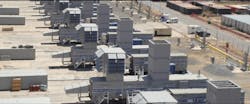
From “Backup” to “Bridging” to Behind-the-Meter Power Plants
The most important shift is conceptual: these systems are increasingly blurring the boundary between emergency backup and primary power supply.
Traditionally, data center electrical architecture has been clearly tiered:
-
UPS (seconds to minutes) to ride through utility disturbances and generator start.
-
Diesel gensets (minutes to hours or days) for extended outages.
-
Utility grid as the primary power source.
What’s changing is the rise of bridging power: generation deployed to energize a site before the permanent grid connection is ready, or before sufficient utility capacity becomes available. Providers such as APR Energy now explicitly market turbine-based solutions to data centers seeking behind-the-meter capacity while awaiting utility build-out.
That framing matters because it fundamentally changes expected runtime. A generator that operates for a few hours per year is one regulatory category. A turbine that runs continuously for weeks or months while a campus ramps is something very different; and it is drawing increased scrutiny from regulators who are beginning to treat these installations as material generation assets rather than temporary backup systems.
The near-term driver is straightforward. AI workloads are arriving faster than grid infrastructure can keep pace. Data Center Frontier and other industry observers have documented the growing scramble for onsite generation as interconnection queues lengthen and critical equipment lead times expand.
Mainstream financial and business media have taken notice. The Financial Times has reported on data centers turning to aeroderivative turbines and diesel fleets to bypass multi-year power delays. Reuters has likewise covered large gas-turbine-centric strategies tied to hyperscale campuses, underscoring how quickly the co-located generation model is moving into the mainstream.
At the same time, demand pressure is tightening turbine supply chains. Industry reporting points to extended waits for new units, one reason repurposed engine cores and mobile aeroderivative packages are gaining attention.
The Packaging Revolution: Trailerized Megawatts
The most consequential innovation may not be the turbine core itself, but the packaging and systems integration that make these units viable for data center campus deployment.
Historically, aeroderivative turbines powered ships, offshore platforms, and heavy industrial facilities. What’s new in the data center context is the aggressive push toward:
-
Modular skid or trailer configurations
-
Integrated switchgear and controls
-
Accelerated commissioning playbooks
-
“Fleet” operating models using multiple identical units
Mitsubishi Power’s MOBILEPAC platform, for example, emphasizes modularity and shipping optimization for rapid deployment. The approach mirrors hyperscale construction philosophy: repeatable blocks, standardized interfaces, and parallelized build schedules.
If operators can add power blocks the same way they add data hall blocks, the entire project critical path begins to compress.
How These Turbines Fit Into Data Center Electrical Design
Even with rapid-start capability, aeroderivative turbines do not eliminate the need for core data center electrical infrastructure. A resilient architecture still requires:
-
UPS ride-through to ensure zero-interruption transfer
-
Switchgear, protection, and synchronization, particularly when paralleling multiple units
-
Power quality management, including harmonics control, voltage regulation, and transient response
-
Controls integration with generators, ATS/STS systems, and in some cases the utility interconnection
In bridging mode, turbines may function as the primary power source feeding campus distribution, with utility service either unavailable or capacity-limited. In traditional backup mode, the same systems may sit idle but fully ready to assume load during an outage.
One critical distinction: fast start does not mean instantaneous power. UPS systems remain essential; particularly for AI training clusters, where even a brief disturbance can trigger costly job interruptions or restarts. For that reason, most emerging architectures are best understood not as turbines replacing traditional resiliency layers, but as UPS plus aeroderivatives working in concert.
Emissions, Permitting, and the End of the “Temporary” Loophole
This is where the advantages of the jet-engine narrative meet regulatory reality: air permitting.
Once operators move from true “emergency generator” behavior to sustained or routine runtime, regulators begin asking a different set of questions focused on potential-to-emit calculations, New Source Review (NSR) thresholds, operating hour limits, and required controls for NOx, CO, VOCs, and particulate matter.
The EPA maintains extensive Clean Air Act guidance relevant to data center operators, including frameworks for determining potential emissions from onsite generation. The Congressional Research Service has likewise noted that facilities exceeding emissions thresholds typically trigger NSR permitting requirements, bringing additional scrutiny to large behind-the-meter deployments.
Recent controversy surrounding portable turbine fleets at AI data center sites has only intensified federal attention. Reporting in early 2026 indicated the EPA is tightening interpretations to prevent large mobile turbine installations from operating for extended periods without appropriate permits.
This shift has direct implications for the repurposed jet-engine model. Much of the economic value comes from the ability to run turbines long enough to bridge multi-year grid delays. If permitting regimes begin restricting runtime or requiring emissions controls that slow deployment, the schedule and cost advantages that make aeroderivatives attractive could narrow.
Economics: Why Pay for On-Site Turbines When the Grid Is Cheaper?
In most markets, utility power remains less expensive on a per-kilowatt-hour basis than self-generation. But for AI-centric developments, the binding constraint is often not the price of electricity; it is time to energized capacity.
When developers are committing billions of dollars to land, facilities, GPUs, and high-speed networking, every month spent waiting for power represents idle capital and deferred revenue. In that context, aeroderivative turbines function as a time-buying strategy:
-
Energize Phase 1 with onsite turbines
-
Begin revenue workloads earlier
-
Transition to utility supply or a dedicated plant later
There is also a longer-term hedging dimension. Onsite turbines can provide a measure of insulation against grid curtailments, transmission outages, or phased utility ramp schedules: risks that are becoming more material in regions facing large-load interconnection pressure.
The Tradeoffs Are Real
Aeroderivatives are not a universal solution. The model introduces a new set of operational and strategic considerations that developers must weigh carefully.
Fuel and Infrastructure Dependence
Gas-fired turbines require reliable fuel delivery with firm transportation rights, adequate pressure, and redundancy planning. Most deployments also maintain onsite liquid fuel backup. This can introduce new single points of failure compared with a purely utility-supplied architecture.
Noise and Community Impact
Aeroderivative units can generate significant acoustic output, and trailerized fleets add both visual and sound footprint. As recent projects have demonstrated, even in rural markets, continuous turbine operation can trigger strong community pushback, particularly as runtime extends beyond traditional emergency profiles.
Maintenance and Parts Availability
While aeroderivative platforms benefit from mature service ecosystems, growing demand and increased reliance on retired engine cores could create new bottlenecks, including hot-section components, qualified field technicians, and overhaul capacity.
Carbon Accounting and Reputational Risk
Even when positioned as temporary bridging assets, extended turbine runtime can collide with hyperscaler climate commitments and local air-quality concerns. As operating hours increase, the narrative around “backup” generation becomes harder to sustain.
Where the Jet-Engine Power Model Goes Next
So what does the future hold for aeroderivative turbines in data center power strategies? Three paths are beginning to emerge.
Phase 0 Becomes Standard Practice
One trajectory is normalization. Developers increasingly design campuses with an expected interim generation phase by using aeroderivative fleets to energize early capacity before transitioning to utility supply, long-term PPAs, or dedicated generation assets.
In this model, “bridging power” stops being an exception and becomes a standard Phase 0/Phase 1 tool in the AI infrastructure playbook.
Regulation Forces “Real Power Plant” Behavior
A second path depends heavily on regulatory interpretation. If federal and state agencies continue tightening rules around portable and temporary generation, many deployments may be pushed toward fully permitted onsite plants.
Those plants could still rely on gas turbines. But the rapid-deployment advantage that makes trailerized aeroderivatives so attractive today would narrow if projects must meet full stationary-source requirements from day one.
Hybrid Architectures Take Hold
A third path is technological convergence. As battery energy storage system (BESS) costs decline and grid services markets mature, more campuses are likely to pair aeroderivative turbines with substantial storage capacity.
In these hybrid designs, turbines increasingly provide firm capacity and long-duration support, while batteries handle ride-through, short transients, and peak shaving. Recent growth in BESS deployments suggests this shift is already underway across portions of the market.
Longer term, OEMs continue to promote hydrogen capability and other decarbonization pathways. But the near-term reality is more pragmatic: aeroderivative turbines are gaining traction because they solve the schedule problem better than any currently scalable alternative.
The Bottom Line
Jet engines are not replacing diesel gensets. But they are rapidly establishing themselves as the high-density, fast-deployment middle layer between UPS batteries and a grid that, in many regions, cannot keep pace with AI demand.
Aeroderivative turbines, particularly those built from retired aircraft cores, offer:
-
Fast-start, modular tens-of-megawatt power blocks.
-
Rapid deployment paths that bypass multi-year grid delays.
-
A practical bridge to permanent infrastructure.
The tradeoffs are equally clear. Greater fuel consumption, more complex permitting exposure, and rising community scrutiny will follow these systems as they move from emergency standby into sustained operation.
In the AI buildout race, aeroderivatives are winning on speed. Whether they can scale cleanly (i.e. operationally, environmentally, and politically) remains the industry’s next defining test.
Supersonic Technology Enters the AI Power Conversation
If today’s aeroderivative surge is largely built on proven but aging aviation cores, the next phase may be defined by purpose-built designs aimed directly at AI-era operating conditions.
In December, Boom Supersonic introduced its Superpower natural gas turbine and named energy-first AI infrastructure developer Crusoe as launch customer, signaling how quickly the distributed generation landscape around data centers is evolving.
Crusoe has ordered 29 Superpower units as part of a broader 1.21-gigawatt onsite generation strategy, positioning the deployment among the more ambitious behind-the-meter power plays tied to AI infrastructure to date. Crusoe’s move fits a broader pattern: the company has consistently positioned itself as an energy-first developer, pursuing unconventional power strategies to accelerate time-to-capacity across its AI infrastructure portfolio.
The turbine is rated at 42 MW per unit and is built around Boom’s new Symphony engine core, the same architecture being developed for the company’s planned Overture supersonic airliner.
Boom founder and CEO Blake Scholl framed the opportunity in characteristically direct terms:
“Supersonic technology is an accelerant—of course for faster flight, but now for artificial intelligence as well.”
Boom also disclosed a $300 million Series B round led by Darsana Capital to fund Symphony engine development and initial Superpower scaling.
A Different Aeroderivative Design Philosophy
Where most current aeroderivative platforms trace their lineage to subsonic commercial engines optimized for intermittent high thrust, Boom is positioning Symphony as a core designed for sustained high-temperature operation: an attribute the company argues becomes increasingly important in hot-weather data center markets such as Texas and the desert Southwest.
According to Boom, Superpower is engineered to:
-
Deliver full rated output in ambient temperatures exceeding 110°F.
-
Operate without water cooling.
-
Run primarily on natural gas with diesel backup capability.
-
Package 42 MW in a container-scale footprint.
If those performance claims are validated in sustained commercial deployments, these characteristics could address one of the persistent limitations of legacy aeroderivatives: thermal derate under high ambient conditions.
Just as important, Boom is pairing the turbine with what it describes as cloud-native monitoring and telemetry inherited from its aerospace development stack, another signal that power generation is beginning to absorb design philosophies from adjacent high-performance industries.
Boom has indicated a goal of scaling Superpower turbine production to more than 4 gigawatts annually by 2030, a target that would require significant manufacturing execution but signals the company’s ambition to compete in AI-scale power markets.
Baker Hughes Partnership Adds Industrial Weight
The effort gained additional industrial credibility in February when Baker Hughes announced it will supply 25 BRUSH Power Generation DAX 7 air-cooled generators, along with automatic voltage regulators and associated systems, to pair with Boom’s Superpower turbines.
Including earlier orders, the combined equipment package is intended to support approximately 1.21 GW of onsite capacity for Crusoe’s AI data center portfolio, with deliveries scheduled from mid-2026 through 2028.
Baker Hughes Chairman and CEO Lorenzo Simonelli positioned the collaboration as part of a broader response to data center power demand growth:
“Pairing our proven generator technology with a novel turbine application enables innovative, efficient and dependable power solutions for the rapidly expanding distributed power generation needs of AI and high-performance computing.”
From Opportunistic Bridging to Purpose-Built AI Power
The Boom–Crusoe partnership highlights a deeper shift now underway in data center energy strategy. It also reflects how AI-driven load growth is now large enough to attract entirely new entrants into the data center power supply chain.
The first wave of behind-the-meter deployments largely repurposed existing aeroderivative platforms to solve immediate interconnection delays. What Boom is attempting represents a more deliberate second phase: designing turbine technology explicitly around AI infrastructure requirements.
The Superpower order is also consistent with Crusoe’s broader pattern of energy innovation. The company originally built its business model around capturing stranded natural gas for modular compute deployments and has since expanded into battery-backed microgrids, carbon-capture-linked projects, and gas-to-nuclear bridge strategies for large AI campuses.
For data center developers evaluating the platform, several technical and operational signals will bear close watching:
-
High-temperature full-load performance. If Superpower can maintain rated output in 100°F+ ambient conditions, it could mitigate one of the persistent constraints of legacy aeroderivatives in hot-climate AI markets.
-
Water-independent operation. The ability to run without evaporative cooling directly addresses water availability constraints that are increasingly shaping hyperscale site selection.
-
Software-defined monitoring and controls. Cloud-native telemetry and remote operations could materially improve fleet management and predictive maintenance for multi-unit campus deployments.
-
Vertically integrated manufacturing. Boom’s stated push to internalize production is aimed at bypassing the turbine backlogs now constraining many large-scale power deployments.
Whether Superpower ultimately proves disruptive will depend on execution, certification timelines, and sustained field performance. But the announcement itself underscores how quickly the industry conversation is shifting, from opportunistic retrofits toward purpose-engineered power platforms for AI-scale infrastructure.
At Data Center Frontier, we talk the industry talk and walk the industry walk. In that spirit, DCF Staff members may occasionally use AI tools to assist with content. Elements of this article were created with help from OpenAI's GPT5.
Keep pace with the fast-moving world of data centers and cloud computing by connecting with Data Center Frontier on LinkedIn, following us on X/Twitter and Facebook, as well as on BlueSky, and signing up for our weekly newsletters using the form below.
About the Author
 David Chernicoff
David Chernicoff
 Matt Vincent
Matt Vincent
Matt Vincent is Editor in Chief of Data Center Frontier, where he leads editorial strategy and coverage focused on the infrastructure powering cloud computing, artificial intelligence, and the digital economy. A veteran B2B technology journalist with more than two decades of experience, Vincent specializes in the intersection of data centers, power, cooling, and emerging AI-era infrastructure. Since assuming the EIC role in 2023, he has helped guide Data Center Frontier’s coverage of the industry’s transition into the gigawatt-scale AI era, with a focus on hyperscale development, behind-the-meter power strategies, liquid cooling architectures, and the evolving energy demands of high-density compute, while working closely with the Digital Infrastructure Group at Endeavor Business Media to expand the brand’s analytical and multimedia footprint. Vincent also hosts The Data Center Frontier Show podcast, where he interviews industry leaders across hyperscale, colocation, utilities, and the data center supply chain to examine the technologies and business models reshaping digital infrastructure. Since its inception he serves as Head of Content for the Data Center Frontier Trends Summit. Before becoming Editor in Chief, he served in multiple senior editorial roles across Endeavor Business Media’s digital infrastructure portfolio, with coverage spanning data centers and hyperscale infrastructure, structured cabling and networking, telecom and datacom, IP physical security, and wireless and Pro AV markets. He began his career in 2005 within PennWell’s Advanced Technology Division and later held senior editorial positions supporting brands such as Cabling Installation & Maintenance, Lightwave Online, Broadband Technology Report, and Smart Buildings Technology. Vincent is a frequent moderator, interviewer, and keynote speaker at industry events including the HPC Forum, where he delivers forward-looking analysis on how AI and high-performance computing are reshaping digital infrastructure. He graduated with honors from Indiana University Bloomington with a B.A. in English Literature and Creative Writing and lives in southern New Hampshire with his family, remaining an active musician in his spare time.
Related
Voices of the Industry
 Source: SNEHIT PHOTO/Shutterstock.com
 Source: Matthew G Eddy/Shutterstock.com