Nuclear’s Next AI Test: Building at Scale
Key Highlights
- Existing nuclear plants like Palisades and Crane are demonstrating the potential for near-term capacity recovery to support data center power needs.
- Advanced nuclear developers are focusing on building dependable supply chains for fuel, manufacturing, and construction to enable large-scale deployment.
- Milestones in reactor testing and criticality are reducing technical and commercial risks, moving nuclear from demonstration to industrialization.
- Long-term power agreements with hyperscalers are making existing nuclear assets more economically viable and supporting plant life extensions.
- Supply chain constraints for equipment like gas turbines highlight the importance of reusing and restarting existing nuclear infrastructure to meet immediate demand.
For data center developers facing multiyear utility interconnection queues and tightening power markets, nuclear energy is entering a different phase of its AI infrastructure story.
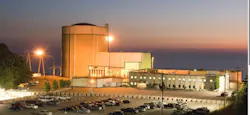
The near-term opportunity still rests largely with the existing reactor fleet. Holtec International has moved the Palisades Nuclear Plant in Michigan into fuel loading, one of the final major stages before reactor startup activities. Constellation Energy, meanwhile, continues to work toward a 2027 restart of the former Three Mile Island Unit 1, now the Christopher M. Crane Clean Energy Center, under its long-term power agreement with Microsoft.
Together, Palisades and Crane represent roughly 1.64 GW of existing nuclear capacity that could return to service without waiting for entirely new plants to be licensed, financed and constructed. That makes reactor restarts one of the few ways nuclear generation can materially intersect with data center power demand before the end of the decade.
But the more consequential change may be taking place further upstream.
A burst of activity from advanced nuclear developers at the end of August pointed increasingly toward the industrial systems required to move new reactor designs from demonstrations to repeatable infrastructure. X-energy, TerraPower, GE Vernova Hitachi, Oklo, Westinghouse, Kairos Power and others reported progress involving fuel supply, reactor testing, manufacturing, licensing and commercial deployment.
None of these advanced reactor projects will solve the industry's 2027 or 2028 power shortage. That is no longer the most useful test.
The more important question is whether advanced nuclear can begin acquiring the characteristics of an industrial supply chain: dependable fuel, standardized manufacturing, repeatable construction, tested reactor systems and enough commercial certainty for large power customers to plan around deployment schedules measured in years rather than speculation.
For data center infrastructure, that is the transition worth watching.
Palisades Moves From Restoration to Startup
The clearest near-term proof point is now Palisades.
Holtec began loading fuel into the 805-MW Michigan reactor at the end of August, moving the plant into the controlled sequence of testing and startup activities that precedes a return to commercial operation.
Fuel loading is not the same as a restart. Palisades must still complete inspections, startup testing, initial criticality and grid synchronization before electricity begins flowing commercially. But the milestone changes the character of the project. What began as an effort to preserve and restore a retired nuclear asset has now become an active reactor startup program.
That distinction matters because Palisades is attempting something without a direct precedent in the U.S. commercial nuclear industry: returning a reactor to operation after it had permanently shut down and entered decommissioning.
The plant ceased operating in May 2022. Holtec acquired it with the expectation that it would be dismantled, then reversed course as electricity-market conditions, federal policy and demand for firm generation changed. Since then, the company has carried out extensive inspections, repairs and equipment replacement involving systems including steam generators and control rod drive mechanisms. The federal government has supported the effort with a $1.52 billion Department of Energy loan guarantee.
For the data center industry, Palisades is important less as a template that can simply be reproduced than as a test of what existing nuclear infrastructure can still contribute to a rapidly tightening power market.
A successful restart would return hundreds of megawatts of continuous generation at an already-developed energy site with established transmission infrastructure. That combination is difficult to reproduce quickly through greenfield generation and transmission development, particularly in regions where data center load growth is already colliding with interconnection delays.
There will not be a large inventory of Palisades-like opportunities, and the economics and engineering will vary considerably from plant to plant. But the project is demonstrating why recently retired nuclear assets, potential life extensions and reactor uprates are receiving renewed scrutiny as utilities and large power customers look for capacity that can arrive before entirely new generation systems are built.
Palisades therefore represents the near-term side of the nuclear equation. The larger question is whether advanced reactor developers can create an industrial system capable of delivering new nuclear capacity repeatedly at much greater scale.
Crane Connects Nuclear Restarts to Hyperscale Demand
If Palisades is the physical proof point for reactor restarts, the Christopher M. Crane Clean Energy Center is the clearest commercial connection between the existing nuclear fleet and hyperscale data center demand.
Constellation announced in 2024 that it would restart the former Three Mile Island Unit 1 after reaching a 20-year power agreement with Microsoft. The 835-MW Pennsylvania reactor shut down for economic reasons in 2019 and is now targeted to return to service in 2027, with the project also supported by a $1 billion Department of Energy loan.
Crane's significance is increasingly straightforward: much of the infrastructure already exists.
The reactor, turbine equipment, supporting facilities and grid connection do not have to be created from scratch. Constellation still faces regulatory, construction and transmission work before restart, but the project operates on a fundamentally different timetable from a greenfield advanced reactor that must move through licensing, financing, site development, construction and commissioning.
Microsoft is not planning to colocate a data center directly with the plant. Instead, its long-term agreement supports the return of nuclear generation to the broader grid as part of the company's strategy to match its electricity consumption with carbon-free power. That makes Crane a useful precedent for another reason: nuclear and data center infrastructure do not necessarily have to occupy the same site for hyperscaler demand to support new or restored generation.
For the existing nuclear fleet, agreements of this kind can change the economics of assets that previously struggled in competitive power markets. For hyperscalers, they can secure long-duration access to large quantities of firm, carbon-free generation without waiting for a new reactor technology to reach commercial scale.
But Crane also illustrates the limit of the restart strategy. Existing reactors can provide important capacity on data center development timelines, but there are only so many recently retired plants available to bring back.
Supplying the much larger AI infrastructure buildout envisioned for the 2030s will require something the restart market cannot provide: a nuclear industry capable of producing new reactors repeatedly.
Power Scarcity Is Becoming an Equipment Problem, Too
The constraint facing AI infrastructure is no longer simply whether enough generation can ultimately be built. Increasingly, it is whether the equipment required to deliver firm power can arrive on data center development schedules.
That problem is helping drive renewed interest in natural gas, particularly for behind-the-meter and other Bring Your Own Power strategies. Gas turbines can generally be deployed faster than new nuclear plants and provide the dispatchable generation required by large, continuously operating AI loads.
But even that option is running into supply-chain limits. GE Vernova has reported a 116-GW gas turbine backlog extending into 2031, while Siemens Energy has cited a 69-GW backlog and lead times of three years or more. Mitsubishi Power has likewise reported a roughly 35-GW backlog, with some deliveries extending into the 2028–2030 period.
Those timelines help explain why existing nuclear assets such as Palisades and Crane have become unusually valuable. Their core generating equipment and much of the associated infrastructure are already in place. Restarting them remains a complex undertaking, but it avoids one of the increasingly important constraints affecting almost every major generation technology: waiting for an entirely new power plant supply chain to deliver.
For advanced nuclear developers, however, the comparison raises the bar.
The opportunity is clear. Large data center customers are looking for firm power on increasingly long planning horizons, while carbon commitments continue to complicate reliance on combustion-based generation. But advanced reactors will compete not only on reactor design or levelized cost of electricity. They will have to demonstrate that fuel, components, manufacturing capacity and construction partners can support dependable delivery schedules at commercial scale.
That is where the advanced nuclear story now moves—from the characteristics of the power itself to the infrastructure required to produce it repeatedly.
Existing Nuclear Becomes a Commercial Asset
The growing connection between data centers and existing nuclear plants does not depend on every hyperscaler building directly beside a reactor.
Microsoft's Crane agreement demonstrates the broader commercial model. A large technology customer can support the economics of an existing nuclear asset through a long-term power agreement even when the electricity continues to move through the regional grid rather than directly into an adjacent data center campus.
That distinction matters as data center developers increasingly organize site-selection and power-procurement strategies around access to large blocks of dependable generation.
Operating nuclear plants bring several advantages into that calculation: substantial existing generation, established high-voltage transmission infrastructure and, in many cases, communities already familiar with large-scale energy facilities. But the experience surrounding AWS and Talen Energy's Susquehanna project in Pennsylvania also demonstrates that proximity to nuclear generation does not eliminate regulatory, transmission or market-design questions.
For nuclear plant owners, however, hyperscalers represent a particularly attractive class of customer. They can support large electricity purchases over 15- or 20-year periods, carry substantial and relatively predictable load, and in many cases are actively seeking lower-carbon sources of firm generation.
Those characteristics can strengthen the economics of nuclear plants that might otherwise face pressure in competitive power markets. They can also support life extensions, uprates and other investments capable of preserving or expanding existing capacity.
But that opportunity remains bounded by the size of the existing fleet. Long-term contracts can help retain nuclear generation already on the system; they cannot create the much larger volume of new capacity that future AI infrastructure forecasts may ultimately require.
That brings the industry back to the central question for advanced nuclear: whether new reactors can be manufactured, fueled and built with enough predictability to become infrastructure rather than exceptions.
X-energy Builds the Fuel Supply Chain
For advanced nuclear, manufacturing reactors at scale solves only part of the problem. The industry also needs an industrial fuel supply capable of supporting an entire reactor fleet.
That remains a major constraint for designs that depend on high-assay low-enriched uranium, or HALEU. U.S. production is not yet available at the volumes required for large-scale commercial deployment, while Russia has historically been the dominant supplier of the material.
X-energy is now trying to close that gap alongside development of its Xe-100, an 80-MWe high-temperature gas reactor designed to be deployed in multi-unit configurations.
The company has signed an enrichment services agreement with Centrus Energy covering both conventional low-enriched uranium and HALEU. At the same time, X-energy is advancing construction of its TRISO-X fuel fabrication facility in Oak Ridge, Tennessee, where the company plans to manufacture the TRISO fuel used by the Xe-100.
That approximately 214,000-square-foot facility is important for reasons that extend beyond X-energy itself. Advanced nuclear cannot become a repeatable infrastructure product if reactor developers remain dependent on scarce or uncertain fuel supplies. Fuel enrichment, fabrication and reactor manufacturing have to scale together.
The issue is particularly relevant to the data center market because Amazon is a major X-energy strategic partner, with the companies outlining plans that could support more than 5 GW of advanced nuclear capacity by 2039.
Ambitions at that scale turn fuel availability from a reactor-development issue into an infrastructure-planning issue.
For hyperscalers considering nuclear power in the 2030s, a reactor design and a power purchase agreement will not be enough. They will need confidence that developers can secure enriched uranium, manufacture fuel in volume and support repeated deployments across multiple sites.
X-energy's work with Centrus and TRISO-X therefore represents something more consequential than another milestone in the Xe-100 development program. It is an attempt to build one of the industrial systems that will have to exist before advanced nuclear can move from individual projects to a deployable fleet.
TerraPower Targets Construction Certainty
If X-energy is working on the fuel side of nuclear industrialization, TerraPower is confronting another problem advanced reactors will have to solve before hyperscalers can plan around them: predictable construction.
TerraPower has selected Hyundai Engineering & Construction as an engineering, procurement and construction partner for as many as eight future Natrium plants. The relationship is intended to develop commercial structures that include project completion, pricing and performance guarantees.
Those provisions go directly at one of nuclear power's longstanding weaknesses.
First-of-a-kind nuclear projects have historically exposed utilities and investors to schedule delays and major cost overruns. That model is difficult to reconcile with data center development, where customers increasingly make multibillion-dollar infrastructure commitments around specific power-availability dates.
A hyperscaler considering nuclear generation therefore needs more than confidence that a reactor will work. It needs reasonable certainty about when the plant will enter service, how much construction will cost and whether subsequent units can be delivered on increasingly standardized schedules.
TerraPower's Natrium project in Kemmerer, Wyoming, is intended to provide some of the construction and operating experience needed to establish that record. The design combines a 345-MW sodium-cooled reactor with molten-salt energy storage, allowing the plant to temporarily increase output to roughly 500 MW.
That flexibility could have value for grids serving large and variable industrial loads. But for the data center market, the more consequential question may be whether Natrium can become a repeatable construction product rather than a succession of bespoke nuclear projects.
The Hyundai relationship points directly at that challenge. If advanced nuclear is going to supply meaningful amounts of AI infrastructure in the 2030s, developers will have to reproduce plants across multiple sites with increasingly predictable costs, schedules and performance.
In that sense, TerraPower is not simply developing a reactor. It is beginning to address the delivery system around the reactor — the engineering, contracting and risk allocation required to make new nuclear capacity something large power customers can actually plan around.
Gas-to-Nuclear Offers a Transitional Model
One possible answer to nuclear's timing problem is to separate the first megawatts from the ultimate generation mix.
Blue Energy and GE Vernova Hitachi Nuclear Energy are pursuing that model in Victoria, Texas, where plans call for an energy complex of roughly 2.5 GW.
The proposed development would begin with approximately 1 GW of natural gas generation, followed by as many as five GE Hitachi BWRX-300 small modular reactors totaling roughly 1.5 GW.
The concept addresses a basic mismatch between data center and nuclear development schedules. Large data center campuses may need initial power within two or three years, while new nuclear capacity can take considerably longer to license, finance and construct.
Rather than requiring a developer to choose between gas today and nuclear later, the Victoria model would sequence the two.
That approach does not solve the broader nuclear industrialization challenge. The reactors still have to be licensed, manufactured, constructed and fueled on dependable schedules. But it illustrates how advanced nuclear could eventually enter data center power strategies without having to satisfy the industry's entire near-term demand problem on its own.
Reactor Testing Moves Beyond the Model
Other recent milestones are beginning to provide something equally important for advanced nuclear: operating data.
Oklo's Groves Isotope Test Reactor in Texas reached first criticality, establishing a controlled, self-sustaining nuclear chain reaction. The small test reactor is not an Aurora commercial power plant and is not supplying a data center, but it gives the company direct reactor-operating experience as it pursues larger commercial deployments.
Westinghouse similarly achieved zero-power criticality for an eVinci microreactor test in Nevada.
Neither milestone should be confused with commercial electricity production. What they provide instead is experimental reactor data that can validate physics calculations, inform engineering decisions and support the licensing work still required before these systems become deployable power assets.
That distinction matters in a market crowded with nuclear announcements.
For data center operators evaluating technologies that may not enter service for years, the useful dividing line is increasingly not whether a developer has announced a project or signed an agreement. It is whether the company is progressively removing specific technical and commercial risks: reactor physics, fuel availability, manufacturing capability, licensing, construction execution and ultimately operating performance.
Criticality is one step in that process. It is not the finish line.
The Nuclear Test Is Moving From Technology to Execution
For the remainder of the 2020s, existing reactors are likely to remain nuclear power's most immediate contribution to the data center power equation.
Palisades and Crane alone represent roughly 1.64 GW of capacity that could return to service without waiting for entirely new nuclear plants to be built. Long-term power agreements, life extensions and uprates at other operating plants may preserve or incrementally expand additional capacity.
But the scale of projected AI infrastructure demand eventually outruns that strategy.
Developers are already discussing data center campuses measured in gigawatts, and there are simply not enough retired nuclear plants available to restart—or existing plants available to uprate—to supply that level of growth.
The more consequential nuclear question therefore shifts into the 2030s: whether advanced reactor developers can build an industry capable of producing new capacity repeatedly rather than delivering isolated first-of-a-kind projects.
The recent milestones begin to show what that industry would require.
X-energy is working to secure enrichment services and manufacture TRISO fuel at scale. TerraPower is developing EPC structures aimed at improving schedule, price and performance certainty across repeated Natrium deployments. GE Hitachi and Blue Energy are testing a phased gas-to-nuclear model intended to reconcile nuclear timelines with near-term data center demand. Oklo and Westinghouse are generating reactor data rather than relying only on simulations and project announcements. Kairos Power and others are likewise investing in manufacturing, construction capability and workforce development.
Taken individually, none of those developments solves the industry's immediate power shortage. Taken together, they show where the advanced nuclear competition is beginning to move.
The differentiators will increasingly be practical: who can secure fuel, manufacture components, obtain regulatory approval, establish repeatable construction processes, control project risk and deliver electricity on schedules and at prices large power customers can incorporate into long-range infrastructure plans.
That is a different test from proving that an advanced reactor can work. It is the test of whether nuclear can become an industrial product. For the data center industry, that distinction may ultimately matter more than any individual reactor announcement.
VIDEO: Oklo’s Groves Isotope Test Reactor reached first criticality in August 2026, providing operating data and hands-on deployment experience as the advanced nuclear sector moves from reactor concepts toward tested hardware.
At Data Center Frontier, we talk the industry talk and walk the industry walk. In that spirit, DCF Staff members may occasionally use AI tools to assist with content.
Keep pace with the fast-moving world of data centers and cloud computing by connecting with Data Center Frontier on LinkedIn, following us on X/Twitter and Facebook, as well as on BlueSky, and signing up for our weekly newsletters using the form below.
About the Author
 David Chernicoff
David Chernicoff
 Matt Vincent
Matt Vincent
Matt Vincent is Editor in Chief of Data Center Frontier, where he leads editorial strategy and coverage focused on the infrastructure powering cloud computing, artificial intelligence, and the digital economy. A veteran B2B technology journalist with more than two decades of experience, Vincent specializes in the intersection of data centers, power, cooling, and emerging AI-era infrastructure. Since assuming the EIC role in 2023, he has helped guide Data Center Frontier’s coverage of the industry’s transition into the gigawatt-scale AI era, with a focus on hyperscale development, behind-the-meter power strategies, liquid cooling architectures, and the evolving energy demands of high-density compute, while working closely with the Digital Infrastructure Group at Endeavor Business Media to expand the brand’s analytical and multimedia footprint. Vincent also hosts The Data Center Frontier Show podcast, where he interviews industry leaders across hyperscale, colocation, utilities, and the data center supply chain to examine the technologies and business models reshaping digital infrastructure. Since its inception he serves as Head of Content for the Data Center Frontier Trends Summit. Before becoming Editor in Chief, he served in multiple senior editorial roles across Endeavor Business Media’s digital infrastructure portfolio, with coverage spanning data centers and hyperscale infrastructure, structured cabling and networking, telecom and datacom, IP physical security, and wireless and Pro AV markets. He began his career in 2005 within PennWell’s Advanced Technology Division and later held senior editorial positions supporting brands such as Cabling Installation & Maintenance, Lightwave Online, Broadband Technology Report, and Smart Buildings Technology. Vincent is a frequent moderator, interviewer, and keynote speaker at industry events including the HPC Forum, where he delivers forward-looking analysis on how AI and high-performance computing are reshaping digital infrastructure. He graduated with honors from Indiana University Bloomington with a B.A. in English Literature and Creative Writing and lives in southern New Hampshire with his family, remaining an active musician in his spare time.