Meta’s Expanded MTIA Roadmap Signals a New Phase in AI Data Center Architecture
Key Highlights
- Meta's MTIA chips are designed to optimize AI inference workloads, supporting trillions of predictions daily across Facebook, Instagram, and Reels.
- Custom silicon allows data centers to tailor power and thermal envelopes, enabling higher densities and more efficient cooling solutions like liquid cooling systems.
- Power management features at the chip level facilitate software-defined power control, maximizing compute output while minimizing energy consumption.
- Next-generation inference platforms will increasingly rely on high-speed interconnects such as CXL to support disaggregated memory and low-latency data transfer.
- Meta's approach exemplifies a broader industry shift towards integrating hardware design with data center architecture to meet the escalating demands of AI infrastructure.
For decades, the data center building was largely agnostic to the hardware inside it. Servers arrived, racks were populated, and operators focused on keeping power flowing and cooling systems stable. That relationship is now reversing.
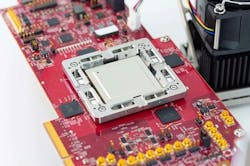
As Meta expands development of its Meta Training and Inference Accelerator (MTIA) silicon, the company is not simply designing chips to run AI workloads. It is effectively designing the power and thermal envelope of the next generation of hyperscale data centers.
Meta recently outlined its roadmap for successive generations of MTIA processors, purpose-built to accelerate AI inference and recommendation workloads that drive services across Facebook, Instagram, and Reels.
The company’s first production deployments of MTIA are already running in its data centers today, supporting ranking and recommendation models that generate trillions of predictions per day across its platforms.
Future generations of the chip (expected to arrive on a roughly 18- to 24-month cadence) are designed to steadily increase performance while improving efficiency for large-scale inference.
Meta engineers describe the effort as part of a broader strategy to optimize hardware specifically for the company’s massive AI infrastructure footprint.
Meta outlined the architecture and roadmap in an engineering blog post describing the evolution of its custom AI accelerator program.
The Inference Economy
While most headlines about AI infrastructure focus on training clusters built with high-end GPUs, companies like Meta face a different operational reality.
Training models is expensive, but serving them to billions of users every day is what drives the largest long-term compute demand.
Every recommendation in a social feed, every advertisement ranking decision, and every suggested video requires real-time inference. This is the workload Meta’s MTIA program targets most directly.
According to industry reporting, Meta plans several successive chip generations in the coming years as it refines the architecture for higher throughput and improved efficiency.
The focus on inference efficiency reflects a growing industry shift. While GPU clusters dominate AI training, the operational cost of always-on inference infrastructure is becoming the dominant factor in hyperscale AI economics.
Silicon as a Data Center Design Tool
Custom silicon also allows hyperscale operators to shape the physical characteristics of the infrastructure around it.
Traditional GPU platforms often arrive with fixed power envelopes and thermal constraints. But internally designed accelerators allow companies like Meta to tailor chips to the rack-level power and cooling budgets of their own data center architecture.
That flexibility becomes increasingly important as AI infrastructure pushes power densities far beyond traditional enterprise deployments.
Custom accelerators like MTIA can be engineered to fit within the liquid-to-chip cooling frameworks now emerging in hyperscale AI racks.
These systems circulate coolant directly across cold plates attached to processors, removing heat far more efficiently than air cooling and enabling higher compute densities.
For operators running thousands of racks across multiple campuses, small improvements in performance-per-watt can translate into enormous reductions in total power demand.
Software-Defined Power
One of the subtler advantages of custom silicon lies in how it interacts with data center power systems.
By controlling chip-level power management features such as power capping and workload throttling, operators can fine-tune how servers consume electricity inside each rack.
This creates opportunities to safely run racks closer to their electrical limits without triggering breaker trips or thermal overloads.
In practice, that means data center operators can extract more useful compute from the same electrical infrastructure.
At hyperscale, where campuses may draw hundreds of megawatts, these efficiencies have a direct impact on capital planning and grid interconnection requirements.
The Interconnect Layer
AI accelerators do not operate in isolation. Their effectiveness depends heavily on how they connect to memory, storage, and other compute nodes across the cluster.
Industry analysts expect next-generation inference platforms to rely increasingly on high-speed interconnect technologies such as CXL (Compute Express Link) and advanced networking fabrics to support disaggregated memory architectures and low-latency data movement.
These fabrics allow accelerators to access large shared memory pools or SSD arrays while maintaining the throughput needed for real-time inference.
For hyperscalers operating massive distributed AI systems, the chip is only one piece of a broader infrastructure puzzle.
Hyperscalers Redesigning the Stack
Meta’s MTIA roadmap fits into a broader trend across the hyperscale ecosystem.
Several large cloud and internet platforms are developing their own AI processors to complement traditional GPU infrastructure.
Examples include:
• Google’s Tensor Processing Units (TPUs)
• Amazon’s Trainium and Inferentia processors
• Microsoft’s Maia AI accelerators
These chips allow hyperscalers to tailor hardware to their workloads while reducing reliance on constrained GPU supply chains.
At the same time, companies continue to deploy large clusters of GPUs for training large language models and other frontier AI systems.
The result is a hybrid architecture combining:
• GPU training clusters
• custom inference accelerators
• high-bandwidth memory architectures
• advanced networking fabrics
• liquid-cooled rack designs
The Gigawatt Context
Meta’s silicon program also reflects the broader scale of infrastructure now required to support AI.
Hyperscalers are increasingly planning mega-campuses capable of supporting hundreds of megawatts of IT load, with some projects ultimately approaching gigawatt-scale power consumption.
In that environment, efficiency gains at the chip level can determine whether a campus requires 400 megawatts, or 500.
Custom silicon gives hyperscalers a new lever to control that equation.
As AI infrastructure continues expanding, the relationship between silicon and buildings will only grow tighter.
The data center was once a neutral container for computing hardware.
In the AI era, the hardware itself is increasingly shaping the building.
At Data Center Frontier, we talk the industry talk and walk the industry walk. In that spirit, DCF Staff members may occasionally use AI tools to assist with content. Elements of this article were created with help from OpenAI's GPT5.
Keep pace with the fast-moving world of data centers and cloud computing by connecting with Data Center Frontier on LinkedIn, following us on X/Twitter and Facebook, as well as on BlueSky, and signing up for our weekly newsletters using the form below.
About the Author
 Matt Vincent
Matt Vincent
Matt Vincent is Editor in Chief of Data Center Frontier, where he leads editorial strategy and coverage focused on the infrastructure powering cloud computing, artificial intelligence, and the digital economy. A veteran B2B technology journalist with more than two decades of experience, Vincent specializes in the intersection of data centers, power, cooling, and emerging AI-era infrastructure. Since assuming the EIC role in 2023, he has helped guide Data Center Frontier’s coverage of the industry’s transition into the gigawatt-scale AI era, with a focus on hyperscale development, behind-the-meter power strategies, liquid cooling architectures, and the evolving energy demands of high-density compute, while working closely with the Digital Infrastructure Group at Endeavor Business Media to expand the brand’s analytical and multimedia footprint. Vincent also hosts The Data Center Frontier Show podcast, where he interviews industry leaders across hyperscale, colocation, utilities, and the data center supply chain to examine the technologies and business models reshaping digital infrastructure. Since its inception he serves as Head of Content for the Data Center Frontier Trends Summit. Before becoming Editor in Chief, he served in multiple senior editorial roles across Endeavor Business Media’s digital infrastructure portfolio, with coverage spanning data centers and hyperscale infrastructure, structured cabling and networking, telecom and datacom, IP physical security, and wireless and Pro AV markets. He began his career in 2005 within PennWell’s Advanced Technology Division and later held senior editorial positions supporting brands such as Cabling Installation & Maintenance, Lightwave Online, Broadband Technology Report, and Smart Buildings Technology. Vincent is a frequent moderator, interviewer, and keynote speaker at industry events including the HPC Forum, where he delivers forward-looking analysis on how AI and high-performance computing are reshaping digital infrastructure. He graduated with honors from Indiana University Bloomington with a B.A. in English Literature and Creative Writing and lives in southern New Hampshire with his family, remaining an active musician in his spare time.