Meta’s Canadian AI Data Center: A New Model for Infrastructure and Energy Integration
Key Highlights
- Meta’s Alberta project represents Canada’s largest announced AI data center investment and could eventually scale to 1.8 GW.
- The development pairs the campus with a dedicated 932 MW natural gas power plant as part of a broader purpose-built power-supply strategy.
- The facility employs innovative dry cooling technology that minimizes water use, addressing environmental concerns associated with AI cooling demands.
- Located within Alberta's Industrial Heartland, the site benefits from existing infrastructure, pipelines, and industrial resources, reducing development hurdles.
- The project exemplifies a new model where data centers are paired with dedicated power generation, influencing regional energy and infrastructure policies.
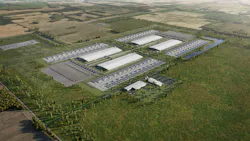
Canada’s expansion as an artificial intelligence infrastructure market received its strongest endorsement yet on July 8, when Meta broke ground on a data center campus representing an investment of more than C$13 billion.
The project, located in Sturgeon County north of Edmonton, will be Meta’s first data center in Canada and the 33rd facility in its global portfolio. Planned initially at 1 GW of power capacity, the AI-optimized campus could eventually scale to 1.8 GW, placing it among the largest data center developments under construction anywhere outside the United States. The announcement follows the Canadian federal government’s May launch of consultations on a forthcoming National Electricity Strategy, which identifies AI data centers as a major source of future electricity demand.
Approximately 3,000 construction workers are expected to be on the site at peak activity, while more than 300 permanent employees will operate the campus after completion. Meta is also committing approximately C$60 million to improvements involving local roads, water systems and other community infrastructure.
The Meta announcement illustrates a fundamental change in Canadian data center construction. Rather than selecting a building site and applying for an ordinary utility connection, Meta and its partners have spent years coordinating the data center with a purpose-built 932 MW generating station, grid upgrades and long-term natural-gas transportation agreements.
The project effectively combines a data center, a power plant and an infrastructure development program into a single construction ecosystem.
Construction Has Begun on the Canadian Campus
Meta describes the Sturgeon County project as an AI-optimized facility intended to support the computing demands of its core platforms, AI services and connected devices. The company said the buildout will occur in phases rather than delivering the entire gigawatt at once.
Alberta’s major-project registry estimates a roughly three-year construction period. That timeline will require a sustained deployment of skilled trades, construction management personnel, engineering teams and mission-critical specialists.
The work will extend far beyond data halls. A development at this scale typically involves multiple computing buildings, substations, utility yards, backup power systems, administrative space, security facilities, equipment staging areas and miles of internal electrical, mechanical and fiber infrastructure.
AI systems also impose requirements that distinguish the campus from older cloud or enterprise data centers. GPU clusters concentrate far more power in each rack, creating higher heat loads and requiring larger electrical feeds, more extensive busway systems and increasingly sophisticated liquid-cooling networks.
The Sturgeon County facility will use closed-loop liquid cooling supported by dry cooling. Meta says the cooling system will consume no water during normal operation. Water use at the campus will instead be limited primarily to domestic requirements, fire protection and equipment maintenance.
That design addresses one of the most frequent concerns surrounding large AI campuses: the potential use of millions of gallons of water. Eliminating operational cooling-water consumption does not eliminate the project’s environmental footprint, but it substantially changes the water discussion compared with AI facilities that depend heavily on cooling towers.
Dry cooling can require more equipment and may use more electricity under certain weather conditions than evaporative systems. Alberta’s comparatively cool climate gives designers an opportunity to use low outside-air temperatures to improve heat-rejection efficiency during much of the year.
The project’s industrial location is another important design choice. The site is within Alberta’s Industrial Heartland, a designated development zone northeast of Edmonton that already contains pipelines, energy facilities, petrochemical plants and heavy industrial infrastructure. Alberta officials said the selected property is not being used for residential development, food production or farming, minimizing potential community concerns for a development project of this scale.
Locating the campus within an established industrial corridor gives Meta access to infrastructure that would be difficult to reproduce at a greenfield site near a major city. It also makes it possible to colocate the data center with the enormous generating capacity required to operate it.
A Power Plant Built Around AI Demand
Six days before Meta publicly confirmed the data center, Pembina Pipeline and its partners announced a positive final investment decision on the Greenlight Electricity Centre. Greenlight will be a 932 MW combined-cycle natural gas generating facility built in the same Sturgeon County industrial area. Meta’s July 8 announcement confirmed that Greenlight would supply the company’s Canadian campus.
The Greenlight partners have entered into a long-term agreement to provide 932 MW of dedicated capacity to the data center. The power arrangement is structured as a tolling agreement, under which the customer makes capacity payments while also covering costs associated with fuel, operations and maintenance.
Greenlight is owned by Pembina and Morgan Stanley Infrastructure Partners, each holding 47.5%, and Kineticor, which owns the remaining 5%. The project carries an estimated capital cost of approximately C$4 billion, rising to approximately C$4.6 billion when construction interest and financing costs are included. The plant is scheduled to begin service during the second half of 2030. Pembina says all major regulatory approvals have been obtained and approximately 85% of project costs have been de-risked through fixed-price agreements.
Aecon and Técnicas Reunidas have been selected to handle engineering, procurement and construction under a fixed-price agreement. Siemens Energy will supply two SGT6-8000H gas turbines, two steam turbines and associated generators. Pembina will lead construction management for the generation project.
The combined-cycle configuration will use waste heat from the gas turbines to produce steam and generate additional electricity, increasing efficiency compared with a simple-cycle gas plant. Greenlight is expected to consume approximately 150 million cubic feet of natural gas each day, with transportation capacity secured through pipeline systems serving the Alberta region.
The site has already been permitted for potential expansion to 1,864 MW. That figure closely corresponds to Meta’s ability to expand the data center from 1 GW to as much as 1.8 GW, suggesting that both the generating plant and computing campus are being planned with a second major construction phase in mind.
The arrangement represents Alberta’s emerging “bring your own power” model for large data centers. Rather than requiring the provincial grid to supply the full load, developers are expected to finance new generation and the infrastructure required to connect or support their projects. This aligns with DCF’s previous coverage of the forthcoming National Electricity Strategy announced in May.
Meta said it will pay the full cost of the new generation and grid infrastructure associated with the campus, working with Capital Power, AltaLink, and the Alberta Electric System Operator on the project’s earlier and grid-connected energy requirements. Capital Power has entered into a long-term agreement to provide 250 MW from its existing Alberta generation fleet beginning in the second half of 2028, before Greenlight enters service.
The company also said its electricity consumption will be matched with clean and renewable energy purchases, although the physical electricity serving much of the campus will be generated from natural gas.
The difference between physical power and renewable-energy matching is important. Renewable contracts or certificates may offset annual electricity consumption on an accounting basis, but they do not make the colocated gas-fired generating station carbon-free.
Alberta offers speed, land and abundant natural gas, but its electricity system has a considerably higher emissions intensity than hydro-dominated systems in Quebec, British Columbia and Manitoba. Reuters reported in June that the vast majority of Canada’s planned hyperscale capacity was concentrating in Alberta even though the province’s grid emissions intensity was nearly five times the national average. In November 2025, Ottawa and Alberta agreed to suspend application of the federal Clean Electricity Regulations in the province while negotiating a new industrial carbon-pricing arrangement.
Alberta’s Construction Strategy Pays Off
Provincial officials have spent roughly two years promoting Alberta’s energy resources, industrial land, climate and regulatory environment to technology companies. The province has also established rules intended to prevent very large data centers from shifting their power and infrastructure costs to ordinary electricity customers.
The Alberta Electric System Operator established an interim 1,200 MW connection allocation for data center projects while longer-term market rules are developed. That capacity has now been assigned. Additional large campuses will therefore need to rely substantially on newly constructed or behind-the-meter generation.
Meta’s campus demonstrates how that policy can translate into construction. The project is not waiting for the existing grid to produce an additional gigawatt of spare capacity. Instead, the company and its energy partners have assembled a package involving new generation, new transmission and existing grid resources.
This approach could allow Alberta to approve projects that would face long delays in locations where utilities must ration limited hydroelectric or transmission capacity among data centers, manufacturers, housing developments and electrification programs.
Alberta officials estimate that the Meta investment could generate approximately C$250 million annually in benefits for Albertans through royalties, taxes, levies and fees. The province also argues that the project and its new generation could reduce transmission costs for electricity customers, although the ultimate effect will depend on construction costs, power-market conditions and how infrastructure charges are allocated over time.
As we regularly see with projects of this scale, equipment procurement could be challenging. Large power transformers, switchgear, turbines, generators, heat exchangers and cooling components frequently carry long delivery times. Greenlight’s use of fixed-price contracts and its early reservation of Siemens equipment indicate how developers are attempting to control those risks years before commissioning.
A New Benchmark for the Canadian Market
Meta’s announcement does not stand alone. As we reported back in April 2026, Bell is developing a 300 MW AI data center campus near Regina, Saskatchewan, while TELUS has outlined a network of AI facilities in British Columbia. Microsoft has committed to multibillion-dollar AI and cloud infrastructure investments in Ontario, and QScale is expanding its liquid-cooled AI campus in Lévis, Quebec.
Meta's project clearly changes the scale of the Canadian AI data center conversation. Bell and TELUS are emphasizing sovereign computing—the ability to provide Canadian companies, researchers and public institutions with advanced AI capacity hosted under Canadian jurisdiction. Meta’s campus is different. It is a hyperscaler-owned AI factory intended primarily to support the company’s global platforms and AI development.
That makes the project an international vote of confidence in Canada as a location for large-scale compute, but it also raises questions about how much of the resulting capacity and economic value will be available to Canadian organizations.
The federal government has allocated billions of dollars to expand sovereign AI computing and has solicited proposals for Canadian-hosted facilities exceeding 100 MW. Meta’s project shows that Canada can attract private infrastructure many times that size, but domestic access and foreign-owned hyperscale capacity are not the same policy objective.
The Alberta announcement also arrives amid growing municipal scrutiny elsewhere in Canada, including recent debates over potential data center moratoriums in Hamilton, Mississauga and Vancouver.
Meta’s Sturgeon County project appears more advanced than many speculative proposals because the company has publicly broken ground, the related generating plant has reached a final investment decision, major equipment has been contracted and the power project has obtained its principal regulatory approvals.
Data Centers Become Energy Infrastructure
Sturgeon County is becoming a potential template for Alberta. Future developers could pair data centers with dedicated gas generation, carbon-capture systems, renewable projects, battery storage or, eventually, nuclear generation.
The model also creates risks. The infrastructure is highly specialized and capital intensive. A significant reduction in AI demand, a change in Meta’s computing strategy or stricter carbon regulations could affect assets designed around a single enormous customer.
For now, however, the project has moved beyond the aspirational announcements that characterize much of the AI data center pipeline.
Meta has identified the site and begun construction. Pembina and its partners have taken a final investment decision on the power plant. Turbine capacity, gas transportation and major engineering contracts have been secured, while grid arrangements are advancing around a defined customer and a long-term operating plan.
Canada has spent years discussing how to convert its AI research strength into domestic infrastructure. The Sturgeon County development marks the moment when that ambition began to resemble an industrial construction program.
The scale of the investment provides clear evidence that Canada’s AI buildout is entering the gigawatt era. It also underscores the urgency behind the forthcoming National Electricity Strategy and demonstrates how Alberta’s natural gas resources, industrial land and self-generation policies are shaping where the country’s first wave of gigawatt-scale AI infrastructure will be built.
About the Author
 David Chernicoff