NVIDIA’s Reported $50B Lease and the Nuclear-Powered AI Factory
Key Highlights
- Hut 8’s Beacon Point campus in Texas, reportedly leased by NVIDIA, carries a potential contract value of $50.2 billion if all renewal options are exercised.
- The Aalo-Crusoe partnership aims to demonstrate nuclear-powered AI data centers by 2027, with plans to deploy modular reactors and data centers, addressing energy constraints and enabling incremental growth.
- Both projects reflect a trend towards integrated infrastructure platforms that combine compute architecture, power generation, and financing, moving away from traditional isolated data center models.
- NVIDIA’s DSX platform standardizes AI factory design and operations, while the reported lease structure could allow capacity to be subleased to neocloud providers and other AI infrastructure customers.
- The nuclear-powered data centers face regulatory, safety, and technical challenges, but represent a promising approach to sustainable, scalable, and energy-efficient AI infrastructure.
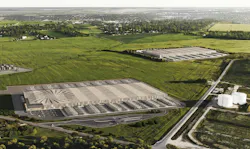
Two recent announcements capture the rapidly changing economics and engineering of the data center industry. In Texas, NVIDIA has reportedly emerged as the customer behind lease commitments worth as much as $50.2 billion at Hut 8’s one-gigawatt Beacon Point campus. In Idaho, Aalo Atomics and Crusoe announced a partnership intended to demonstrate a nuclear-powered AI data center in 2027 and begin deploying commercial 50-megawatt nuclear-powered AI factories by the end of 2029.
Though the projects are very different in scope they both capture the sense that the industry is here to stay and that technology will be a major differentiator now and in the future. Beacon Point is a gigawatt-scale campus designed for hundreds of megawatts of dense AI computing. The Aalo-Crusoe project aims to be a practical demonstration that will begin with a modular data center powered by a relatively small advanced reactor. Both announcements share a defining characteristic: neither treats the data center as an isolated building connected to whatever utility service happens to be available.
Both announcements look at a future that combines compute architecture, financing, construction, power and operations into a more vertically coordinated infrastructure platform.
NVIDIA’s Reported $50 Billion Lease Bet
The NVIDIA story is not a conventional $50 billion equity investment or a check being written at the outset. Hut 8 has disclosed two 15-year leases at Beacon Point with a combined base-term contract value of $19.6 billion. If all renewal options are exercised, the campus-level value could reach $50.2 billion.
The Financial Times identified NVIDIA as the previously unnamed investment-grade tenant, while Reuters said it could not independently verify the report. NVIDIA neither confirmed nor denied its role, saying only that it is working with ecosystem partners to deploy efficient AI infrastructure through its DSX AI factory architecture.
Even with that caveat, the reported arrangement would represent a notable expansion of NVIDIA’s role in the data center market. If confirmed, NVIDIA would become an anchor tenant whose credit quality helps make a multibillion-dollar campus financeable—not merely a supplier of GPUs, networking, systems and software.
The Beacon Point campus, located in Nueces County, Texas, has one gigawatt of utility capacity secured through an interconnection agreement with AEP Texas. The two leases cover 704 megawatts of IT capacity, divided into two 352-megawatt phases. Each phase carries a base-term contract value of approximately $9.8 billion.
The second agreement fully commercialized the campus and increased Hut 8’s total contracted AI data center portfolio to 949 megawatts, supported by 1,330 megawatts of utility capacity. Hut 8 projects aggregate base-term contract value of $26.6 billion and average annual net operating income exceeding $1.75 billion across its contracted AI portfolio.
Consistent with the identity of the reported tenant, the campus is being designed around NVIDIA’s DSX reference architecture for gigawatt-scale AI factories. Like other purpose-built AI facilities, the campus is being engineered as a complete computing system rather than a collection of interchangeable servers.
GPU clusters require coordinated design across electrical distribution, liquid cooling, networking, rack density, software orchestration and building layout. NVIDIA describes DSX as a common platform that brings together reference designs, accelerated computing, software, facility systems and partner technologies. It is intended to improve deployment speed, reliability and token performance per megawatt.
Reporting has speculated that NVIDIA could sublease capacity to cloud providers that purchase its GPUs and sell AI computing services. This model would allow smaller cloud companies and AI developers to access large-scale capacity without independently signing a multibillion-dollar campus lease.
NVIDIA could help accelerate projects that might otherwise struggle to secure financing, standardize deployments around its architecture and expand the customer base for AI compute. Hut 8 would gain a long-term, investment-grade tenant and a clearer path to financing construction. Under a subleasing model, neocloud providers could gain access to scarce power and data center capacity.
The difference between the $19.6 billion base term and the potential $50.2 billion value is especially important. The larger number depends on future renewals extending beyond the initial 15-year commitments. In an industry where computing systems turn over rapidly, the physical campus may remain valuable for decades, but its technology, power density and cooling systems will require repeated upgrades.
Hut 8 has already demonstrated the importance of design flexibility. The company said it redesigned the first Beacon Point data hall around NVIDIA’s architecture, increasing capacity by 57 percent within the same land and utility footprint. The first Phase 2 data hall is expected to be delivered during the second quarter of 2028.
Aalo and Crusoe Pursue the Nuclear-Powered AI Factory
The Aalo-Crusoe partnership addresses the industry’s power problem by bringing power generation directly to the compute. In this case, skipping intermediary power stages such as minimal grid or custom BTM gas turbine solutions and going straight to nuclear.
Aalo Atomics and Crusoe said they plan to deploy a Crusoe Spark modular data center running Crusoe Cloud at Idaho National Laboratory in 2027. The proof-of-concept project is intended to demonstrate an AI workload operating on power from an Aalo advanced reactor. Crusoe continues to expand their other data center campus projects.
The companies then intend to deploy Aalo Pods, Aalo’s 50-megawatt-electric nuclear power plants, at Crusoe data centers by the end of 2029. Aalo has already begun work on a second reactor beside its initial test unit at the Idaho site. That reactor is expected to produce electricity for the Crusoe installation.
On July 4, 2026, Aalo’s zero-power Critical Test Reactor reached criticality, sustaining a nuclear chain reaction without generating commercial electricity. The test reactor contains a full-scale core and components analogous to those planned for the 10-megawatt-electric Aalo-X power reactor being built next door, but it operates before sodium coolant and electricity-generating systems are added.
Aalo plans to continue experiments with the Critical Test Reactor to refine its reactor-physics models, characterize control behavior and generate data supporting development and licensing of the full-power Aalo-X system.
Advanced nuclear announcements sometimes blur the line between a successful test, an electricity-producing demonstration and a commercially licensed fleet. Aalo has achieved an important technical milestone, but substantial work remains before reactors can be manufactured, licensed, financed and operated at commercial data center sites.
The pairing with Crusoe should be noted because it connects a reactor developer with a company that can provide the data center load, the physical infrastructure and the cloud platform.
Crusoe Spark is a prefabricated AI data center, integrating power, cooling, remote monitoring, fire suppression and high-density racks. Crusoe says the modules can be deployed individually or combined into larger clusters, scaling from hundreds of kilowatts to tens or hundreds of megawatts. Crusoe says the factory lease and buildout, together with investment in an initial fleet of Spark modules, represents a commitment of more than $200 million.
That modularity aligns closely with Aalo’s product strategy. A 50-megawatt Aalo Pod could support a meaningful AI deployment without waiting for the transmission upgrades required by a conventional hyperscale campus. Multiple reactor and data center modules could theoretically be added as demand grows.
This creates a more incremental development model than building a one-gigawatt campus before the full load is ready. It also represents an effort to apply factory manufacturing to both halves of the project: Aalo manufactures the power plant while Crusoe manufactures the data center.
The obstacles for even a small reactor deployment outside a national laboratory are significant. Commercial deployments will require regulatory approvals, acceptable safety and security arrangements, fuel availability, waste-management plans, insurance, financing and community support. First-of-a-kind reactors also face construction and cost risks even when their designs emphasize factory manufacturing.
Aalo has secured more than $136 million in funding and is expanding toward a one-million-square-foot manufacturing operation. Nevertheless, the 2027 demonstration and 2029 commercial target should be viewed as ambitious milestones rather than guaranteed delivery dates.
Two Models for an Energy-Constrained Market
At Beacon Point, the reported model uses NVIDIA’s balance-sheet strength, DSX architecture and ecosystem relationships to support an enormous grid-connected AI campus. With Aalo and Crusoe, the model combines a manufactured reactor, a manufactured modular data center and an integrated cloud service.
One approach concentrates capacity at gigawatt scale. The other attempts to make nuclear generation and AI computing repeatable in smaller increments. Both are responses to the same constraint: obtaining power has become as important as obtaining GPUs.
NVIDIA’s reported Beacon Point commitment demonstrates how a dominant technology supplier can use its financial strength to accelerate the market surrounding its products. The Aalo-Crusoe partnership demonstrates how data center and energy systems may increasingly be designed as a single product.
Neither announcement eliminates the risks facing the AI infrastructure boom. One concentrates enormous financial commitments around future compute demand; the other depends on advanced nuclear technology progressing from demonstration to commercial operation. Both represent attempts to gain greater control over the increasingly interconnected data center, compute, power and financing stack.
About the Author
 David Chernicoff