NVIDIA Pushes DSX Deeper Into Data Center Infrastructure
Key Highlights
- NVIDIA's DSX platform is expanding its AI factory reference-design approach into a broader infrastructure framework spanning power, cooling, software, simulation, site development and data center operations.
- Partnerships with Lancium, Cloverleaf, Trane, and Eaton demonstrate NVIDIA's focus on integrating power management, cooling, and site planning early in data center development to optimize AI capacity and efficiency.
- NVIDIA projects that DSX MaxLPS can support up to 40% more Rubin GPU capacity within the same power envelope by optimizing GPU power use and incorporating 45°C liquid cooling.
- The integration of DSX into site development allows for infrastructure tradeoff evaluations, ensuring maximum AI output from available power and resources.
- NVIDIA is extending its role beyond GPU supply toward AI infrastructure architecture, including investments and partnerships with companies developing powered land and utility-connected data center capacity.
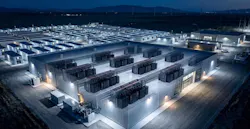
NVIDIA’s effort to transform the data center into an AI factory is increasingly becoming as much an infrastructure strategy as a computing strategy. Three recently announced partnerships provide some of the clearest evidence yet of that focus.
On August 17, Trane Technologies and Eaton unveiled an integrated power-and-cooling reference design aligned with NVIDIA DSX that they say can improve energy efficiency by as much as 15%, reduce installation costs by as much as 30%, and slash copper requirements by as much as 80% compared with conventional low-voltage approaches.
Four days later, data center infrastructure developer Cloverleaf Infrastructure announced a strategic partnership with NVIDIA, including a minority investment by the chipmaker. Cloverleaf plans to apply the DSX platform much earlier in data center development, integrating decisions involving land, power, cooling, computing and the facility itself.
Then on August 24, Lancium disclosed a partnership that brings DSX into a development portfolio exceeding 15 GW of powered land. NVIDIA is making a strategic investment in the Blackstone-backed infrastructure company while positioning Lancium's portfolio of more than 15 GW of powered-land development as potential deployment locations for NVIDIA AI infrastructure. Lancium says it already has 4 GW of capacity under lease.
Taken together, the announcements show NVIDIA extending DSX's AI factory reference architecture into an increasingly broad infrastructure framework stretching from utility interconnection and data center cooling to GPU performance and AI token production.
For data center developers, the important shift may be the metric NVIDIA increasingly emphasizes. Instead of asking primarily how many GPUs a building can accommodate, DSX increasingly asks how much useful AI computing can be extracted from each available megawatt.
From Reference Design to Infrastructure Platform
NVIDIA formally launched DSX as a broader AI factory platform at GTC Taipei on May 31. The company describes DSX as a combination of reference designs, modular software, APIs, accelerated computing platforms and partner technologies that coordinate the design, deployment and operation of AI factories.
In March, NVIDIA introduced its Vera Rubin DSX AI Factory reference design and made the Omniverse DSX Blueprint generally available. That architecture extended NVIDIA's reference-design philosophy beyond compute and networking into facilities infrastructure, including power, cooling and controls.
Omniverse DSX adds a digital-twin layer. Developers can model data center layouts, electrical topologies, thermal behavior and operating policies before deploying the physical infrastructure. The broader DSX architecture now encompasses several functions particularly relevant to data center operators.
DSX Reference Designs provide generation-specific infrastructure architectures encompassing compute, networking and storage as well as power, cooling, controls and structural considerations. DSX Sim provides simulation across the AI factory lifecycle. DSX Exchange connects signals from compute, networking, energy, cooling and operational technology. DSX Flex connects data center workloads with grid signals and energy resources.
And DSX MaxLPS attacks what may have become the central economic problem facing AI infrastructure developers: maximizing computing output when additional electricity is difficult or impossible to obtain.
NVIDIA says MaxLPS combines power optimization technologies with 45-degree-Celsius liquid cooling and can allow operators to install as many as 40% more GPUs within the same fixed power envelope while operating the processors closer to their most energy-efficient operating point.
In the August 24 technical update, NVIDIA further described MaxLPS as a system that dynamically reallocates available rack power, matches GPU power configurations to workload types and takes advantage of higher-temperature liquid cooling to reduce dependence on mechanical chilling. NVIDIA estimates that the combined approach could support as much as 40% additional Rubin GPU capacity inside a hypothetical 100 MW AI factory.
That proposition takes on considerable significance when power is the limiting factor in new data center development. It helps explain why NVIDIA is now striking relationships with companies that traditionally would have existed several layers removed from the GPU manufacturer.
Lancium: DSX Meets the Gigawatt Data Center Campus
The Lancium partnership represents perhaps the clearest example of DSX moving into the power and real-estate layer of the AI infrastructure stack.
Lancium has built its business around developing very large computing campuses that combine grid connections with behind-the-meter generation, storage and power-management technology.
Under the NVIDIA agreement announced August 24, Lancium's campuses will become strategic deployment locations for NVIDIA's full-stack AI factory platform, including computing, networking and software. Michael McNamara, CEO and Co-Founder, Lancium, said:
"We have spent years assembling the power, the land, and the infrastructure expertise needed to deliver AI data center capacity at a scale the world has never seen. Partnering with NVIDIA — the definitive technology platform for AI computing — ensures that every campus in our portfolio will be deployed with the industry's most advanced technology and that NVIDIA's customers will have access to the capacity they need to compete and lead in the AI era."
Lancium reports 4 GW of capacity already under lease and a development pipeline exceeding 15 GW of powered land. NVIDIA also made a strategic investment in Lancium, which is backed by Blackstone Energy Transition Partners and Blackstone Multi-Asset Investing.
The most consequential part of the announcement for data center infrastructure, however, may involve what happens to the power after it reaches the campus. Lancium plans to use both DSX MaxLPS and DSX Flex.
MaxLPS is intended to increase the amount of useful accelerated computing that can be installed within a fixed campus power allocation. Lancium and NVIDIA specifically cite the potential for as much as 40% more GPU capacity within the same power budget.
DSX Flex addresses a different problem: interaction between the AI factory and the electrical grid.Rather than treating a large AI campus simply as a massive fixed electrical load, DSX Flex is designed to allow computing demand to react to utility signals, including demand-response events, load-shedding requirements and electricity pricing. It can also coordinate utility power with onsite generation, renewable resources and storage.
That is particularly compatible with Lancium's development model. The company describes its campuses as integrating grid interconnections, behind-the-meter generation and storage while using power-management systems intended to make the sites responsive to grid conditions.
The traditional operating model that treats a data center as a largely inflexible electrical load has become increasingly problematic as AI campuses request interconnections measured in hundreds of megawatts or multiple gigawatts. Software capable of demonstrating that some computing workloads can be adjusted around grid conditions could potentially change the conversation between data center developers and utilities.
The concept is already being tested commercially. DSX Flex is being used in a commercial multi-megawatt pilot involving Emerald AI and Silicon Valley Power designed to demonstrate that AI factories can modify power consumption in response to utility signals while protecting workload performance.
Cloverleaf Moves DSX Into Site Development
If Lancium demonstrates DSX's potential role in operating powered AI campuses, NVIDIA's August 21 agreement with Cloverleaf Infrastructure pushes the architecture even further upstream. It brings DSX into the process of deciding what an AI data center should look like before construction begins.
Cloverleaf was founded in 2024 and develops powered, shovel-ready data center sites in collaboration with utilities, investors and energy companies. The company says it has already advanced multiple gigawatt-scale projects for customers across North America.
NVIDIA made a minority investment in Cloverleaf as part of the partnership. Under the agreement, Cloverleaf plans to apply DSX to integrate site, power, cooling, computing and facility decisions earlier in the development process. David Berry, Co-Founder and CEO of Cloverleaf said:
"AI is accelerating demand for digital infrastructure at an unprecedented scale and driving strong economic development opportunities for American communities. This partnership strengthens Cloverleaf's ability to identify and develop high-quality sites that provide the compute power for our country's growth and security. Together, we will help America's businesses and workers gain a critical edge."
Historically, the physical data center and the IT equipment installed inside it could be developed as somewhat separate engineering disciplines. AI infrastructure increasingly makes that difficult as GPU rack densities, liquid-cooling temperatures, CDU architectures, electrical distribution, backup power, network topology and the behavior of the workload are becoming interdependent.
Cloverleaf says DSX will allow customers to evaluate those infrastructure tradeoffs while considering limits on power availability, water resources and grid capacity. Once facilities become operational, DSX software can continue coordinating computing capacity and energy use.
A developer evaluating a 500 MW site would no longer consider only whether 500 MW can be delivered. The relevant question becomes how the electrical and cooling architecture can turn that 500 MW into the greatest quantity of economically useful AI output.
Trane and Eaton Attack the Power-and-Cooling Boundary
The third announcement addresses another boundary DSX is attempting to eliminate: the traditional separation between electrical and mechanical systems. Trane Technologies and Eaton announced their joint DSX-aligned design on August 17.
The companies argue that conventional data center engineering frequently treats electrical power distribution and cooling infrastructure as separate systems. Their new architecture instead coordinates Eaton's electrical infrastructure with Trane's thermal-management systems from the beginning of the design process. The architecture relies heavily on higher-voltage electrical distribution.
According to the companies, moving more of the AI factory electrical architecture toward medium voltage can produce energy-efficiency gains of as much as 15%, reduce installation costs by as much as 30%, and cut copper consumption by as much as 80% compared with conventional low-voltage designs. Those figures are vendor projections rather than independently verified operating results, but they illustrate the scale of the infrastructure optimization the companies are targeting. Michael Regelski, Senior Vice President and Chief Technology Officer, Electrical Sector, Eaton, said:
“We’re advancing the industry standard for speed of deployment by progressing reference designs into unified systems teams can deploy repeatedly. Aligned with the NVIDIA DSX platform, we’re integrating our medium-voltage power systems and white space thermal management solutions with Trane’s advanced thermal management system architecture to help accelerate AI-factory deployment at scale.”
The joint reference design appears in Trane's Continuum Rubin DSX and Eaton's Beam Rubin DSX platforms. The goal is a pre-coordinated architecture stretching from grid power to the chip rather than requiring developers and engineering teams to independently assemble electrical and mechanical systems for each project.
The systems are also intended to exchange operating data. Rather than cooling and electrical systems responding independently, the systems can instead exchange leading indicators and respond more dynamically to changing operating requirements. This is an approach that closely mirrors NVIDIA's larger DSX philosophy.
Trane and Eaton are also designing the architecture to accommodate future liquid-cooling and direct-current power-distribution technologies. That future-proofing matters as rack power densities continue to rise. An electrical and cooling plant optimized for one GPU generation may otherwise become a constraint several hardware generations later.
The Broader DSX Buildout
The Lancium, Cloverleaf and Trane/Eaton agreements are part of a considerably wider expansion of the DSX ecosystem. Earlier deals show NVIDIA moving into many of the same infrastructure layers through partnerships spanning powered land, electrical design, digital twins and even project financing.
In May, NVIDIA and IREN announced plans to support as much as 5 GW of DSX-aligned AI infrastructure across IREN's global development pipeline, with the companies identifying IREN's 2 GW Sweetwater campus in Texas as an expected flagship DSX deployment. NVIDIA also received a five-year right to purchase up to 30 million IREN shares at $70 each, representing a potential investment of as much as $2.1 billion.
The infrastructure ecosystem has widened as well. Siemens, NVIDIA and Fluence, incorporating nVent design considerations, have developed a DSX Vera Rubin-aligned electrical, power and controls architecture extending from the utility connection to the rack. ABB is integrating digital models of medium-voltage switchgear, power-distribution equipment and UPS systems into the Omniverse DSX Blueprint, while Vertiv is integrating its SmartRun infrastructure digital twin with DSX workflows.
Together, those efforts push NVIDIA's reference architecture deeper into the systems engineers use to design and validate the physical data center before construction begins.
NVIDIA is also extending the model into financing. In August, the company announced agreements with Apollo, BlackRock, Blackstone, Brookfield, Goldman Sachs and KKR aimed at creating financing platforms capable of mobilizing more than $500 billion of third-party capital for AI infrastructure. NVIDIA explicitly positioned those pools of capital as a mechanism for helping customers finance and build DSX AI factories.
The geographic footprint continues to expand. On September 9, NVIDIA announced plans with Firmus, Sharon AI, IREN, ResetData, Megaport, CDC, NEXTDC and AirTrunk for as much as 2 GW of Australian AI infrastructure by 2027. NVIDIA described the effort as an expansion of land, power and shell capacity intended to support multiple generations of DSX AI factories. The participating infrastructure providers will operate the facilities, while NVIDIA supplies the DSX platform, accelerated computing, networking, software and ecosystem support.
The pattern reinforces the larger point: DSX is increasingly less a specification for what goes inside an AI data center than a framework for coordinating the infrastructure, capital and operating systems required to get one built and keep it productive.
The AI Factory Becomes One Machine
What connects the Lancium, Cloverleaf and Trane/Eaton deals is NVIDIA's push toward what could be described as infrastructure co-design. The data center is increasingly being treated less like a building containing IT equipment and more like a single engineered machine. The components of the AI factory end up getting determined by a number of non-traditional factors:
· Site and interconnection conditions constrain available power.
· Workload and GPU architecture establish rack-level power requirements.
· Rack density drives cooling requirements.
· Power and cooling architecture determine facility overhead.
· Facility efficiency affects how much site power reaches compute.
· GPU operating points ultimately affect AI throughput and token economics.
DSX is an attempt to create an architecture connecting those decisions, which helps explain NVIDIA's repeated emphasis on performance per megawatt and token cost rather than traditional infrastructure metrics alone. In a power-constrained market, adding another 5% or 10% of computing capacity without the need to acquire another 5% or 10% of utility power can have enormous economic value.
NVIDIA has already described power as the limiting resource in AI factory development. Its March DSX announcement cited more than 200 GW of projects waiting in U.S. interconnection queues and more than $300 billion of equipment backlogs associated with the energy infrastructure challenge.
Powered Land Is Not Deployed Capacity
There are nevertheless important distinctions to make between the scale described in these announcements and infrastructure actually operating today.
1. Lancium's more than 15 GW figure represents its powered-land development pipeline, not 15 GW of installed NVIDIA infrastructure. The company says 4 GW is currently under lease.
2. Cloverleaf says it has advanced multiple GW-scale projects, but the NVIDIA partnership does not announce a specific amount of new computing capacity or a construction timetable.
3. The efficiency, copper and construction-cost reductions cited by Eaton and Trane are projected benefits of their reference architecture rather than measurements from a large fleet of completed operating facilities.
Reference designs do not create transmission capacity, shorten every utility interconnection queue, manufacture transformers, secure environmental permits or guarantee community approval. But they can potentially help developers extract more computing output from the infrastructure that does become available and reduce the engineering uncertainty involved in deploying it.
From GPU Vendor to AI Infrastructure Architect
NVIDIA says cloud infrastructure providers including CoreWeave, Crusoe, IREN, Lambda, Nebius, Nscale and others are deploying components of DSX, while Dell Technologies, HPE, Lenovo, Supermicro and numerous manufacturers are developing DSX-ready systems.
NVIDIA is now investing in companies controlling the powered land on which AI factories may be built. It is working with developers during the earliest stages of site and utility planning. And its partners are creating integrated electrical and mechanical designs intended specifically for its future computing platforms. That suggests DSX could become one of NVIDIA's more important mechanisms for extending its role across the design and operation of AI infrastructure.
At Data Center Frontier, we talk the industry talk and walk the industry walk. In that spirit, DCF Staff members may occasionally use AI tools to assist with content.
Keep pace with the fast-moving world of data centers and cloud computing by connecting with Data Center Frontier on LinkedIn, following us on X/Twitter and Facebook, as well as on BlueSky, and signing up for our weekly newsletters using the form below.
About the Author
 David Chernicoff
David Chernicoff
 Matt Vincent
Matt Vincent
Matt Vincent is Editor in Chief of Data Center Frontier, where he leads editorial strategy and coverage focused on the infrastructure powering cloud computing, artificial intelligence, and the digital economy. A veteran B2B technology journalist with more than two decades of experience, Vincent specializes in the intersection of data centers, power, cooling, and emerging AI-era infrastructure. Since assuming the EIC role in 2023, he has helped guide Data Center Frontier’s coverage of the industry’s transition into the gigawatt-scale AI era, with a focus on hyperscale development, behind-the-meter power strategies, liquid cooling architectures, and the evolving energy demands of high-density compute, while working closely with the Digital Infrastructure Group at Endeavor Business Media to expand the brand’s analytical and multimedia footprint. Vincent also hosts The Data Center Frontier Show podcast, where he interviews industry leaders across hyperscale, colocation, utilities, and the data center supply chain to examine the technologies and business models reshaping digital infrastructure. Since its inception he serves as Head of Content for the Data Center Frontier Trends Summit. Before becoming Editor in Chief, he served in multiple senior editorial roles across Endeavor Business Media’s digital infrastructure portfolio, with coverage spanning data centers and hyperscale infrastructure, structured cabling and networking, telecom and datacom, IP physical security, and wireless and Pro AV markets. He began his career in 2005 within PennWell’s Advanced Technology Division and later held senior editorial positions supporting brands such as Cabling Installation & Maintenance, Lightwave Online, Broadband Technology Report, and Smart Buildings Technology. Vincent is a frequent moderator, interviewer, and keynote speaker at industry events including the HPC Forum, where he delivers forward-looking analysis on how AI and high-performance computing are reshaping digital infrastructure. He graduated with honors from Indiana University Bloomington with a B.A. in English Literature and Creative Writing and lives in southern New Hampshire with his family, remaining an active musician in his spare time.
Voices of the Industry
 Source: Shutterstock, courtesy of nVent Data Solutions