OCP 2026: Agentic AI Drives the Data Center's Chip-to-Grid Transformation
Key Highlights
-
OCP is extending its standards mission from servers and racks to the full AI infrastructure stack, encompassing silicon, cooling, power distribution, facilities and utility-grid integration.
-
AMD introduced its Helion agentic AI rack, while Arm and NVIDIA outlined new CPU architectures and infrastructure requirements for rapidly expanding autonomous workloads.
-
Meta detailed the engineering behind its Prometheus AI cluster in Ohio, including fabric structures, new optical networking, open-source transport software and AI-optimized concrete.
-
Broadcom and NVIDIA presented advances in Ethernet networking and optical interconnects designed to overcome the growing physical constraints of accelerator clusters.
-
New OCP data center and grid-resilience specifications, along with NVIDIA's advances in dynamic power management, signal a shift toward treating the AI factory as a coordinated, grid-aware infrastructure system.

Standing before thousands of engineers and technology executives at the opening of the 2026 Open Compute Project (OCP) Global Summit in San Jose, Meta's Santosh Janardhan pointed to the enormous fabric structure surrounding the audience.
It was, he explained, an example of the same construction technology Meta had begun deploying to accelerate its massive AI infrastructure buildout.
At the company's Prometheus AI cluster in New Albany, Ohio, traditional assumptions about data center construction had given way to an urgent question: What if the next generation of AI infrastructure could be built in months rather than years, using engineered fabric structures instead of conventional concrete-and-steel buildings?
"We are actually also training a model while we were building it," said Janardhan, Meta's head of infrastructure.
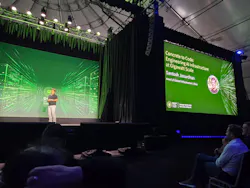
The presentation offered a striking illustration of the larger message emerging from Monday's opening keynotes: The AI factory is becoming a fundamentally different kind of data center.
Across presentations by AMD, Meta, Arm, Broadcom and NVIDIA, a common theme emerged. The rapid expansion of AI inference and autonomous agents is forcing new approaches to computing, networking, construction, power distribution and operations. At the same time, the diversity of silicon architectures and the enormous physical scale of deployments are making common infrastructure specifications increasingly important.
The result is a significant expansion of OCP's original mission.
Fifteen years after the organization began applying open-source principles to hardware design, the industry's next challenge is developing interoperable infrastructure across the entire data center, from processor architecture to the utility connection.
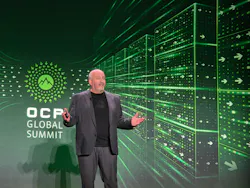
OCP's New Mandate: From Chip to Grid
OCP CEO George Tchaparian opened the summit by describing an organization whose scale increasingly reflects the industry's transformation.
This year's event attracted approximately 15,000 attendees, with another 3,000 on a waitlist. Tchaparian said OCP expects membership to exceed 700 organizations by year-end, while technical contributions are growing approximately 30% annually.
The organization has already announced that its 2027 Global Summit will move to San Francisco's Moscone Center to accommodate further growth.
More consequential than the attendance figures, however, is the widening scope of OCP's work.
Originally centered on open server designs, racks and supporting hardware, the organization's roadmap now encompasses facilities infrastructure, liquid cooling, power distribution, firmware, security, networking and the increasingly complex connections between data centers and utilities.
Tchaparian characterized the emerging approach as "chip-to-grid" infrastructure.
This reflects a fundamental engineering problem. As hyperscalers and AI infrastructure providers deploy increasingly specialized processors, the electrical, thermal and mechanical consequences of those design decisions extend well beyond individual servers.
Higher accelerator densities require new cooling strategies. New power architectures affect rack configurations and electrical distribution. Faster networks alter equipment layouts and cable requirements. Different silicon designs can introduce entirely new facility-level constraints.
The traditional process of designing computing equipment and adapting data centers to accommodate it is increasingly difficult to sustain at AI scale.
OCP is therefore emphasizing what Tchaparian called co-optimized data centers: infrastructure in which silicon, racks, networking, cooling and power systems are developed with common interfaces and shared design objectives.
The challenge is compounded by growing silicon diversity. Hyperscalers are developing custom accelerators alongside commercial GPUs and CPUs, increasing the risk of fragmented hardware ecosystems that require repeated engineering across otherwise similar facilities.
OCP also intends to extend hyperscale-derived standards into what it calls the AI computing continuum, encompassing neocloud providers, colocation operators, enterprises and geographically distributed inference infrastructure.
The objective is not to eliminate architectural differentiation. It is to reduce the amount of infrastructure that must be redesigned every time the underlying computing technology changes.

Agentic AI Gives the CPU a New Mission
One of the most consequential themes of the opening keynotes was the renewed importance of general-purpose computing.
AMD Chair and CEO Lisa Su described 2026 as the year of inference, estimating that inference now represents approximately 60% of the AI computing market.
She pointed to an approximately 14-fold increase in agentic AI traffic during the year, reflecting the accelerating adoption of systems that do more than respond to individual prompts.
Instead, autonomous agents can plan tasks, invoke software tools, execute code, retrieve information and coordinate multiple model interactions.
These operations create substantial demand for CPUs, even as GPUs remain essential to model training and inference.
For infrastructure designers, this introduces a distinction between generating AI tokens and executing the work those tokens initiate.
An agent may use a GPU-accelerated language model to determine its next action, but that action can require dedicated CPU resources, memory, networking, storage and secure execution environments.
Multiply those activities across millions of persistent agents, and the computing requirements begin to look very different from those of traditional chatbot services.
Su said AMD has revised its estimated total addressable market for data center CPUs three times in nine months. The company now forecasts a market exceeding $200 billion by 2030, with annual growth approaching 50%.
Those are aggressive company projections, but they underscore the degree to which agentic computing is altering expectations for data center hardware demand.
"AI at scale is a team sport," Su said, emphasizing the importance of interoperability across CPUs, GPUs, purpose-built accelerators, networking and software.
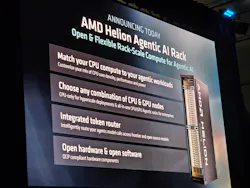
AMD Introduces Helion for Agentic Infrastructure
AMD used the summit to announce Helion, an open rack-scale reference design intended specifically for agentic AI workloads.
Unlike the company's Helios AI rack, which emphasizes tightly integrated GPU acceleration, Helion is designed to accommodate different combinations of CPU and GPU resources according to the applications being deployed.
Hyperscale configurations can use CPU-only racks alongside separate GPU inference systems. Enterprise configurations can combine CPUs and AMD Instinct GPUs within a single rack.
The architecture supports up to 32,768 sixth-generation EPYC CPU cores in its highest-density CPU-only configuration, while mixed configurations can incorporate AMD Instinct MI350P GPUs.
It also integrates a token router intended to direct model requests toward appropriate computing resources, reflecting the growing importance of matching individual AI tasks with suitable models and hardware.
Based on OCP rack specifications, Helion supports both air-cooled and liquid-cooled configurations. AMD plans to contribute the design to OCP, with partner-developed systems expected to become available beginning in November.
Su also provided an update on Helios, the company's existing rack-scale AI architecture developed in collaboration with Meta.
Helios incorporates 72 GPUs in a liquid-cooled rack weighing nearly 7,000 pounds. Production shipments began in September, according to Su, with initial installations at major AI customers and a broader manufacturing ramp planned through the first half of 2027.
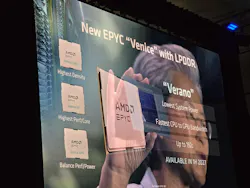
The company also displayed its EPYC Verano processor, a 192-core design intended to improve power efficiency and CPU-to-GPU connectivity. Production is planned for the first half of 2027.
Together, these developments illustrate AMD's strategy of treating CPUs, GPUs and specialized accelerators as complementary components within increasingly configurable AI infrastructure.
Arm: When AI Agents Become Virtual Users
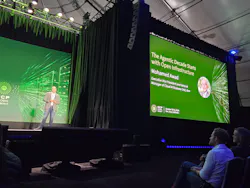
Arm Executive Vice President Mohamed Awad approached the same transition from a different direction.
Awad argued that agentic AI fundamentally changes the relationship between computing infrastructure and its users.
Traditional cloud applications generally respond to requests initiated by people. Autonomous agents introduce virtual users capable of initiating tasks continuously, at machine speed.
That shift places new demands on the cloud-native systems supporting them.
Awad distinguished three increasingly important CPU functions: processors optimized to support AI accelerators, general-purpose cloud CPUs that operate infrastructure and services, and CPUs dedicated to executing agentic workloads.
The distinction also has implications for security.
Agents may execute software, access applications and handle sensitive information within persistent computing environments. Isolating those activities becomes essential as autonomous systems proliferate.
Arm announced a new white paper, developed with input from Fujitsu, Meta and OpenAI, examining how CPU performance should be evaluated for agentic applications.
Rather than relying exclusively on conventional processor benchmarks, the initiative seeks to establish performance measurements that better reflect the real-world behavior of AI agents.
Awad's central argument was that CPU performance can no longer be evaluated independently of the distributed services, memory resources and accelerated computing systems with which processors interact.
NVIDIA Adds a Dedicated Vera CPU Rack
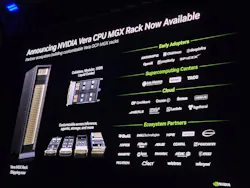
NVIDIA reinforced the same trend with a new Vera CPU rack architecture based on its MGX infrastructure specification.
The liquid-cooled design accommodates 256 Vera CPUs and targets agent execution, orchestration, tool calling and related computing workloads.
NVIDIA Vice President Ian Buck described the Vera CPU as an important component of the company's broader agentic computing architecture, citing significant per-core performance improvements over its previous Grace generation.

The company also outlined plans for Meta to deploy Vera-based CPU infrastructure.
Collectively, the AMD, Arm and NVIDIA presentations suggest an important shift in how AI data centers may be organized.
The future AI factory may not consist primarily of increasingly powerful accelerator racks. It may instead contain a more varied mixture of specialized GPU systems, CPU-dense agentic racks, purpose-built networking and software capable of allocating workloads among them.
Meta's Prometheus: Reengineering the Physical AI Factory
If the processor announcements addressed the computing requirements of agentic AI, Meta's presentation offered a detailed account of what happens when those requirements reach enormous physical scale.
Janardhan described Prometheus as one of the most ambitious infrastructure projects Meta has undertaken.
Located in New Albany, Ohio, the cluster encompasses more than 30 structures, connected by an extensive network of fiber-optic infrastructure. Meta reported approximately 3 million to 4 million kilometers of fiber within the project.
At that scale, the conventional assumption that a computing cluster operates within a single building no longer holds.
"AI training moves forward at the speed of the slowest conversation that you can have between two GPUs," Janardhan explained.
For distributed training applications, communication latency can become a critical determinant of overall performance. Even small delays accumulate as enormous numbers of processors exchange information repeatedly.
Meta addressed the problem by developing an Ethernet super-spine architecture connecting multiple buildings, using deep buffering and redundant paths to manage communication across a geographically distributed cluster.
The company also developed MetaRoCE, a transport mechanism designed to improve multipath communication, congestion handling and reliability. Meta is contributing the software and associated testing tools to the open ecosystem.
Additional work includes an optical backplane prototype intended to increase bandwidth within racks while preserving familiar equipment layouts and serviceability.
But networking was only part of the challenge.
When the Building Becomes a Bottleneck
Janardhan described how conventional construction schedules became increasingly incompatible with the pace of AI infrastructure deployment.
Traditional facilities may require years to design, permit and construct. Meta began questioning whether every element of that model was necessary for its newest computing clusters.
Its answer included enormous engineered fabric structures developed with Sprung Structures, the same company responsible for the summit venue.
Built on concrete foundations, these facilities can be assembled substantially faster than conventional buildings.
Janardhan said the approach, combined with simplified power and cooling infrastructure, enabled some facilities to reach operational readiness in approximately three to five months.
The underlying design principle was what he characterized as the minimum viable data center: providing the power, cooling and physical infrastructure necessary to support the computing environment without incorporating unnecessary complexity.
Meta also reconsidered the construction materials themselves.
The company developed an AI-assisted approach to concrete formulation that Janardhan said produced a mix with 19% lower embodied carbon, 43% faster curing and no additional material cost.
Meta has made both the tool and concrete formulation openly available.
The development is particularly noteworthy because it connects AI infrastructure innovation to the construction supply chain rather than treating the building merely as a container for computing equipment.
Designing for Failure at Massive Scale
Another central lesson from Prometheus concerns operational reliability.
As clusters grow to hundreds of thousands of components, failures become statistical certainties rather than exceptional events.
Even highly reliable individual systems will experience frequent failures when deployed at sufficient scale.
Meta established a target of roughly two training interruptions per 8,000 GPUs per day, according to Janardhan, and developed additional software capabilities to approach that objective.
These include fault-tolerant training mechanisms, frequent checkpointing and the ability to incorporate additional computing resources into ongoing training jobs.
The objective is to prevent individual hardware problems from interrupting entire training operations or requiring substantial amounts of completed work to be repeated.
In a particularly significant architectural development, Meta can expand the computing resources assigned to a training workload as new portions of the cluster become available.
That allows infrastructure deployment and model development to proceed concurrently rather than sequentially.
The lessons are now informing Meta's even larger Hyperion project in Richland Parish, Louisiana, which is planned to reach 5 gigawatts across a development footprint of approximately 4,000 acres.
For the data center industry, the broader implication is clear: AI infrastructure at this scale increasingly resembles a continuously evolving industrial system rather than a conventional facility delivered as a completed construction project.
Broadcom: Ethernet Meets the Limits of Physics
The networking challenges described by Meta received a more detailed technical examination from Broadcom Senior Vice President Asad Khamisy.
Khamisy characterized AI infrastructure as a distributed computing problem in which network performance directly influences accelerator utilization.
He distinguished three architectural domains: scale-up networking within tightly connected computing systems, scale-out networking across large clusters, and scale-across networking connecting computing resources over greater geographic distances.
Each introduces different latency, bandwidth and reliability requirements.
Broadcom's position is that Ethernet can provide a common operational foundation across these domains, reducing complexity through shared approaches to network management, telemetry, congestion control and diagnostics.
Khamisy said more than five hyperscalers are already operating Ethernet-based scale-up networks in production, while more than ten partners are developing associated rack architectures.
OCP's Ethernet for Scale-Up Networking initiative, or ESUN, has expanded rapidly since its introduction.
But the more interesting part of Broadcom's argument concerned the physical limitations of connectivity.
Copper remains an attractive option for very short connections because of its low latency, relatively modest power requirements and cost advantages.
Optical connections become increasingly important as bandwidth requirements rise and clusters extend beyond the reach of conventional copper cabling.
Khamisy described a likely progression toward hybrid architectures that retain copper within tightly coupled computing domains while using optics to connect larger groupings of accelerators.
Broadcom is also developing its Optical Compute Interconnect technology to combine lower-power connectivity with longer optical reach.
The challenge is not simply moving more information. It is moving that information within the latency, power and physical constraints necessary to keep expensive accelerators productively occupied.
That engineering balance is becoming central to the economics of AI infrastructure.

NVIDIA Opens More of the AI Factory Architecture
NVIDIA's Ian Buck closed the opening keynote program with an extensive presentation covering Vera Rubin systems, open rack designs, networking, power delivery and AI factory software.
The company announced additional contributions to OCP based on its third-generation MGX 1.2 reference architecture.
The specification includes high-density liquid-cooled computing systems, improved cooling connections, standardized power interfaces and modular mechanical designs.
Buck emphasized that these developments are as much about manufacturing and serviceability as they are about computational performance.
He described how NVIDIA reduced the assembly time for a compute tray from approximately 90 minutes in the Grace Blackwell generation to roughly one minute for Vera Rubin through simplified mechanical construction and more automated assembly.
At the scale of thousands of racks, those manufacturing improvements can materially influence deployment schedules.
NVIDIA also previewed its next-generation Vera Rubin Ultra architecture, designed to interconnect 576 GPUs using an advanced NVLink fabric with co-packaged optics.
Open Data Center and Grid Resilience Specifications
For data center developers and operators, however, NVIDIA's most consequential OCP contributions may lie outside the computing rack.
NVIDIA, AMD, Google and Meta have published an Open Data Center Specification, currently at version 0.7, intended to establish common design principles for AI factory facilities.
The specification addresses power architecture, cooling infrastructure and physical layout, helping equipment suppliers and developers coordinate around shared infrastructure requirements.
That shared facilities work unfolds alongside vendor-specific programs such as NVIDIA's DSX Ready, which establishes qualification requirements for battery energy storage and liquid cooling equipment supporting its AI factory designs.
NVIDIA also joined Google, Meta and Microsoft in publishing an OCP Grid Resilience Specification addressing the behavior of large AI installations during grid disturbances.
The specification establishes expectations for facilities to remain connected, respond automatically to disturbances and recover toward normal operating load rapidly.
These initiatives reflect the growing importance of treating the AI factory as an integrated electrical and computational system.
Buck made the broader objective explicit:
"AI factories need to be part of the grid, not just consumers but contributors."
He described a future in which computing workloads could respond dynamically to electrical-system conditions, shifting or reducing demand when necessary rather than behaving exclusively as inflexible loads.
NVIDIA also highlighted Visionbay's planned K-1 AI factory architecture, which incorporates 800-volt DC power distribution and supporting power and thermal technologies from Vertiv.
Higher-voltage distribution promises reductions in copper requirements and conversion stages while supporting increasingly dense computing installations.
According to Buck, 800VDC approaches can reduce copper requirements by approximately 45% relative to certain conventional alternatives.
The significance extends beyond individual racks. As AI deployments approach hundreds of megawatts and eventually gigawatt scale, electrical distribution becomes a central constraint on facility design, deployment speed and operating efficiency.
Managing Power as a Computing Resource
NVIDIA also introduced another important dimension of AI factory optimization: using software to extract greater computing productivity from existing electrical infrastructure.
Buck discussed DSX MaxLPS, an approach to dynamic power management that allocates electrical capacity according to actual workload requirements rather than assuming every processor will continuously operate at its maximum rated draw.
The premise is straightforward. A data center may have a fixed utility allocation, but its computing equipment does not necessarily consume that full allocation at every moment.
That difference creates opportunities to accommodate additional workloads or computing systems, provided power use can be managed within electrical limits.
In a previously published joint evaluation with Nscale at its Iceland facility, NVIDIA demonstrated an increase from 140 to 192 managed GPUs within the same provisioned 264.4-kilowatt power budget.
The test produced approximately 49% higher aggregate inference throughput under the evaluated workload configuration.
Although the results are specific to the test environment and should not be assumed to apply uniformly across deployments, they point toward an important emerging strategy.
AI factory operators may be able to increase the productivity of constrained electrical capacity through coordinated workload scheduling, dynamic power management and more granular infrastructure controls.
That introduces another dimension to the industry's familiar pursuit of improved power usage effectiveness.
The objective is not merely to reduce the energy consumed by supporting infrastructure. It is to increase useful computing output within the electrical capacity already available.
Optical Networking and an Open Transport Ecosystem
NVIDIA also detailed advances in its Spectrum-X networking architecture, including co-packaged optics and multiplane Ethernet switching.
The company said its new Spectrum-X Photonics Multiplane switches will improve energy efficiency and fault response while reducing the complexity of large AI fabrics.
Buck highlighted hardware-assisted fault detection capable of identifying network problems in approximately 2.6 milliseconds.
NVIDIA also announced expanded networking collaboration with Meta, including Spectrum-6 technology for the hyperscaler's new liquid-cooled IceCube switching platform.
Separately, NVIDIA and Google announced work to support Google's Falcon transport technology on future NVIDIA ConnectX-10 SuperNICs and BlueField DPUs.
These developments reinforce the expanding importance of common networking interfaces, even as major suppliers compete through different silicon, switching architectures and software implementations.
The industry's increasingly complex AI networks cannot afford to be constrained by completely isolated hardware ecosystems.
The New Infrastructure Equation
The opening keynotes at OCP 2026 demonstrated how thoroughly AI is changing the engineering assumptions behind data center development.
The shift toward agentic workloads is creating new demand for CPU infrastructure alongside accelerating investment in GPUs and purpose-built silicon.
Gigawatt-scale projects are changing expectations for construction schedules, cooling, network architecture and operational reliability.
And electrical infrastructure, once largely treated as a supporting requirement, is becoming inseparable from computing-system design and software orchestration.
Yet the most revealing feature of the summit may be the degree to which competing technology companies are acknowledging a shared engineering problem.
AMD, NVIDIA, Arm, Broadcom, Meta and the broader OCP community continue to compete vigorously in processors, networking technology, software and integrated systems.
At the same time, the physical and operational complexity of AI infrastructure increasingly demands common interfaces, reusable designs and collaborative specifications.
That tension—between proprietary computing advantage and the need for open infrastructure—now sits at the center of the AI factory buildout.
For data center developers, operators and the suppliers supporting them, the implications extend far beyond the next generation of server hardware.
As AI computing expands from individual racks into geographically distributed, power-intensive infrastructure, the industry's ability to deploy and operate capacity increasingly depends on how effectively the entire system is engineered together.
The next frontier of open computing is no longer confined to the server rack. It extends from the silicon to the utility grid.
At Data Center Frontier, we talk the industry talk and walk the industry walk. In that spirit, DCF Staff members may occasionally use AI tools to assist with content.
Keep pace with the fast-moving world of data centers and cloud computing by connecting with Data Center Frontier on LinkedIn, following us on X/Twitter and Facebook, as well as on BlueSky, and signing up for our weekly newsletters using the form below.
About the Author
 Matt Vincent
Matt Vincent
Matt Vincent is Editor in Chief of Data Center Frontier, where he leads editorial strategy and coverage focused on the infrastructure powering cloud computing, artificial intelligence, and the digital economy. A veteran B2B technology journalist with more than two decades of experience, Vincent specializes in the intersection of data centers, power, cooling, and emerging AI-era infrastructure. Since assuming the EIC role in 2023, he has helped guide Data Center Frontier’s coverage of the industry’s transition into the gigawatt-scale AI era, with a focus on hyperscale development, behind-the-meter power strategies, liquid cooling architectures, and the evolving energy demands of high-density compute, while working closely with the Digital Infrastructure Group at Endeavor Business Media to expand the brand’s analytical and multimedia footprint. Vincent also hosts The Data Center Frontier Show podcast, where he interviews industry leaders across hyperscale, colocation, utilities, and the data center supply chain to examine the technologies and business models reshaping digital infrastructure. Since its inception he serves as Head of Content for the Data Center Frontier Trends Summit. Before becoming Editor in Chief, he served in multiple senior editorial roles across Endeavor Business Media’s digital infrastructure portfolio, with coverage spanning data centers and hyperscale infrastructure, structured cabling and networking, telecom and datacom, IP physical security, and wireless and Pro AV markets. He began his career in 2005 within PennWell’s Advanced Technology Division and later held senior editorial positions supporting brands such as Cabling Installation & Maintenance, Lightwave Online, Broadband Technology Report, and Smart Buildings Technology. Vincent is a frequent moderator, interviewer, and keynote speaker at industry events including the HPC Forum, where he delivers forward-looking analysis on how AI and high-performance computing are reshaping digital infrastructure. He graduated with honors from Indiana University Bloomington with a B.A. in English Literature and Creative Writing and lives in southern New Hampshire with his family, remaining an active musician in his spare time.
Related
Voices of the Industry
 Source: SNEHIT PHOTO/Shutterstock.com
 Source: Matthew G Eddy/Shutterstock.com