HPE's Quantum Computing Bet: A Multi-Vendor Path to the Data Center
Key Highlights
-
HPE’s collaboration with QuEra targets future on-premises integration of neutral-atom quantum systems with HPE Cray supercomputers.
-
HPE is working across competing quantum architectures to avoid committing its infrastructure strategy to a single processor technology.
-
Quantum installations have architecture-specific facility requirements, ranging from cryogenic cooling to precision lasers, vacuum systems, vibration isolation and environmental controls.
-
Specialized classical processors will handle time-critical quantum control and error correction, while HPC systems support broader hybrid computing workloads.
-
Existing demonstrations establish integration feasibility, but commercially scalable fault-tolerant systems and viable deployment economics remain unproven.
Hewlett Packard Enterprise (HPE) is approaching quantum computing as an infrastructure integration challenge rather than a race to develop its own quantum processor. The company is positioning its HPE Cray supercomputing platforms as a foundation for bringing quantum systems into established high-performance computing (HPC) and data center environments.
HPE's September 22 collaboration announcement with neutral-atom quantum computing developer QuEra Computing expands a relationship dating to 2025. The companies aim to integrate future fault-tolerant quantum systems with on-premises HPE Cray infrastructure, enabling quantum processors and conventional supercomputers to operate within coordinated computing environments. The effort builds on HPE's June expansion of collaborations with eight quantum technology companies, spanning competing processor architectures along with quantum control systems, error-correction technologies and software interoperability.
For data center operators, the implications extend well beyond adding another type of computing accelerator. Depending on the architecture, quantum systems can require extreme cryogenic cooling, precision lasers, vacuum equipment, vibration isolation and specialized environmental controls. They also depend on classical computing resources for measurement processing, system control and increasingly demanding error-correction workloads. Integrating those requirements with existing HPC infrastructure presents challenges that could prove as consequential to commercial deployment as advances in quantum processors themselves.
HPE's strategy is to provide the classical computing infrastructure surrounding those emerging technologies without committing to a single quantum architecture. Research installations have already demonstrated that quantum processors can operate alongside conventional supercomputing resources. The more consequential question is whether HPE and its partners can turn those early integrations into reliable, repeatable and commercially supportable fault-tolerant systems.
QuEra Deal Targets On-Premises Quantum Integration
Under the expanded collaboration, HPE and QuEra intend to develop integrated testbeds, software interoperability, hybrid algorithms and performance benchmarks to support future quantum deployments alongside HPE Cray supercomputing infrastructure. The work is intended to address the practical requirements of coordinating quantum processors with the classical computing systems that prepare workloads, process results and support quantum error correction.
QuEra Chief Commercial Officer Yuval Boger, who previously discussed the development of hybrid quantum-classical infrastructure on the DCF Show, emphasized that integrating quantum hardware into an HPC environment presents different engineering challenges than providing access through the cloud.
Boger said, “HPE's deep experience in supercomputing gives organizations the benefit of working with a partner who can solve that problem at the scale they need.”
The collaboration envisions deploying future fault-tolerant quantum hardware at customer facilities rather than requiring organizations to rely exclusively on cloud-based quantum computing services. That option could appeal to national laboratories, defense organizations, pharmaceutical researchers and other institutions managing classified information, proprietary intellectual property or data subject to sovereignty requirements.
QuEra's neutral-atom architecture uses individual atoms as qubits, manipulating them with lasers and electromagnetic controls. Unlike superconducting quantum processors, which generally require dilution refrigerators operating at temperatures measured in millikelvin, neutral-atom systems can operate without extreme cryogenic refrigeration. They still require specialized laser systems, vacuum equipment, precision optics and environmental controls, presenting facility requirements substantially different from those of conventional servers.
On-premises quantum-HPC integration is already being tested. In Japan, the National Institute of Advanced Industrial Science and Technology (AIST) operates QuEra's 260-physical-qubit Gemini neutral-atom computer as part of its ABCI-Q research platform, which also incorporates an NVIDIA H100-based AI supercomputer. An October 26 case study published by QuEra describes Gemini operating in a separate building approximately 350 meters from the main GPU installation, mounted on vibration-isolation equipment and connected through a software-defined network.
The installation demonstrates how specialized quantum hardware can be incorporated into a broader computing environment without occupying the same physical space as conventional HPC resources. The broader ABCI-Q testbed also highlights an important distinction: loosely coupled, batch-oriented quantum-classical workflows are feasible today, while future fault-tolerant systems will require tighter, lower-latency coordination between quantum processors and their classical control infrastructure.
QuEra's next-generation roadmap illustrates the potential implications for data center design. The company projects that its planned Libra system will operate without cryogenic refrigeration, consume less than 40 kW and occupy less than 1,000 square feet. Those remain vendor development targets rather than verified commercial deployment specifications, but they suggest that some quantum architectures could be accommodated within existing data center environments without the extensive cryogenic infrastructure required by superconducting systems.
The HPE collaboration complements QuEra's existing relationship with Amazon Web Services. Libra, targeted for availability through Amazon Braket in 2028, is designed to provide 256 error-corrected logical qubits and execute on the order of one million reliable logical quantum operations. Logical qubits represent quantum information protected through error-correction techniques, rather than the much larger population of physical qubits required to maintain that information. QuEra projects that Libra will require more than 10,000 physical qubits.
QuEra has also outlined a next-generation gigaquop-class system, targeted for 2028–2029, designed to support more than 1,000 logical qubits and approximately one billion reliable logical operations. The HPE collaboration could provide a path for deploying such a system on premises. These remain development targets; neither company has announced a completed HPE-integrated fault-tolerant installation, a firm customer delivery schedule or pricing for a commercial on-premises configuration.
Building a Quantum Ecosystem Without Choosing a Winning Architecture
HPE's broader quantum strategy is built around supporting multiple competing quantum computing architectures rather than committing its infrastructure investments to a single approach. Its June announcement identified eight industry collaborators spanning quantum processors, control technologies and error correction, reflecting the range of technical approaches still competing for commercial viability.
Intel is developing semiconductor-based silicon spin qubits, while IQM and Rigetti are pursuing superconducting quantum processors. Quantinuum specializes in trapped-ion systems, and QuEra focuses on neutral-atom technology. Beyond the processors themselves, Qblox and Quantum Machines develop the control electronics and software needed to operate quantum hardware, while Riverlane specializes in quantum error correction.
HPE's objective is to develop an infrastructure framework capable of accommodating these different technologies within established HPC environments. The approach resembles the evolution of conventional supercomputing and AI infrastructure, where CPUs, GPUs and specialized accelerators increasingly operate as components of larger computing systems.
For HPE, supporting multiple architectures could reduce the risk of committing to a particular quantum technology before the industry establishes which approaches offer the best combination of reliability, scalability, performance and manufacturing cost. It could also allow research institutions and enterprise customers to evaluate different quantum processors while retaining more of their existing classical computing infrastructure.
The challenge is that quantum architectures differ substantially in their physical requirements, control mechanisms and operating characteristics. A common HPC environment does not eliminate those differences. HPE's June announcement identified hybrid algorithm co-design, software interoperability and system-level benchmarking as priorities. Developing those capabilities will be essential to making quantum processors usable within established computing workflows, regardless of which qubit technology ultimately prevails.
Quantinuum Adds Another Hardware Path
A separate June 22 collaboration with Quantinuum extends HPE's quantum-HPC integration efforts to trapped-ion computing. Under the agreement, Quantinuum will provide access to quantum systems, development tools and engineering expertise, while HPE contributes high-performance computing infrastructure and experience deploying large-scale computing environments.
The companies plan to develop and evaluate hybrid reference architectures, application workflows, interoperability and performance benchmarks. Trapped-ion systems use electrically charged atoms confined by electromagnetic fields, differing from QuEra's neutral-atom approach in their physical implementation and control requirements. Supporting both technologies within an HPE computing environment would provide a practical test of how much infrastructure and software integration can be standardized across competing quantum architectures.
Quantinuum is also pursuing a separate route into commercial data center infrastructure. In August, the company announced a multiyear partnership with Oracle to deploy its 98-physical-qubit Helios trapped-ion quantum computer inside a U.S. Oracle Cloud Infrastructure (OCI) AI data center. The planned installation would make quantum computing available alongside OCI's GPU, HPC, networking and cloud services, allowing customers to explore hybrid workloads without operating specialized quantum hardware at their own facilities.
That partnership has begun moving toward customer access. In October, Oracle opened applications for its Quantum AI Compute beta program, through which approved participants are expected to gain cloud-based access to Helios alongside OCI's GPU and HPC infrastructure. An October 22 update from Quantinuum indicated that the physical Helios installation inside Oracle's infrastructure was still forthcoming.
The two partnerships illustrate distinct but potentially complementary approaches to commercial quantum integration. HPE is concentrating on incorporating multiple quantum architectures into established supercomputing environments, including installations operated directly by research and enterprise customers. Oracle is developing a managed cloud model in which quantum computing becomes another specialized resource accessible through an existing infrastructure platform.
For data center operators, both approaches point toward a future in which quantum hardware is integrated into broader computing systems rather than treated as a standalone laboratory installation. Neither partnership, however, has yet established that such integration will translate into commercially scalable fault-tolerant computing.
Quantum Error Correction Creates a New Infrastructure Workload
One of the less visible but potentially consequential elements of HPE's quantum strategy involves quantum error correction. Quantum processors are exceptionally sensitive to disturbances that can corrupt calculations. Temperature fluctuations, electromagnetic interference, imperfect control operations and other sources of noise can introduce errors that must be managed as computations proceed.
Making quantum computing reliable at scale requires detecting and correcting those errors without interrupting the calculation. That creates a demanding workload for classical computing systems operating alongside the quantum hardware.
A fault-tolerant quantum computer continuously generates measurement data that can reveal errors in its physical qubits. Classical processors must interpret those measurements, identify the appropriate corrective action and communicate the results to quantum control systems within tightly constrained time windows. Depending on the error-correction method, responses may involve physical control operations or updates to how subsequent calculations are interpreted.
The processing requirements are substantially different from those of conventional enterprise applications. In September, Qblox and Riverlane reported a hardware integration demonstration in which a complete error-detection and correction feedback loop achieved approximately 6.9 microseconds of round-trip latency for a smaller surface-code configuration and 11.9 microseconds for a larger configuration. The integration connected Qblox quantum control electronics with Riverlane's Deltaflow 2 error-correction system through QECi, an open interface for exchanging measurement and correction data.
The demonstration used physical control and decoding hardware but emulated qubit measurement data rather than measurements from a live quantum processor. The companies completed 50,000 error-correction cycles, demonstrating sustained operation of the control and decoding pathway under test conditions. The results represent progress toward real-time quantum error correction, not evidence of a completed fault-tolerant quantum computer.
Other suppliers are advancing complementary approaches to quantum-classical integration. In September, Quantum Machines demonstrated an end-to-end NVIDIA CUDA-Q program running across live qubits, specialized classical control hardware, CPUs and GPUs using NVIDIA NVQLink. Quantum Machines reported completing the cross-system exchange in approximately one microsecond, illustrating how quantum processors and conventional computing resources can exchange information within a coordinated workflow. Unlike the Qblox-Riverlane benchmark, the demonstration involved live qubits, although it measured a different integration process and did not establish full fault-tolerant operation.
Together, these developments suggest that future quantum installations could require two distinct but interconnected classes of classical computing infrastructure. The first would handle time-critical quantum control, measurement processing and error correction, using specialized electronics and potentially GPU-accelerated processing close to the quantum hardware. The second would supply the broader HPC resources needed for algorithm execution, simulation, preprocessing and analysis.
That distinction has practical implications for data center design. The most time-sensitive operations require predictable, low-latency communication between quantum hardware and its control systems, while other hybrid computing workloads can draw on larger, more conventional HPC installations. A large HPE Cray system could support those broader computational tasks, while dedicated control electronics and error-correction processors manage the operations that cannot tolerate significant delays.
Integrating both layers into a coordinated operating environment, without assuming that conventional HPC infrastructure can handle every real-time quantum control function, will be a defining engineering challenge as hybrid quantum computing moves toward commercial deployment.
Data Center Infrastructure Must Accommodate a Different Type of Machine
Bringing quantum computing into established data center environments involves more than finding space for another type of processor. Depending on the architecture, quantum installations can require extreme cryogenic cooling, vacuum systems, precision lasers, electromagnetic shielding and protection against mechanical vibration. The physical requirements vary considerably among quantum technologies, making it premature to establish a universal quantum data center design.
For facility designers, the challenge extends to power distribution, cooling, equipment placement and the communications infrastructure linking quantum processors with conventional computing resources. Time-sensitive quantum control electronics may need to operate close to the quantum hardware, while larger HPC systems supporting simulations, workload scheduling and analysis can be located elsewhere. Accommodating both creates new considerations for equipment isolation, environmental controls, networking and long-term serviceability.
A working example emerged in June at Oak Ridge National Laboratory (ORNL), which commissioned Pathfinder, a 20-qubit IQM Radiance superconducting quantum computer installed in its Translational Research Capability (TRC) building. The system uses a helium-based cryogenic cooling arrangement that brings portions of the equipment to 4 kelvin, while its superconducting quantum circuits operate at temperatures below 10 millikelvin, just a fraction of a degree above absolute zero.
The TRC building, completed in 2025 specifically for quantum information science research, incorporates ground-floor laboratories with isolated structural slabs designed to minimize vibration affecting sensitive equipment. The installation illustrates how quantum computing can introduce facility requirements that differ fundamentally from conventional server deployments, particularly where cryogenic systems and precision instrumentation must operate alongside classical computing hardware.
Pathfinder is intended to connect with HPC resources in the National Center for Computational Sciences Technology Integration Group's testbed, located in another building on the Oak Ridge campus. Researchers are also developing hardware-agnostic software interfaces intended to coordinate quantum systems from different vendors with conventional computing environments, including common approaches to resource management, scheduling and application workflows.
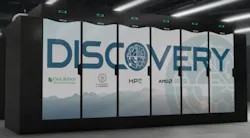
Oak Ridge already operates the HPE Cray Frontier exascale supercomputer and plans to deploy its AMD-powered successor, Discovery, in 2028. Built on the HPE Cray Supercomputing GX5000 platform, Discovery is intended to support HPC and AI workloads while serving as a testbed for the laboratory's continuing quantum computing research. The relationship between these systems reflects a broader effort to make quantum processors usable within established supercomputing environments without requiring every component to occupy the same physical space.
HPE Cray Provides the Classical Computing Foundation
HPE's quantum strategy is closely tied to its broader investment in supercomputing infrastructure. In July, the company announced additional capabilities for its HPE Cray Supercomputing GX5000 platform, incorporating sixth-generation AMD EPYC processors and a fully direct-liquid-cooled architecture.
HPE says the GX5000's CPU-only GX250 compute blade configuration can support up to 81,920 AMD EPYC processor cores per rack, with direct-liquid-cooling technology designed to accommodate warmer facility water temperatures. Those specifications apply to the classical computing infrastructure rather than to quantum processors themselves, but they illustrate the scale of processing, thermal management and systems integration HPE brings to its quantum strategy.
In a hybrid computing application, classical HPC systems might prepare a computational problem, execute selected portions on a quantum processor and return results to CPUs or GPUs for additional processing. The objective is not to replace conventional computing with quantum hardware, but to combine different processing technologies within coordinated workflows.
AI could also play an operational role in quantum computing infrastructure. In August, QuEra and Anthropic reported an AI-assisted hardware control experiment in which Anthropic's Claude developed and validated software to restore the precise laser frequencies required by QuEra's neutral-atom systems. The resulting controller successfully recovered the laser system in 695 of 700 timed trials, typically completing recoveries in seconds rather than the several minutes required by a specialist.
Importantly, the finished controller operates through deterministic software rather than an AI model making real-time hardware decisions. The demonstration addresses one specialized subsystem, not the operation of a complete quantum computer, but it illustrates how AI-assisted engineering could eventually reduce maintenance burdens and improve operational consistency.
Quantum computing and AI still address different computational problems, and no broadly demonstrated quantum advantage has emerged for mainstream AI training or inference. Their potential convergence lies in using specialized processors and classical computing resources where each is most effective.
For data center operators, making that convergence practical will require common scheduling, management and monitoring environments. A quantum processor accessible only through specialized laboratory software is a very different proposition from one that can participate in established HPC workflows with predictable performance, operational visibility and support requirements.
IBM Demonstrates Another Path to Quantum-Classical Integration
HPE is not alone in pursuing that goal. In March 2026, IBM published a quantum-centric supercomputing reference architecture outlining how quantum processing units could operate alongside CPUs and GPUs through coordinated software, networking and application workflows.
IBM's strategy is supported by actual integration work. In February, IBM and Japan's RIKEN research institute reported a closed-loop quantum-classical computing demonstration linking an on-premises IBM Heron quantum processor with the Fugaku supercomputer.
The experiment involved a quantum chemistry calculation using the full 152,064-node Fugaku system, with quantum and classical computing resources exchanging data within a coordinated workflow. It demonstrated the ability to orchestrate the two computing environments at substantial scale, although it did not establish a general commercial performance advantage over conventional HPC.
The demonstration is significant because it moves quantum-HPC integration beyond reference architectures and planned partnerships. IBM and RIKEN have shown that quantum processors and large classical supercomputers can participate in a common computational workflow, even as the broader economics and application advantages remain unresolved.
IBM and HPE are approaching this emerging market from different positions. IBM develops its own quantum processors and supporting technologies, while HPE is concentrating on integrating quantum systems from multiple hardware suppliers into established supercomputing platforms. Both approaches recognize that commercially useful quantum computing will depend on the classical infrastructure surrounding the quantum processor as much as on advances in qubit technology.
What Data Center Operators Should Be Watching For
The next stage of HPE's quantum initiative will depend on whether its partnerships produce functioning, repeatable and commercially supportable systems. Three developments will help determine when those capabilities become practical infrastructure investments.
The first is the emergence of HPE-integrated quantum computing testbeds that demonstrate meaningful applications using actual quantum hardware alongside HPE Cray platforms. These installations will need to establish how workloads are scheduled, how computing resources communicate, how performance is measured and whether integration can be repeated across different quantum architectures.
The second is continued progress in quantum error correction. Systems capable of performing sustained, reliable logical operations will be more commercially relevant than those emphasizing large physical-qubit counts without corresponding improvements in computational reliability.
Progress is measurable, although important limitations remain. On October 19, Quantinuum reported that its Helios trapped-ion system achieved 99.9995% logical memory fidelity per syndrome-extraction cycle in an error-correction experiment, equivalent to a logical failure probability of approximately five in one million per cycle under the tested conditions. The result represents a significant improvement in protecting quantum information, but it does not establish that the system can execute a million arbitrary computational operations without error or deliver sustained commercial fault-tolerant performance.
The third is the development of practical data center deployment specifications. Operators will need verified information about power consumption, cooling, physical footprint, environmental conditions, equipment maintenance and lifecycle costs. They will also need to understand which components must remain physically close to the quantum processor, which workloads can use remote HPC resources and how specialized quantum equipment can be serviced without disrupting broader computing operations.
Those considerations extend beyond hardware specifications to the commercial model itself. Data center operators will need evidence that quantum installations can deliver predictable availability, manageable operating costs and useful computational results before treating them as routine infrastructure investments.
The unanswered question is no longer whether quantum hardware can be installed alongside conventional computing infrastructure. Research facilities are already demonstrating that capability, and commercial providers are beginning to develop more integrated deployment models. The larger challenge is turning those installations into repeatable, commercially supportable systems with reliable operation, measurable application advantages and predictable facility requirements.
HPE is positioning its supercomputing infrastructure to support that transition without committing to a single quantum processor architecture. Whether those partnerships can deliver the performance, economics and operational maturity required for widespread commercial deployment of fault-tolerant quantum computing remains an open question.
At Data Center Frontier, we talk the industry talk and walk the industry walk. In that spirit, DCF Staff members may occasionally use AI tools to assist with content.
Keep pace with the fast-moving world of data centers and cloud computing by connecting with Data Center Frontier on LinkedIn, following us on X/Twitter and Facebook, as well as on BlueSky, and signing up for our weekly newsletters using the form below.
About the Author
 David Chernicoff
 Matt Vincent
Matt Vincent is Editor in Chief of Data Center Frontier, where he leads editorial strategy and coverage focused on the infrastructure powering cloud computing, artificial intelligence, and the digital economy. A veteran B2B technology journalist with more than two decades of experience, Vincent specializes in the intersection of data centers, power, cooling, and emerging AI-era infrastructure. Since assuming the EIC role in 2023, he has helped guide Data Center Frontier’s coverage of the industry’s transition into the gigawatt-scale AI era, with a focus on hyperscale development, behind-the-meter power strategies, liquid cooling architectures, and the evolving energy demands of high-density compute, while working closely with the Digital Infrastructure Group at Endeavor Business Media to expand the brand’s analytical and multimedia footprint. Vincent also hosts The Data Center Frontier Show podcast, where he interviews industry leaders across hyperscale, colocation, utilities, and the data center supply chain to examine the technologies and business models reshaping digital infrastructure. Since its inception he serves as Head of Content for the Data Center Frontier Trends Summit. Before becoming Editor in Chief, he served in multiple senior editorial roles across Endeavor Business Media’s digital infrastructure portfolio, with coverage spanning data centers and hyperscale infrastructure, structured cabling and networking, telecom and datacom, IP physical security, and wireless and Pro AV markets. He began his career in 2005 within PennWell’s Advanced Technology Division and later held senior editorial positions supporting brands such as Cabling Installation & Maintenance, Lightwave Online, Broadband Technology Report, and Smart Buildings Technology. Vincent is a frequent moderator, interviewer, and keynote speaker at industry events including the HPC Forum, where he delivers forward-looking analysis on how AI and high-performance computing are reshaping digital infrastructure. He graduated with honors from Indiana University Bloomington with a B.A. in English Literature and Creative Writing and lives in southern New Hampshire with his family, remaining an active musician in his spare time.
Related
 Artist's rendering of cloud-based quantum computing.

Voices of the Industry
 Source: Rob Byron/Shutterstock.com
 Source: Shutterstock, courtesy of nVent Data Solutions