Comparing Space-Driven Data Center Strategies: Modular Satellites vs. Integrated Rocket Nodes
Key Highlights
- Orbital Compute proposes 100,000 small satellites supporting 10 gigawatts of AI compute capacity, emphasizing modularity and incremental deployment.
- Cowboy Space plans to develop fewer, larger megawatt-class data centers integrated into rocket upper stages, aiming for more capacity with fewer launches.
- Both companies leverage space's solar energy and cooling advantages but face challenges in thermal management, hardware obsolescence, and regulatory approval for large satellite constellations.
- Orbital focuses on AI inference in orbit, ideal for processing data from Earth-observation satellites, while Cowboy aims for high-capacity nodes suitable for intensive AI workloads.
- The race hinges on overcoming technical, economic, and regulatory hurdles, with milestones including operational AI nodes, commercial services, and scalable orbital infrastructure.
The emerging race to build data centers in space continues to grow, with the most recent contenders taking very different approaches. Los Angeles startup Orbital Compute has filed plans for a constellation of as many as 100,000 satellites capable of providing an aggregate 10 gigawatts of artificial-intelligence computing capacity. The proposal, first announced in mid-June, would distribute that capacity among thousands of relatively small, independently launched spacecraft.
In May, 2026 Cowboy Space Corporation, formerly known as Aetherflux, filed its own application for a 20,000-satellite constellation called Stampede. Rather than placing a comparatively small computing payload aboard a conventional satellite, Cowboy plans to integrate a megawatt-class data center directly into the upper stage of a company-built rocket.
The two companies are pursuing the same underlying opportunity: using solar energy in low Earth orbit to bypass the electricity, permitting, land and water constraints increasingly affecting terrestrial data-center development.
Their strategies for reaching that objective, however, could hardly be more different.
Orbital is proposing an enormous fleet of modular, 100-kilowatt computing satellites launched by outside providers. Cowboy is developing a smaller number of much larger nodes delivered by a vertically integrated launch system in which the rocket’s upper stage becomes the permanent data center.
Both concepts remain highly speculative. Neither company has launched an operational AI data center, and the Federal Communications Commission filings that have been made are regulatory applications rather than deployment approvals. But together they demonstrate how quickly orbital computing has moved from a theoretical discussion to a potential new category of digital infrastructure.
Orbital’s 100,000-node Vision
Orbital’s proposal has been described as a plan for 100,000 data centers in space. More precisely, the company is proposing 100,000 satellites, each operating somewhat like a high-density data-center rack.
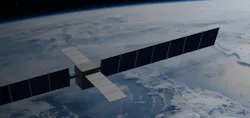
Orbital says each production satellite would support approximately 100 kilowatts of computing power, equivalent to roughly eight current servers. Each spacecraft would weigh about two metric tons and span approximately 100 meters after deployment of its solar arrays.
At full scale, 100,000 such nodes could produce approximately 10 gigawatts of aggregate compute capacity without drawing electricity from the terrestrial grid or using land and cooling water on Earth. At the published two-ton design weight, completing the constellation would require placing roughly 200,000 metric tons of spacecraft into orbit, before accounting for replacement satellites.
Orbital is not proposing to launch anything close to that scale immediately.
The company plans to begin with Pathfinder, a hosted payload carrying a single high-performance GPU aboard a SpaceX Falcon 9 rideshare mission in 2027. Pathfinder is intended to test GPU operation, radiation tolerance, thermal performance and communications between the spacecraft and the ground.
Orbital-1, the company’s first purpose-built computing satellite, is targeted for 2028. It would include multiple GPU nodes, higher-capacity communications and the ability to provide commercial AI inference services.
The company raised a $5 million pre-seed round in June, led by a16z speedrun, to finance Pathfinder, the company’s proof of concept test launch, begin Orbital-1 development and establish Factory-1, a satellite assembly and testing facility in the Los Angeles area. Orbital says a larger financing round will be required as the program moves from technology validation toward manufacturing and deployment. The company is currently looking for engineers for their Los Angles facility.
Orbital’s architecture emphasizes horizontal scaling. Rather than constructing an enormous orbital facility containing thousands of interconnected racks, the company would add computing capacity one satellite at a time.
A failed satellite would remove a small fraction of the network’s total capacity rather than disabling an entire orbital platform. The modular design could also allow Orbital to introduce newer processors through successive satellite generations.
AI accelerators become commercially dated within several years, while satellites are normally expected to operate for much longer periods. Orbital must show that the revenue generated during a satellite’s useful computing life can justify manufacturing, launching and eventually replacing the hardware.
Cowboy Space Reins in Stampede
Cowboy Space is taking a more vertically integrated approach. With its proposed Stampede Data Center System. This development model would include as many as 20,000 satellites operating primarily in dawn-dusk sun-synchronous orbits at altitudes between approximately 700 and 1,000 kilometers. The spacecraft would communicate through optical laser links and are expected to have operating lives of about five years. Cowboy has identified 2028 as the target for its first Stampede launch, followed by a progressive buildup over subsequent years.
The defining feature of Cowboy’s architecture is that the rocket’s upper stage would not be discarded after delivering a separate satellite. Instead, the upper stage would become the satellite/data center node.
Cowboy describes the unified vehicle as a megawatt-class data center with integrated computing, solar generation and active thermal management. By eliminating some of the structural and avionics duplication between a launch vehicle and a conventional satellite payload, the company expects to dedicate a greater percentage of the launched mass to processors, power systems and cooling equipment.
The concept represents an effort to optimize the entire system around the cost of delivering compute into orbit rather than purchasing a standard launch and designing a satellite to fit inside it.
Cowboy says it intends to own the launch system, satellite infrastructure and manufacturing operation. That could eventually give the company more control over costs, launch schedules and spacecraft design than a company dependent on third-party rocket providers.
And, as recent issues with well-funded Blue Origin have shown, it dramatically increases the number of technical problems Cowboy must solve.
In addition to developing radiation-tolerant computing, optical communications, deployable solar arrays and orbital thermal-management systems, Cowboy must successfully design, manufacture, test and license a new rocket. Its launch vehicle would require authorization from the Federal Aviation Administration in addition to the approvals needed for the satellite constellation.
Cowboy nevertheless enters the race with considerably more capital than Orbital. The company announced a $275 million Series B round in May at a reported $2 billion valuation. Founded in 2024 by Robinhood co-founder Baiju Bhatt, with a focus on space-based solar power before expanding into orbital computing and launch systems.
One Hundred Kilowatts Versus One Megawatt
The clearest distinction between the two proposals is the capacity assigned to each node.
Orbital’s production design calls for approximately 100 kilowatts of computing power per satellite. Cowboy is targeting megawatt-class spacecraft, potentially giving each Stampede node approximately 10 times the power capacity of an Orbital satellite.
At their stated maximum scales, Orbital’s 100,000 satellites would provide approximately 10 gigawatts. If Cowboy ultimately achieved one megawatt across all 20,000 Stampede spacecraft, its theoretical aggregate capacity would approach 20 gigawatts.
Those figures should be treated as design objectives, not capacity forecasts. Neither company has demonstrated even one operational node at its proposed production power level.
Orbital’s smaller satellites may be easier to test and deploy incrementally. The company can begin with a single hosted GPU, progress to a purpose-built prototype and expand as launch economics and customer demand permit.
Cowboy’s larger nodes could provide more useful computing capacity with fewer satellites and potentially fewer launches. Combining the rocket stage and data center would also reduce the amount of structural mass that does not directly support power generation or computing.
The tradeoff is concentration risk. The failure of a megawatt Cowboy spacecraft would remove considerably more capacity than the loss of a 100-kilowatt Orbital node. Cowboy’s model also depends on its new launch platform succeeding alongside the data-center technology.
Orbital avoids the expense of developing a rocket but remains exposed to the pricing, payload limitations and launch schedules of outside providers. Pathfinder, for example, is scheduled to fly through SpaceX and is subject to any operational issues that SpaceX need deal with.
Why Both Companies are Looking Beyond the Grid
The appeal of orbital computing begins with the expanding electricity requirements of AI. Orbital and Cowboy contend that low Earth orbit offers an alternative source of energy. Solar panels above the atmosphere receive stronger and, in carefully selected orbits, more consistent sunlight than ground-mounted systems affected by weather, atmospheric absorption and the day-night cycle.
Orbital says solar intensity in space can reach approximately 1,361 watts per square meter. Cowboy similarly argues that placing the silicon next to the sunlight would allow Stampede to avoid the delays and expense of building grid-connected infrastructure on Earth.
The companies also emphasize the absence of cooling-water requirements. An orbital data center would not need cooling towers, chillers or evaporative cooling systems of the type used by many terrestrial facilities.
That does not mean cooling in space is effortless. It is still a complex issue to solve, if only because a vacuum prevents heat from escaping through conventional air movement. Heat generated by GPUs must be moved away from the processors and released as infrared radiation through radiator surfaces.
NASA describes spacecraft thermal control as a balance between a number of factors, including internally generated heat, incoming solar energy and radiative heat rejection. High-power computing will therefore require large, lightweight radiators, dependable fluid loops or other thermal-transfer systems and careful protection from direct solar exposure.
Space may eliminate cooling-water consumption, but thermal management will become the largest determinants of spacecraft size, mass and reliability.
Inference May Come Before Orbital AI Training
Orbital is initially designing its platform for AI inference rather than attempting to train the largest frontier models in space.
That is a pragmatic distinction. Large-scale AI training requires thousands of accelerators to exchange data continuously with extremely low latency. Reproducing the tightly connected architecture of a terrestrial AI cluster across moving satellites and optical links would be exceptionally difficult. Inference requests can be smaller and more independent. Space-based computing may be particularly useful when the original data is already being generated in orbit.
Earth-observation satellites, for example, collect far more imagery and sensor data than can always be transmitted efficiently to ground stations. Onboard processing could identify wildfires, military activity, weather patterns or other events and transmit only useful results.
Academic work on cooperative orbital computing has proposed distributing such processing among satellite meshes connected by laser links, reducing the volume of raw information that must be sent back to Earth. And this could be the clearest benefit of any space-based solution.
For terrestrial workloads, both Orbital and Cowboy will still need extensive ground connectivity. Data must be transmitted into orbit, processed and returned without introducing unacceptable delays or communications costs.
Economics Remain Unproven
Neither company has demonstrated that orbital compute can compete economically with a terrestrial data center.
Orbital must manufacture its satellites at unprecedented scale while purchasing enough launch capacity to deploy and replenish the constellation. Cowboy hopes to improve the economics by controlling its launch vehicle, but developing a new rocket can consume billions of dollars before routine commercial operations begin.
Both companies must also account for hardware failures, radiation damage, launch losses, deorbiting costs and rapid GPU obsolescence.
Insurance markets are only beginning to examine those risks. Brokers and underwriters told Reuters in June that discussions about orbital AI infrastructure remained preliminary because insurers lack sufficient operating data to model failures and value fast-depreciating AI hardware in space. Insurance will become particularly important if orbital-data-center companies eventually rely on debt rather than venture capital to finance expansion.
Orbital’s $5 million financing is enough to support an early demonstration, but not its large constellation plan. Cowboy’s $275 million round provides a much longer runway, although the company is simultaneously pursuing spacecraft, data center and rocket development.
The Regulatory Challenge May Rival the Engineering
Together, the Orbital and Cowboy proposals seek permission for as many as 120,000 satellites.
Orbital’s application alone would significantly exceed the approximately 15,000 active satellites that Secure World Foundation estimated were in orbit as of May 2026. Cowboy’s 20,000-satellite filing would also exceed the existing active population.
Constellations of this scale raise questions about collision avoidance, orbital congestion, failed spacecraft, launch emissions, atmospheric effects from reentry and interference with astronomical observations.
Secure World Foundation has recommended phased authorizations, system-level risk analysis and stricter reporting for large orbital-data-center proposals. The organization argues that compliance cannot be assessed solely at the individual-satellite level because even low failure rates can produce significant cumulative risks when multiplied across tens of thousands of spacecraft.
In early June, Cowboy asked the FCC for flexibility from conventional deployment milestones, arguing that Stampede could begin commercial operations with a single satellite and then scale according to demand and technological progress. Its plan to rely primarily on optical rather than radio-frequency links also falls somewhat outside traditional spectrum-coordination models.
Two Architectures, One Enormous Bet
Orbital and Cowboy Space are making the same fundamental wager: that AI’s demand for electricity will eventually grow faster than terrestrial grids can accommodate and that the cost of reaching orbit will decline enough to make solar-powered computing satellites competitive.
Orbital’s architecture may be easier to demonstrate in stages. Cowboy’s could eventually deliver more computing capacity with fewer spacecraft and less duplicated launch hardware. Orbital carries less launch-development risk but remains dependent on outside rocket companies.
The most important milestones will not be the 100,000th Orbital satellite or the completion of Cowboy’s 20,000-node Stampede. They will be the first GPU that operates reliably through repeated thermal cycles, the first commercial workload processed economically in orbit and the first customer willing to pay for the service.
Until then, both plans remain ambitious regulatory filings backed by early-stage engineering. They make one point clear: as the AI industry searches for power, the boundaries of the data-center market are expanding far beyond campuses, utility territories and national borders. The next major computing region may not appear on any terrestrial map. It may become something that you can look up and see.
About the Author
 David Chernicoff