Moses Lake Moves From Bitcoin to AI and HPC
Key Highlights
- Keel Infrastructure is converting an 18-MW former Bitcoin mining site in Moses Lake into an AI and HPC data center, with commissioning targeted for 2027.
- The project benefits from existing power, fiber networks, and infrastructure, positioning it within the established Quincy hyperscale market in Washington.
- Active permits, equipment delivery, and site preparation mark tangible progress, even as final vertical permits are still underway.
- Keel is focusing on rapid deployment of capacity to attract prospective tenants, including AI companies and GPU cloud providers, ahead of full commercialization.
- The Moses Lake site exemplifies industry trends of repurposing mining infrastructure for AI, highlighting regional advantages and the strategic importance of smaller, quickly deployable data centers.
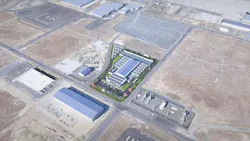
Moses Lake, Washington, is emerging as a revealing test case for the next phase of AI infrastructure development.
Keel Infrastructure, the company formerly known as Bitfarms, is converting its 18-MW cryptocurrency mining site in central Washington into an AI and high-performance computing data center, with demolition complete, long-lead equipment arriving and commissioning targeted for 2027.
The project sits at the intersection of several forces now converging across the data center industry: the repurposing of former Bitcoin mining assets, the premium being placed on already-secured power, the push toward modular construction and the expansion of established hyperscale markets into nearby secondary locations.
In Moses Lake, those forces converge just down the road from Quincy, one of the Pacific Northwest’s most mature data center clusters.
From Mining Site to Data Center
Keel’s plans have moved beyond the increasingly common category of announced AI capacity.
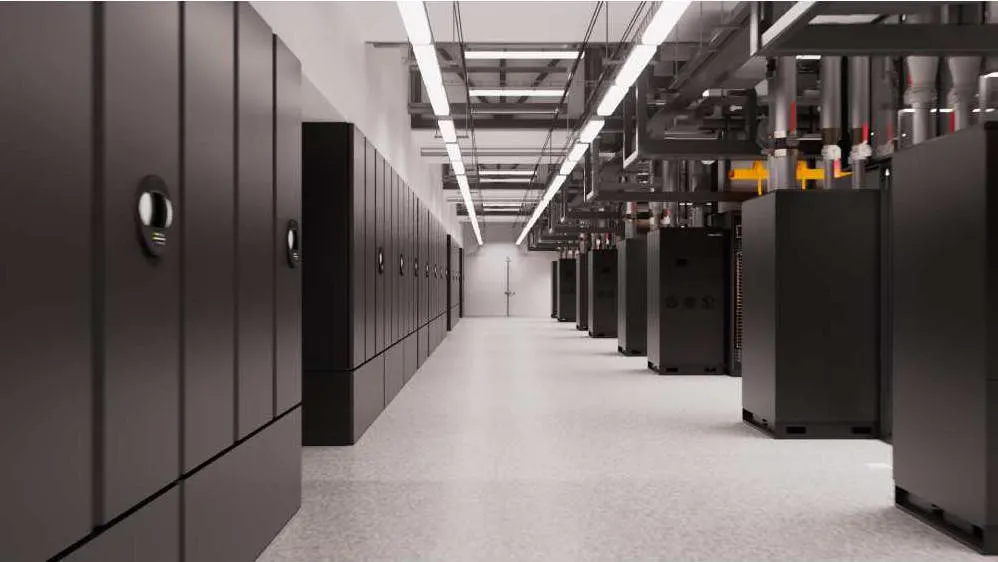
The six-acre Moses Lake site is served by Grant County Public Utility District. Keel’s 2025 annual filing says the company committed $128.742 million under a turnkey agreement with Vertiv for engineering, project-management assistance, procurement and manufacturing, site support and factory acceptance testing.
The stated objective is a fully integrated 18-MW “hybrid-built” data center.
Keel’s subsequent Q1 investor presentation rounds the Vertiv commitment to $128 million and lists 2027 as the project's earliest ready-for-service date. The company estimates power usage effectiveness across its development portfolio, including Moses Lake, at between 1.15 and 1.35.
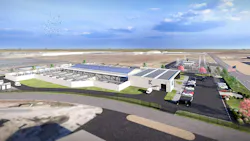
More important than the rendering is what has begun happening on the ground.
Keel said in its Aug. 10 second-quarter results that the first Vertiv modules have arrived at Moses Lake and additional long-lead equipment is being delivered or manufactured. The company has also begun executing final fiber contracts across its three priority U.S. development sites while refining designs for greater power density.
The former Bitcoin mining building has meanwhile been demolished. Mining at Moses Lake ceased April 28, and Keel has since decommissioned all four of its U.S. cryptocurrency mining sites as it moves its capital and development effort toward HPC infrastructure. Data Center Dynamics reported on the U.S. shutdowns Aug. 20.
Evidence of Execution
The construction record adds another useful layer.
A Washington Department of Ecology record for the Grant Node Data Center shows an active construction stormwater permit effective June 1.
The associated project record identifies Keel Infrastructure as site owner, Turner Construction as permittee and site contact, and Langan as project engineer. It lists all six acres as disturbed, identifies utility installation as part of the work, specifies more than 1,000 cubic yards of concrete and records a project start date of June 8, 2026. The listed project end date is Dec. 3, 2027.
A stormwater construction permit is not the same thing as final approval to build and energize the complete data center. Keel itself said in August that final vertical permitting remained underway.
But the distinction cuts both ways. In an industry awash in multi-gigawatt announcements whose construction schedules remain uncertain, physical site preparation, equipment procurement, named construction partners and active permits provide harder markers of progress.
Keel CEO Ben Gagnon distilled the company’s strategy in the Q2 release:
“Power is the constraint. Everything else is downstream of it.”
Keel says multiple prospective tenants are negotiating across its three priority sites, while its Moses Lake commercial discussions include AI companies, GPU cloud providers and enterprises looking for near-term capacity in the Pacific Northwest.
That makes the absence of a publicly announced tenant worth noting. Keel is deliberately putting capital into Moses Lake ahead of commercialization, betting that speed-to-capacity will carry a premium once the facility is ready.
Moses Lake and the Quincy Effect
Moses Lake should not be understood as an isolated rural data center project. It sits within the larger Grant County infrastructure ecosystem that helped make nearby Quincy one of the defining hyperscale markets of the cloud era.
Keel has called Moses Lake “adjacent to one of the most proven data center markets in the United States,” noting that hyperscale infrastructure has operated around Quincy for nearly two decades. In its Q1 remarks, management argued that increasingly constrained regional power leaves operators seeking incremental Pacific Northwest capacity with fewer options.
The Grant County Economic Development Council’s data center inventory includes Microsoft, NTT Data, Sabey, Vantage, Intuit and other operators. The organization counts more than 1.5 million square feet of data center operations in the county and points to a diverse fiber network and Grant County PUD’s Columbia River hydroelectric resources as core advantages.
That existing cluster changes the equation for an 18-MW project.
The headline AI developments of 2026 are increasingly measured in hundreds of megawatts or gigawatts. But another market exists underneath those megacampus announcements: operators that need tens of megawatts in the right geography on a timeline measured in quarters rather than many years.
An 18-MW facility with power, fiber, equipment and construction underway can therefore be strategically more relevant than its relatively modest capacity suggests.
Keel had previously secured an option for another 10 MW near Moses Lake, but management said during its second-quarter call that it has relinquished that option and is now focused exclusively on the existing 18 MW. The decision further distinguishes Moses Lake from the industry's race to advertise ever-larger pipelines.
This project is about getting capacity online.
A Second Life for Crypto Power
That may ultimately be the larger Moses Lake story.
Bitcoin miners assembled portfolios around one resource the AI industry is now struggling to obtain: large blocks of electricity. Their mining buildings are generally not interchangeable with high-availability AI data centers, which require substantially different cooling, redundancy, networking and power-distribution architectures.
But land, electrical infrastructure, utility relationships and existing interconnections can give those sites a development head start. Keel is spending heavily to bridge the considerable infrastructure gap between those two types of computing.
Its overall development pipeline is 2.2 GW, spanning Washington, Pennsylvania and Quebec. Yet Moses Lake — at just 18 MW — is expected to be Keel’s first fully commissioned and energized AI/HPC data center and its first source of HPC revenue.
That makes the small Washington project unusually important. Quincy demonstrated what inexpensive hydroelectric power, fiber and available land could do for the first great wave of hyperscale cloud infrastructure.
Moses Lake may now help answer a different question: how quickly can existing powered infrastructure be transformed to serve the AI era?
The Bitcoin mine is already gone. The next test is whether 18 MW of existing power can be turned into AI capacity faster than the market can build it from scratch.
At Data Center Frontier, we talk the industry talk and walk the industry walk. In that spirit, DCF Staff members may occasionally use AI tools to assist with content.
Keep pace with the fast-moving world of data centers and cloud computing by connecting with Data Center Frontier on LinkedIn, following us on X/Twitter and Facebook, as well as on BlueSky, and signing up for our weekly newsletters using the form below.
About the Author
 Matt Vincent
Matt Vincent
Matt Vincent is Editor in Chief of Data Center Frontier, where he leads editorial strategy and coverage focused on the infrastructure powering cloud computing, artificial intelligence, and the digital economy. A veteran B2B technology journalist with more than two decades of experience, Vincent specializes in the intersection of data centers, power, cooling, and emerging AI-era infrastructure. Since assuming the EIC role in 2023, he has helped guide Data Center Frontier’s coverage of the industry’s transition into the gigawatt-scale AI era, with a focus on hyperscale development, behind-the-meter power strategies, liquid cooling architectures, and the evolving energy demands of high-density compute, while working closely with the Digital Infrastructure Group at Endeavor Business Media to expand the brand’s analytical and multimedia footprint. Vincent also hosts The Data Center Frontier Show podcast, where he interviews industry leaders across hyperscale, colocation, utilities, and the data center supply chain to examine the technologies and business models reshaping digital infrastructure. Since its inception he serves as Head of Content for the Data Center Frontier Trends Summit. Before becoming Editor in Chief, he served in multiple senior editorial roles across Endeavor Business Media’s digital infrastructure portfolio, with coverage spanning data centers and hyperscale infrastructure, structured cabling and networking, telecom and datacom, IP physical security, and wireless and Pro AV markets. He began his career in 2005 within PennWell’s Advanced Technology Division and later held senior editorial positions supporting brands such as Cabling Installation & Maintenance, Lightwave Online, Broadband Technology Report, and Smart Buildings Technology. Vincent is a frequent moderator, interviewer, and keynote speaker at industry events including the HPC Forum, where he delivers forward-looking analysis on how AI and high-performance computing are reshaping digital infrastructure. He graduated with honors from Indiana University Bloomington with a B.A. in English Literature and Creative Writing and lives in southern New Hampshire with his family, remaining an active musician in his spare time.
Related
Voices of the Industry
 Source: SNEHIT PHOTO/Shutterstock.com
 Source: Matthew G Eddy/Shutterstock.com