AMD Helion Puts CPU Density at the Center of Agentic AI Infrastructure
Key Highlights
-
AMD Helion offers two configurations: a CPU-only rack supporting up to 32,768 sixth-generation EPYC cores and an integrated enterprise design combining EPYC processors with Instinct MI350P accelerators.
-
The architecture supports independent scaling of CPU-based agent execution and GPU inference resources, potentially improving infrastructure utilization as AI workload demands evolve.
-
Built around Open Compute Project standards, Helion provides a modular foundation for hardware integration, customization and future upgrades across participating equipment manufacturers.
-
AMD offers high-density, balanced and high-frequency CPU configurations, allowing system designers to match processor performance and electrical requirements to different agentic AI workloads.
-
Initial Helion availability is targeted for November 2026, with commercial implementations planned by industry partners. Rack-level power requirements, independent performance benchmarks and deployment economics remain unproven.
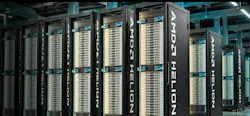
The next phase of AI infrastructure will require more than expanding GPU capacity. As agentic AI moves toward production deployment, data center operators face a different computing challenge: how to balance the CPU resources needed to execute increasingly complex workflows with the GPU infrastructure that powers AI model inference.
AMD's answer is Helion, an open, modular rack-scale architecture introduced October 12 at the Open Compute Project (OCP) Global Summit in San Jose, California. As DCF reported from the event, Helion reflects AMD's expectation that agentic applications will place substantially greater demands on general-purpose computing, requiring infrastructure that can be configured around distinct workloads rather than fixed combinations of CPUs and GPUs.
Built around OCP specifications, Helion offers two principal configurations. A CPU-only rack supports as many as 32,768 sixth-generation AMD EPYC processor cores, targeting large-scale agent execution. An integrated enterprise configuration combines EPYC CPUs with AMD Instinct MI350P accelerators to support agent processing and model inference within the same rack. The architecture accommodates both air-cooled and liquid-cooled implementations, giving system manufacturers options for different deployment environments.
Helion also extends AMD's rack-scale strategy beyond Helios, its tightly integrated architecture for GPU-intensive AI training and large-scale inference. Where Helios concentrates accelerator performance within high-density systems, Helion emphasizes the distribution of computing resources across the different tasks involved in agentic AI.
For data center operators, the distinction raises questions that extend beyond processor selection. How CPU and GPU resources are distributed will affect electrical demand, cooling requirements, network architecture and ultimately the amount of useful AI computing capacity that can be delivered within a facility's infrastructure constraints.
Agentic AI Changes the Computing Equation
Traditional chatbot-style AI applications generally follow a straightforward computing pattern: a user submits a prompt, a model processes the request on GPUs, and a response is generated. Agentic AI introduces a more complex sequence of operations, extending beyond model inference into software execution, data retrieval, decision-making and coordination across multiple systems.
An AI agent may query databases, execute code, retrieve information from external sources, communicate with other agents and evaluate intermediate results before completing a task. These activities introduce substantial general-purpose processing requirements alongside the GPU resources needed for model inference. As the number of agents and concurrent tasks increases, so do the demands on memory, storage, networking, security and workload orchestration.
The result is a more heterogeneous computing environment, where adding GPU capacity alone may not improve overall application performance. CPU throughput, memory bandwidth and the ability to coordinate workloads across distributed infrastructure become increasingly important to system efficiency. For data center operators, that changes the equation for allocating computing resources within available power and cooling capacity.
AMD sees this diversity of workloads as a central consideration in the design of agentic AI infrastructure. As Dan McNamara, senior vice president and general manager of Compute and Enterprise AI at AMD, explained:
Agentic AI is not a single workload. It spans personal agents, enterprise applications, code execution and complex workflows, each with different compute requirements. To do that takes optimized compute and infrastructure that can adapt to different workloads. With AMD Helion, we are bringing AMD EPYC performance, open software and flexible rack designs together so our partners can build systems around customer needs and make efficient use of available power.
AMD expects the growth of agentic applications to substantially increase demand for server CPUs alongside GPU infrastructure. During her October 12 OCP keynote, CEO Lisa Su said the company now projects the server CPU market will exceed $200 billion by 2030, a significant upward revision from its earlier $120 billion estimate. While that remains AMD's market forecast rather than an independent measure of future demand, it underscores the company's conviction that general-purpose computing will play a much larger role in AI infrastructure.
Two Rack Designs for Different Markets
Helion's two principal configurations reflect different approaches to deploying and managing agentic workloads. For hyperscale operators, the architecture emphasizes high-density CPU infrastructure dedicated to agent execution, with model inference handled by separate GPU-accelerated systems. This separation allows operators to expand CPU and GPU capacity independently, potentially improving resource utilization as the balance between agent activity and inference demand changes.
The approach also introduces infrastructure considerations. Agents may communicate repeatedly with models hosted elsewhere in a data center or across distributed environments, making network performance, latency and workload orchestration important factors in overall system efficiency. The ability to scale computing resources independently is an architectural advantage, but realizing that benefit will depend on how effectively those resources are connected and managed.
For enterprise deployments, Helion takes a more integrated approach, combining EPYC CPU blades, Instinct MI350P GPU blades and general-purpose computing resources within the same rack. The reference design accommodates up to 16 MI350P accelerators in two independent eight-GPU servers, each occupying five rack units. These GPU nodes operate separately rather than through a common rack-level scale-up fabric, reflecting the architecture's emphasis on enterprise inference rather than the tightly coupled accelerator environments used for frontier-model training.
The enterprise configuration also accommodates dedicated resources for databases, storage and technical computing, supporting the broader range of operations performed by AI agents. Rather than requiring separate infrastructure for every function, the design allows system manufacturers to assemble combinations of computing resources appropriate to specific workloads.
Another component is AMD's integrated token-routing capability, designed to direct model requests between locally hosted open-source models and larger frontier models running in external infrastructure. This could allow enterprises to keep selected workloads close to their data while drawing on cloud-based inference for more demanding tasks. Decisions about model placement, data security and latency would remain important considerations in implementing such an approach.
Taken together, the configurations illustrate a shift from treating AI infrastructure primarily as a collection of accelerator systems toward designing computing environments around the full sequence of tasks performed by AI applications. For operators, the question is how effectively those resources can be deployed, connected and managed within the electrical, cooling and networking capacity available to them.
CPU Selection Becomes a Power and Cooling Decision
Helion's modularity extends to processor selection, allowing system manufacturers to configure CPU resources around the performance and power requirements of different agentic workloads. Rather than applying a uniform processor configuration across the rack, AMD's reference architecture supports varying combinations of core density, processing speed and electrical demand.
AMD outlines three principal options. High-density configurations use 256-core EPYC processors rated at 400 watts, targeting maximum agent concurrency within a given power envelope. Balanced configurations retain 256 cores but increase the processor power rating to 600 watts, providing additional performance headroom for more demanding workloads. For latency-sensitive technical applications, a high-frequency configuration offers 96 cores operating at up to 5 GHz, prioritizing individual task performance over maximum core density.
The ability to combine these profiles could help operators avoid deploying the highest-performance processors for workloads that do not require them. That flexibility may improve utilization and overall computing efficiency, although the actual benefits will depend on workload characteristics, system configuration and the performance delivered per watt.
For data center operators, these choices have implications beyond processor performance. CPU power ratings are only one component of total rack consumption, which also includes memory, networking, storage and supporting systems. The combined electrical and thermal loads will determine how much computing capacity can be accommodated within a facility's available power and cooling infrastructure.
AMD has not yet published comprehensive rack-level power and cooling requirements for the different Helion configurations. Without those figures and independently validated workload benchmarks, the potential infrastructure efficiencies remain a design proposition rather than a demonstrated operating advantage.
Open Standards and the Infrastructure Ecosystem
Helion's approach to hardware flexibility depends in part on its adoption of Open Compute Project standards. The reference architecture uses a 21-inch, 44 OpenU rack based on the OCP Open Rack Version 3 (ORv3) specification, with standardized components for power distribution, processor modules, networking, system management and security. These include the Data Center Modular Hardware System (DC-MHS), Data Center Secure Control Module (DC-SCM), High Power Rack Version 2 (HPRv2), OCP NIC 3.0 and Caliptra silicon root-of-trust technology.
For data center operators, the significance extends beyond component compatibility. Open specifications provide equipment manufacturers with a common foundation for developing systems that can be adapted to different computing requirements, potentially reducing dependence on proprietary hardware configurations. Standardization may also simplify integration, maintenance and future upgrades, although interoperability across implementations will still require validation.
AMD plans to contribute the Helion specifications to OCP for further development and industry adoption. The company is relying on original equipment manufacturers (OEMs), original design manufacturers (ODMs) and infrastructure partners to translate the reference architecture into commercial systems. Initial supporters include Cisco, Dell Technologies, HPE, Lenovo, Foxconn, QCT, Supermicro and Wiwynn.
Several partners have outlined their intended approaches. Dell plans to extend its PowerRack infrastructure to support Helion, including networking and storage capabilities. Supermicro intends to incorporate the architecture into its Data Center Building Block Solutions portfolio, while HPE has emphasized support for air-cooled and direct-liquid-cooled networking infrastructure. Together, these commitments indicate an emerging manufacturing and integration ecosystem, although commercial deployment and operational performance remain to be demonstrated.
The broader challenge is ensuring that modular computing resources can operate as a coordinated infrastructure platform. As agentic workloads distribute processing across CPUs, GPUs, storage systems and networks, integration, management and security become as important as the flexibility of the underlying hardware. Jeremy Foster, senior vice president and general manager of Cisco Compute, addressed that challenge in AMD's announcement:
Agentic AI is changing what customers need from their infrastructure. It's not just about compute performance, but how the entire system is connected, managed and secured. Architectures like AMD Helion, combined with Cisco's full-stack infrastructure capabilities, can give customers greater flexibility to deploy, operate and scale agentic workloads into their environments as their needs evolve.
Helion and Helios: Complementary Architectures
AMD's Helion and Helios architectures represent complementary approaches to AI infrastructure, reflecting the different computing requirements of model execution and the applications built around it. Helios is designed for GPU-intensive training and large-scale inference, integrating 72 Instinct MI455X accelerators with EPYC processors, Pensando networking and AMD's ROCm software ecosystem. Its tightly coupled architecture emphasizes high-bandwidth communication between accelerators, supporting workloads that demand substantial computational capacity and rapid movement of data between GPUs.
Helion, by contrast, emphasizes configurable CPU resources, with GPU acceleration incorporated where workloads require it. In a large-scale deployment, the two architectures could operate together, with Helios providing centralized model inference while Helion handles agent execution, application logic and supporting computing tasks. Such an arrangement would allow operators to expand these resources independently as demand evolves.
The distinction is particularly relevant as AI infrastructure moves toward production environments supporting large numbers of autonomous agents. Rather than optimizing an entire installation around GPU performance, operators may need to manage a broader mix of computing resources, each with different utilization patterns, networking demands and power and cooling characteristics.
Commercial Availability and the Infrastructure Challenge
AMD says Helion configurations are under development with ecosystem partners, with initial availability targeted for November 2026. Commercial rollout schedules will vary by manufacturer, however. Supermicro, for example, expects its Helion-based rack offering to become available in the first half of 2027.
The architecture's broader operating economics also remain to be established. AMD has outlined the available processor configurations and rack design, but detailed system-level power and cooling requirements, independent performance benchmarks, pricing and confirmed customer deployment schedules have yet to emerge. These figures will be important in assessing whether Helion's modular approach can deliver measurable improvements in computing utilization, energy efficiency and total cost of ownership.
For operators evaluating the architecture, the practical questions extend to network latency, integration complexity and the infrastructure needed to support different combinations of CPU and GPU workloads. The ability to configure computing resources independently could prove valuable in facilities with limited electrical capacity, but any efficiency gains must be weighed against the additional networking, management and supporting infrastructure required.
The larger significance of Helion lies in the changing demands of AI deployment. The initial wave of AI factory development concentrated heavily on building the GPU capacity required to train and serve increasingly sophisticated models. As agentic applications move into production, attention is expanding to the general-purpose computing, networking and supporting systems needed to translate model capabilities into useful work.
AMD is betting that this shift will create a substantial market for more flexible, CPU-intensive infrastructure. Whether Helion fulfills that promise will depend on the performance and economics of the commercial systems its partners ultimately deliver. For data center operators, the broader challenge is already taking shape: AI infrastructure capacity will increasingly be measured not simply by the accelerators installed, but by how effectively the entire computing environment performs within its available power, cooling and networking resources.
At the 2026 Open Compute Project Global Summit, AMD Chair and CEO Lisa Su introduces the Helion rack-scale architecture and explains how agentic AI is reshaping the balance between CPU processing, GPU inference and open data center infrastructure. (Video: Open Compute Project)
At Data Center Frontier, we talk the industry talk and walk the industry walk. In that spirit, DCF Staff members may occasionally use AI tools to assist with content.
Keep pace with the fast-moving world of data centers and cloud computing by connecting with Data Center Frontier on LinkedIn, following us on X/Twitter and Facebook, as well as on BlueSky, and signing up for our weekly newsletters using the form below.
About the Author
 David Chernicoff
 Matt Vincent
Matt Vincent is Editor in Chief of Data Center Frontier, where he leads editorial strategy and coverage focused on the infrastructure powering cloud computing, artificial intelligence, and the digital economy. A veteran B2B technology journalist with more than two decades of experience, Vincent specializes in the intersection of data centers, power, cooling, and emerging AI-era infrastructure. Since assuming the EIC role in 2023, he has helped guide Data Center Frontier’s coverage of the industry’s transition into the gigawatt-scale AI era, with a focus on hyperscale development, behind-the-meter power strategies, liquid cooling architectures, and the evolving energy demands of high-density compute, while working closely with the Digital Infrastructure Group at Endeavor Business Media to expand the brand’s analytical and multimedia footprint. Vincent also hosts The Data Center Frontier Show podcast, where he interviews industry leaders across hyperscale, colocation, utilities, and the data center supply chain to examine the technologies and business models reshaping digital infrastructure. Since its inception he serves as Head of Content for the Data Center Frontier Trends Summit. Before becoming Editor in Chief, he served in multiple senior editorial roles across Endeavor Business Media’s digital infrastructure portfolio, with coverage spanning data centers and hyperscale infrastructure, structured cabling and networking, telecom and datacom, IP physical security, and wireless and Pro AV markets. He began his career in 2005 within PennWell’s Advanced Technology Division and later held senior editorial positions supporting brands such as Cabling Installation & Maintenance, Lightwave Online, Broadband Technology Report, and Smart Buildings Technology. Vincent is a frequent moderator, interviewer, and keynote speaker at industry events including the HPC Forum, where he delivers forward-looking analysis on how AI and high-performance computing are reshaping digital infrastructure. He graduated with honors from Indiana University Bloomington with a B.A. in English Literature and Creative Writing and lives in southern New Hampshire with his family, remaining an active musician in his spare time.
Voices of the Industry
 Image courtesy of Midea Building Technologies
 Adobe Stock image courtesy of Hitachi Energy