At 7x24 Exchange, AI Data Center Growth Confronts New Realities of Power, Grid Reliability and Community Trust

SAN ANTONIO, Texas — The data center industry's accelerating transition toward artificial intelligence is challenging some of its longest-standing assumptions about infrastructure design, operational reliability and relationships with the outside world.
That was the overriding message Monday, October 26, as the 7x24 Exchange Fall 2026 Conference opened its technical program in San Antonio under the theme The Intersection of AI & Traditional Data Centers.
Across a series of presentations spanning agentic AI, power system engineering, grid reliability and community engagement, speakers described an industry confronting challenges that extend well beyond higher rack densities and greater demand for electricity.
AI workloads are changing how power must be delivered and managed. Large data center campuses are becoming consequential participants in grid operations rather than simply customers of electric utilities. And developers are finding that technical and economic arguments alone may no longer be enough to secure acceptance in communities where they intend to build.
Opening the proceedings, 7x24 Exchange Chairman Bob Cassiliano identified community opposition as a challenge that has overtaken several of the industry's other longstanding concerns.
"Last year it was artificial intelligence, sustainability, the labor shortage," Cassiliano said. "Although these challenges remain, they have been superseded by community opposition to data centers."
Cassiliano pointed to mounting concerns over electricity prices, water consumption, noise, land use and property values, along with the increasingly political character of efforts to restrict development. He suggested that industry organizations develop a more coordinated strategy for engaging governors and senior state officials, complementing ongoing outreach to local communities.
The opening also included an announcement that 7x24 Exchange would contribute $40,000 to American Red Cross disaster relief efforts supporting communities affected by wildfires, hurricanes and flooding across the United States.
Agentic AI Raises New Questions for Infrastructure Design
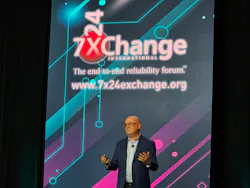
The morning keynote, delivered by AI futurist and former Google DeepMind executive Steve Brown, placed the industry's infrastructure expansion within a larger transition from conversational AI tools toward autonomous agents capable of executing complex work.
"We're using data centers to turn energy into intelligence," Brown told attendees, describing the physical infrastructure required to support an increasingly AI-driven economy.
Brown argued that growing demand for AI inference and autonomous agents could sustain the industry's expansion even as questions persist about the financial sustainability of massive infrastructure investments.
"There may be a financial bubble, there may be a debt bubble, but I do not believe there is a demand bubble," he said.
Of particular relevance to data center operators, Brown described how agentic computing introduces different workload characteristics from conventional chatbot interactions.
Rather than responding to a single prompt, AI agents may execute repeated cycles of reasoning, tool use, database access and task completion over hours or days. Depending on their complexity, he suggested, agents could consume hundreds or thousands of times more tokens than conventional chatbot interactions.
The implications extend to hardware architecture. Agentic applications move between GPU-intensive reasoning and CPU-based operations, increasing the importance of heterogeneous computing environments with both CPU/GPU and CPU-only infrastructure.
Brown also emphasized persistent memory, low-latency interconnects and secure execution environments as requirements for increasingly autonomous systems.
Those changes, he suggested, will demand new ways of evaluating AI infrastructure efficiency. Rather than emphasizing tokens generated per second, Brown proposed measuring useful tasks or economic outcomes relative to energy consumption.
The shift, in his view, points toward a future in which data center productivity is judged less by raw computational output than by the useful work that computing delivers.
Google and Cummins Examine the Electrical Consequences of AI Loads
The next presentation moved from AI's computational requirements to the electrical systems needed to support them.
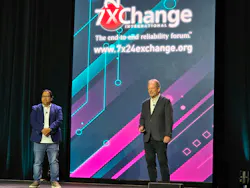
In a joint session on AI load dynamics, Google power systems engineer Ashish Upreti and Cummins technical advisor Rich Scroggins detailed the challenges created by rapid, synchronized changes in power demand from AI computing equipment.
Unlike conventional data center workloads, AI training can produce repeated swings between high-power computation and comparatively low-power states as processors complete calculations, exchange information and begin subsequent operations.
These fluctuations can occur over milliseconds or seconds, creating distinct challenges for generation equipment, power electronics, UPS systems and electrical distribution infrastructure.
The speakers outlined a layered approach to mitigating those fluctuations.
Software-level controls can limit how quickly computing loads increase or decrease, although slowing workload transitions can affect computational efficiency. Supercapacitors can address extremely short-duration power spikes, while battery energy storage systems are better suited to absorbing fluctuations occurring over several seconds.
The distinction matters because repetitive power swings can create operating conditions that conventional generator acceptance testing does not fully capture.
Scroggins explained that a generator may successfully handle an individual load step but behave differently when similar changes occur repeatedly, particularly when the next transition arrives before the governor or voltage regulator has fully recovered.
The companies described testing and modeling representative AI workload profiles in which electrical demand fluctuated between approximately 50% and 90% of available capacity.
Their preferred operating configuration placed a battery energy storage system in grid-forming mode, allowing the battery system to establish voltage and frequency while the generator operated in a load-governed configuration.
"We want the load on the generator to be as constant as possible," Scroggins explained.
The arrangement effectively allows energy storage to absorb much of the workload volatility while the generator delivers more stable power.
However, it also presents practical limitations. A grid-forming battery system may require enough power capacity to serve the entire IT load, making the approach difficult or uneconomical for some projects.
The companies examined alternative configurations, including arrangements suitable for retrofitting existing facilities. In one modeled operating scenario, voltage and frequency variations remained within approximately 3% to 5%, which Scroggins characterized as acceptable performance.
The research also highlighted unresolved questions about equipment longevity. During the audience discussion, Scroggins acknowledged that millisecond-scale fluctuations may not produce measurable voltage or frequency disturbances but could potentially create cumulative thermal or mechanical stresses within generator components.
Those longer-term effects remain under investigation.
With AI equipment generations changing much faster than the electrical infrastructure designed to support them, both speakers emphasized the importance of validated modeling and simulation.
The broader implication is that AI power system engineering must account not only for the maximum load a facility can impose, but also for how that load behaves continuously across the operating envelope.
When Data Center Reliability Becomes a Grid Reliability Problem
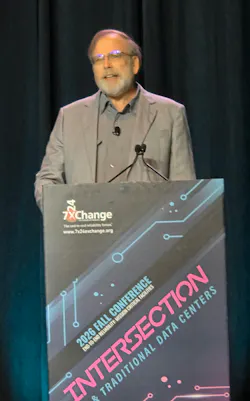
The morning's discussion of power system behavior took a more pointed turn when Steve Fairfax, president of engineering consultancy Oresme, challenged one of the data center industry's foundational operating practices.
For decades, data center reliability strategies have prioritized maintaining internal operations during utility disturbances, often by transferring loads to UPS systems and onsite generators at the first indication of abnormal power conditions.
Fairfax argued that this philosophy has become increasingly problematic as individual campuses and regional concentrations of facilities reach gigawatt-scale electrical demand.
"Your UPS battery is not permission to get off the grid," he told attendees.
His presentation, originally framed around the Odessa power disturbances in West Texas, focused heavily on the July 22, 2026 event in northern Virginia, when approximately 3,800 MW of data center demand unexpectedly disconnected from the PJM Interconnection system following a transmission line fault.
According to PJM's account of the incident, the fault was cleared properly, but data center protection systems initiated transfers to onsite generation. The resulting loss of demand caused voltage and frequency increases, followed by a second wave of data center disconnections.
Grid operators stabilized the imbalance within minutes, avoiding a broader reliability failure. Nevertheless, the event demonstrated how multiple facilities responding independently to a routine grid disturbance can collectively amplify its consequences.
Fairfax described the problem as a failure of protection coordination rather than a failure of utility equipment.
Protection settings intended to maximize internal uptime, he argued, may cause data centers to disconnect during short-duration voltage disturbances that their UPS systems are already designed to accommodate.
He specifically questioned the use of sensitive undervoltage thresholds and so-called three-strike rules that trigger a transfer to backup generation after repeated voltage disturbances.
Such practices can unintentionally turn normal transmission line fault-clearing sequences into major grid events.
Fairfax urged operators to review their protection settings and coordinate directly with utilities, arguing that improvements may sometimes be achieved through control and relay adjustments rather than major hardware investments. Any such changes, however, require appropriate facility-specific engineering and utility coordination.
His warning arrives as regulators and grid operators move to establish more formal requirements for large computational loads.
In July, the Federal Energy Regulatory Commission directed NERC to develop reliability standards and registration criteria for computational loads by the end of 2026. ERCOT's large computational load ride-through requirements became effective August 1, while PJM has advanced proposals addressing similar concerns.
Fairfax also discussed prospective requirements for dynamic modeling, synchronized event recording and trained facility operators capable of responding to grid authority instructions.
The comparison with the Odessa incidents was particularly instructive. In West Texas, unexpected generation disconnections following voltage disturbances created imbalances between electricity supply and demand. In northern Virginia, unexpected data center load disconnections produced the opposite imbalance.
Both cases illustrate the potential consequences of large numbers of independently controlled electrical assets responding to disturbances without sufficient coordination.
As energy storage and onsite generation become more deeply integrated into AI infrastructure, the interaction between data center protection systems and the wider grid is likely to become an increasingly important design consideration.

DC BLOX: Community Engagement Must Go Beyond Public Relations
The afternoon program shifted attention from electrical infrastructure to the growing challenges surrounding data center development and community acceptance.
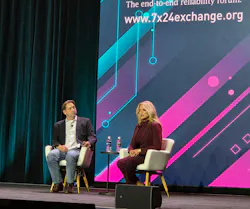
In a discussion moderated by Juli Ierulli, strategic account manager at Environmental Air Systems and vice president of 7x24 Exchange International, Michael Clark, senior vice president of data center construction at DC BLOX, described how the company has revised its approach to engaging communities as it expands into new markets.
Clark acknowledged that DC BLOX had encountered significant opposition after entering markets where it lacked the established relationships that had supported earlier developments across the Southeast.
"We made multiple stumbles in some of those new markets," he said, describing how the company sometimes found itself responding to negative publicity rather than presenting a clear explanation of its plans and commitments.
The experience led DC BLOX to develop a more systematic approach to community engagement, emphasizing early communication, site-specific websites, accessible explanations of resource consumption and written commitments that residents and officials can evaluate.
Clark also pointed to what he called the industry's "NDA hangover," reflecting years of development activity conducted under confidentiality agreements that frequently left neighboring communities unaware of what was being planned.
But perhaps the most revealing moment came when Clark recounted a conversation with residents near a DC BLOX development in Rockdale County, Georgia.
After the company outlined the countywide economic and community benefits expected from the project, one neighbor challenged the distribution of those benefits.
"So the rest of the county gets the benefit and we have to pay all the costs," the resident observed, according to Clark.
The question captured a fundamental tension in the industry's community engagement efforts: tax revenues and economic development benefits may extend across a county, while nearby residents experience the immediate effects of construction activity, traffic, noise and changes to the landscape.
Clark acknowledged that he had no satisfactory answer.
"I don't have a good answer for you," he recalled telling the resident.
The exchange illustrated why conventional presentations emphasizing tax receipts and employment forecasts may be insufficient to win support from neighborhoods directly affected by development.
Clark offered more concrete examples from DC BLOX's Indianapolis project, where community input led to commitments involving lower-noise generator enclosures, diesel particulate filters, additional green space and the use of local union labor.
The company has also explored supporting local organizations and services identified as priorities by community members, including discussions about replacing services lost when a neighborhood YMCA closed.
Those efforts reflect a broader recognition that community engagement must produce tangible outcomes rather than simply improve the industry's messaging.
Clark also challenged the effectiveness of traditional job-creation arguments, observing that promises of a few dozen permanent data center positions often fail to resonate with skeptical residents. The broader ecosystem of construction, equipment manufacturing, maintenance and service employment may be more substantial, but remains difficult to communicate convincingly.
The unresolved question is how developers can create meaningful benefits for the immediate neighbors who experience a project's greatest localized impacts.
Suggestions raised during the discussion included neighborhood improvements, targeted grants and potential property tax relief for nearby homeowners. Clark acknowledged that the industry has yet to establish a consistent answer.
His message nevertheless emphasized a practical change in approach: listening to communities, responding to specific concerns and making commitments that can be measured.
"Give them a voice, give them the facts, and in time the temperature will come down," he said.
Cooling Infrastructure and Insurance Face Their Own Reliability Pressures
The afternoon's concurrent breakout sessions broadened the discussion to operational resilience and the financial consequences of increasingly complex facilities.
In a presentation on future-ready cooling infrastructure, Alan Neely of Owens Corning and Brandie Williams of Enercon emphasized the importance of thermal insulation as an often-overlooked component of cooling system reliability.
Neely observed that insulation is frequently among the final elements specified in a cooling system, even though deterioration can occur quietly behind cladding, within plenums or around piping components.
He identified elbows, valves, tees, strainers and pipe supports as particularly vulnerable locations where improper insulation practices can allow moisture intrusion and compromise long-term thermal performance.
The discussion reinforced the importance of treating cooling infrastructure as an integrated system rather than concentrating exclusively on its most technologically prominent components.
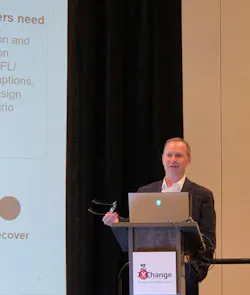
In a separate breakout, Brian Hearst, managing director of Aon Global Risk Consultants, addressed how the growing complexity and value of data center developments are reshaping insurance underwriting and recovery planning.
Long equipment lead times can magnify the financial consequences of even relatively contained incidents, particularly when damaged electrical equipment requires a year or longer to replace.
Hearst also highlighted the growing importance of location-specific catastrophe exposure, onsite power infrastructure, liquid cooling risks and the challenges of insuring campuses that transition into operation in multiple phases.
He described lifecycle insurance arrangements designed to provide continuity between builder's risk coverage and operational property insurance, reducing potential coverage disputes when some portions of a campus are operating while others remain under construction.
Both breakouts underscored how resilience must be considered across the entire infrastructure lifecycle, including systems and exposures that may receive comparatively little attention during initial project planning.
The Intersection of AI and Traditional Infrastructure
Taken together, Monday's presentations demonstrated that the intersection of AI and traditional data centers is producing challenges that extend well beyond the familiar subjects of density, cooling capacity and electrical demand.
AI agents are introducing new workload characteristics and infrastructure requirements. Power systems must accommodate increasingly dynamic computing loads. Grid operators are reassessing the obligations of facilities whose collective electrical behavior can influence regional reliability.
Meanwhile, developers are confronting a more skeptical public, and operators must account for increasingly complex mechanical, operational and financial risks.
The industry's traditional commitment to uptime remains essential. But as data centers expand into infrastructure measured in gigawatts rather than megawatts, the definition of reliability is widening.
It now encompasses not only whether an individual facility can maintain continuous operations, but also how that facility behaves within the electrical grid, the surrounding community and the broader systems on which its operations depend.
For the data center industry, the next phase of AI infrastructure development may depend as much on adapting those established practices as on deploying the next generation of computing technology.
At Data Center Frontier, we talk the industry talk and walk the industry walk. In that spirit, DCF Staff members may occasionally use AI tools to assist with content.
Keep pace with the fast-moving world of data centers and cloud computing by connecting with Data Center Frontier on LinkedIn, following us on X/Twitter and Facebook, as well as on BlueSky, and signing up for our weekly newsletters using the form below.
About the Author
 Matt Vincent
Matt Vincent is Editor in Chief of Data Center Frontier, where he leads editorial strategy and coverage focused on the infrastructure powering cloud computing, artificial intelligence, and the digital economy. A veteran B2B technology journalist with more than two decades of experience, Vincent specializes in the intersection of data centers, power, cooling, and emerging AI-era infrastructure. Since assuming the EIC role in 2023, he has helped guide Data Center Frontier’s coverage of the industry’s transition into the gigawatt-scale AI era, with a focus on hyperscale development, behind-the-meter power strategies, liquid cooling architectures, and the evolving energy demands of high-density compute, while working closely with the Digital Infrastructure Group at Endeavor Business Media to expand the brand’s analytical and multimedia footprint. Vincent also hosts The Data Center Frontier Show podcast, where he interviews industry leaders across hyperscale, colocation, utilities, and the data center supply chain to examine the technologies and business models reshaping digital infrastructure. Since its inception he serves as Head of Content for the Data Center Frontier Trends Summit. Before becoming Editor in Chief, he served in multiple senior editorial roles across Endeavor Business Media’s digital infrastructure portfolio, with coverage spanning data centers and hyperscale infrastructure, structured cabling and networking, telecom and datacom, IP physical security, and wireless and Pro AV markets. He began his career in 2005 within PennWell’s Advanced Technology Division and later held senior editorial positions supporting brands such as Cabling Installation & Maintenance, Lightwave Online, Broadband Technology Report, and Smart Buildings Technology. Vincent is a frequent moderator, interviewer, and keynote speaker at industry events including the HPC Forum, where he delivers forward-looking analysis on how AI and high-performance computing are reshaping digital infrastructure. He graduated with honors from Indiana University Bloomington with a B.A. in English Literature and Creative Writing and lives in southern New Hampshire with his family, remaining an active musician in his spare time.
Voices of the Industry
 Source: Shutterstock, courtesy of nVent Data Solutions