Nomads at the Frontier: PTC 2026 Signals the Digital Infrastructure Industry’s Moment of Execution
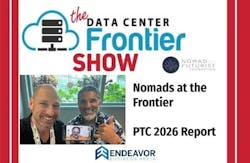




Each January, the Pacific Telecommunications Council conference serves as a barometer for where digital infrastructure is headed next.
And according to Nomad Futurist founders Nabeel Mahmood and Phillip Koblence, the message from PTC 2026 was unmistakable:
The industry has moved beyond hype. The hard work has begun.
In the latest episode of The DCF Show Podcast, part of our ongoing 'Nomads at the Frontier' series, Mahmood and Koblence joined Data Center Frontier to unpack the tone shift emerging across the AI and data center ecosystem.
Attendance continues to grow year over year. Conversations remain energetic. But the character of those conversations has changed.
As Mahmood put it:
“The hype that the market started to see is actually resulting a bit more into actions now, and those conversations are resulting into some good progress.”
The difference from prior years? Less speculation. More execution.
From Data Center Cowboys to Real Deployments
Koblence offered perhaps the sharpest contrast between PTC conversations in 2024 and those in 2026.
Two years ago, many projects felt speculative.
Today, developers are arriving with secured power, customers, and construction underway.
“If 2024’s PTC was data center cowboys — sites that in someone’s mind could be a data center — this year was: show me the money, show me the power, give me accurate timelines.”
In other words, the market is no longer rewarding hypothetical capacity.
It is demanding delivered capacity.
Operators now speak in terms of deployments already underway, not aspirational campuses still waiting on permits and power commitments.
And behind nearly every conversation sits the same gating factor.
Power.
Power Has Become the Industry’s Defining Constraint
Whether discussions centered on AI factories, investment capital, or campus expansion, Mahmood and Koblence noted that every conversation eventually returned to energy availability.
“All of those questions are power,” Koblence said. “Whether it’s investment or AI factories, ultimately it’s all power.”
Mahmood emphasized that sustainability discussions have also matured beyond marketing language:
“Power and sustainability are now central business issues. Discussions have shifted from if we should talk about energy and carbon impacts to how we build infrastructure that balances growth with sustainability and grid realities.”
Even ambitious government targets - including talk of hundreds of gigawatts of future power development - raise a key practical question:
When will power actually be accessible for data center deployment?
For builders racing to meet AI demand, future generation capacity matters less than near-term deliverability.
And that reality is reshaping power strategy.
Behind-the-Meter Power Moves from Backup to Primary Strategy
One of the biggest tone shifts at PTC involved attitudes toward grid connections.
Until recently, developers insisted on immediate or near-term utility interconnection before committing to sites. Behind-the-meter generation was seen as temporary.
That assumption is now fading.
Koblence explained:
“The requirement for a grid connection anytime soon has kind of been pushed off to the side… The grid bureaucracy is the long pole in the tent.”
Instead, operators are increasingly treating behind-the-meter generation as a viable medium-term solution, supported by contractual SLAs rather than waiting indefinitely for transmission upgrades.
“Behind-the-meter solutions… are likely the only path to getting online in the medium term.”
Natural gas remains dominant, but alternatives are emerging, including fuel cells and hydrogen solutions, though scale and location constraints persist.
Still, sustainability concerns remain unresolved.
Sustainability: Still the Can Kicked Down the Road?
While sustainability is widely discussed, Koblence cautioned that economic pressures often override environmental priorities.
“In general, sustainability is always going to be the can that’s kicked down the road.”
However, Mahmood argued that the industry cannot afford complacency:
“We need to put sustainability at the forefront because the long-term implications could be catastrophic.”
Longer-term nuclear solutions may ultimately help, but deployment timelines remain decades away. Meanwhile, builders face immediate demand pressures.
The challenge remains balancing growth, profitability, and environmental responsibility.
Workforce and Community: The License to Build
Power is not the only constraint.
Communities increasingly influence whether projects proceed at all.
Mahmood and Koblence stressed that workforce development and community engagement are deeply connected.
Digital infrastructure is no longer invisible. Communities now debate data center development at town meetings, often without understanding the industry’s economic or workforce implications.
Koblence shared a personal example:
“My sister lives outside Richmond… and for the first time in 30 years she called me asking what I do because data centers were being discussed at a community board meeting.”
Nomad Futurist aims to bridge this gap by demystifying the industry and connecting communities to career opportunities within it.
Their Mana Hui gathering during PTC underscored the growing intentionality around engaging the next generation.
The industry, once hidden infrastructure, now sits in public view.
That visibility requires new advocacy.
The AI Bubble? Yes — But Not Like 2000
The conversation inevitably turned to whether AI infrastructure growth is sustainable.
Mahmood believes today’s AI surge represents a bubble — but not a catastrophic one.
“It is a bubble and it’s going to burst, but not like the dot-com era.”
Instead, growth is expected to normalize rather than collapse, shifting from massive training campuses toward inferencing closer to users.
“We’re going to see growth in inferencing closer to the user… but the sector will still see double-digit growth over the next decade.”
Some projects will underperform expectations. But digital infrastructure demand itself continues rising.
The challenge shifts from speculation to disciplined execution.
Nvidia, Compute Density, and the Reality Gap
The conversation also tackled Nvidia’s rapid hardware progression and claims around megawatt-scale racks.
Mahmood acknowledged innovation but urged realism:
“We’ve moved from kilowatts to potentially megawatts of compute in a rack. That’s amazing. But what is real and what is practical?”
Industry average densities still hover around 15–20 kW per rack globally. Facilities capable of supporting megawatt racks at scale simply do not exist today.
Koblence put it bluntly:
“There are zero facilities that exist today that can handle a one or one-and-a-half megawatt rack. Zero.”
Most campuses coming online over the next two years are designed around current-generation hardware, not speculative future densities.
Innovation is moving quickly. Deployment reality moves slower.
The Bottom Line: Execution Era Begins
PTC 2026 revealed an industry entering its execution phase.
Capital is committed. Projects are underway. But the constraints are now real:
• Power deliverability
• Workforce shortages
• Community acceptance
• Sustainability tradeoffs
• Deployment realism
The digital infrastructure industry has stepped into the spotlight. Now it must deliver responsibly at unprecedented scale.
As Mahmood concluded, the stakes are larger than quarterly returns:
“If we won’t have this planet in 20 or 30 years, then there’s no money to be made.”
Execution now matters more than hype.
And 2026 may be remembered as the year the AI infrastructure boom moved from speculation to accountability.
At Data Center Frontier, we talk the industry talk and walk the industry walk. In that spirit, DCF Staff members may occasionally use AI tools to assist with content. Elements of this article were created with help from OpenAI's GPT5.
Keep pace with the fast-moving world of data centers and cloud computing by connecting with Data Center Frontier on LinkedIn, following us on X/Twitter and Facebook, as well as on BlueSky, and signing up for our weekly newsletters using the form below.
About the Author
 Matt Vincent
Matt Vincent
Matt Vincent is Editor in Chief of Data Center Frontier, where he leads editorial strategy and coverage focused on the infrastructure powering cloud computing, artificial intelligence, and the digital economy. A veteran B2B technology journalist with more than two decades of experience, Vincent specializes in the intersection of data centers, power, cooling, and emerging AI-era infrastructure. Since assuming the EIC role in 2023, he has helped guide Data Center Frontier’s coverage of the industry’s transition into the gigawatt-scale AI era, with a focus on hyperscale development, behind-the-meter power strategies, liquid cooling architectures, and the evolving energy demands of high-density compute, while working closely with the Digital Infrastructure Group at Endeavor Business Media to expand the brand’s analytical and multimedia footprint. Vincent also hosts The Data Center Frontier Show podcast, where he interviews industry leaders across hyperscale, colocation, utilities, and the data center supply chain to examine the technologies and business models reshaping digital infrastructure. Since its inception he serves as Head of Content for the Data Center Frontier Trends Summit. Before becoming Editor in Chief, he served in multiple senior editorial roles across Endeavor Business Media’s digital infrastructure portfolio, with coverage spanning data centers and hyperscale infrastructure, structured cabling and networking, telecom and datacom, IP physical security, and wireless and Pro AV markets. He began his career in 2005 within PennWell’s Advanced Technology Division and later held senior editorial positions supporting brands such as Cabling Installation & Maintenance, Lightwave Online, Broadband Technology Report, and Smart Buildings Technology. Vincent is a frequent moderator, interviewer, and keynote speaker at industry events including the HPC Forum, where he delivers forward-looking analysis on how AI and high-performance computing are reshaping digital infrastructure. He graduated with honors from Indiana University Bloomington with a B.A. in English Literature and Creative Writing and lives in southern New Hampshire with his family, remaining an active musician in his spare time.
Voices of the Industry
 Image courtesy of Midea Building Technologies
 Adobe Stock image courtesy of Hitachi Energy