Sabey Data Centers Building for the Future on Both Coasts
ASHBURN, Va. – As you walk through the long corridors and equipment rooms of Building C at Sabey Data Centers’ Intergate.Ashburn campus, you encounter the sturdy infrastructure that drives home Sabey’s motto: “Serious Data Centers for Serious Business.”
Sabey is serious about the future as well. Long known for its focus on engineering and efficient data centers, Seattle-based Sabey intends to be a player in the hunt for huge hyperscale deals here in Northern Virginia’s in Data Center Alley, the world’s largest cloud computing cluster.
Those ambitions are visible as you look across the parking lot at the facade of Building B, an even larger data center that will offer up to 22.8 megawatts of capacity for servers and data storage for the world’s largest technology companies.
The progress at Intergate.Ashburn is the latest chapter in the growth story for Sabey Data Centers, which now operates more than 3 million square feet of data center space across the U.S., including campuses in Ashburn, Manhattan and three sites across the Pacific Northwest. The company is in expansion mode, adding capacity across its footprint.
“Sabey is still a private data center company in a world of public behemoths,” said Rob Rockwood, President of Sabey Data Centers. “We know how to do medium-to-large size deals in our data centers, and stay one data hall ahead of demand. We know what it costs, and we know how to deliver it.”
An Early Player in Data Center Development
Sabey is one of the industry’s most experienced players, with more than 25 years of experience in the data center business. The company initially focused on commercial development, including office and industrial space for major Seattle corporations like Boeing and Starbucks. Sabey then diversified into data center real estate, as well as technical facilities for life sciences and healthcare.
Sabey Data Centers is a joint venture between Sabey Corporation and National Real Estate Advisors. The company’s real estate portfolio is anchored by data center campuses in Washington State, including the Intergate.East and Intergate.West developments in the Seattle suburb of Tukwila, the Intergate.Columbia project in Wenatchee, and the Intergate.Quincy project.
A differentiator for Sabey, according to Rockwood, is that it offers full integration of design/build capabilities through Sabey Construction Inc. (SCI), which has built more than 30 million square feet of commercial property for the military, aeronautic, healthcare and data center industries.
“I believe we are the only data center company with its own construction arm,” said Rockwood. “For customers, it means we can deliver on their capacity cycles. We believe we are more likely than our competitors to deliver on time.”
Looking East for Expansion
Sabey has long been Seattle’s hometown data center provider. Its Tukwila operation features eight data centers housed on two campuses spanning nearly 1.4 million square feet of data center space. It has built several data centers in the central Washington towns of Quincy and Wenatchee, taking advantage of cheap hydroelectric power and ideal conditions for fresh air cooling.
In 2010 Sabey expanded east, acquiring the former Verizon building at 375 Pearl Street in lower Manhattan, which it is developing as a mixed-use asset with both office and data center tenants. It also bought land in Ashburn in 2011, but only began developing the Intergate.Ashburn campus in 2016. The first building (Building C) opened in 2017, and Sabey began working on Building B last year. It has enough land to build a third facility with the same design as Building B, which would give the campus a total of 900,000 square feet of data centers.
The nature of the Ashburn market has led to some adjustments in design. Building C, the first phase at Intergate.Ashburn, offered 7.2 megawatts of capacity across four data halls, each sized at 12,000 square feet and 1.8 megawatts of capacity.
In 2018 hyperscale deals helped data center operators lease 270 megawatts of capacity in Northern Virginia, more than doubling the region’s previous record for annual absorption. With marquess cloud customers seeking much larger chunks of capacity,
Sabey adapted its design for Building B, a two-story facility which will feature eight data halls, each sized at 21,000 square feet and 2.85 megawatts, for a total of 22.8 megawatts of capacity.
The new Building B at Sabey Data Centers’ Intergate.Ashburn campus in Northern Virginia. (Photo: Rich Miller)
Although Sabey will compete on hyperscale deals, it remains focused on enterprise customers, who also require space in the cloud-focused Northern Virginia market.
“This is a hyperscale demand market, but it’s not just a hyperscale market,” said Rockwood. “We continue to do medium-sized deals. What we care about is our market share. As long as the market is growing, we’ll be fine keeping our share. We can’t build fast enough to win every deal.”
“In the last year, the transaction volume wasn’t high, although the size of the transactions were astronomical,” said Cameron Richardson, the Director of Leasing at Sabey Data Centers. “The transaction volume in the enterprise customers came back in the second half of the year.”
Sabey’s facilities at Intergate.Ashburn feature a slab design rather than a raised floor, with air handlers on the roof feeding a data hall filled with cabinets using hot aisle containment. Customer office space is deployed around the exterior of the building. The Ashburn site is supported by a 300-megawatt substation featuring diverse power feeds from Dominion Virginia Power.
Clean, Cheap Energy and Lots of It
Even as it expands in new markets, Sabey Data Centers says that there’s no place like home.
“We’ll meet customers in New York and Ashburn,” said Rockwood. “But we believe the best place for the world to build data centers is with renewable power in the Pacific Northwest.”
“We believe the best place for the world to build data centers is with renewable power in the Pacific Northwest.”
Rob Rockwood, Sabey Data Centers
The company’s campuses in Quincy and Wenatchee take advantage of some of the lowest power prices in the country, supported by renewable hydro-electric power from dams on the Columbia River. Power prices run as low as 2.5 cents per kWh, which has also boosted interest in the region from bitcoin mining operations.
The region’s climate is ideal for data center cooling, supporting the use of fresh air economization (free cooling) that enables data centers to operate using less electricity. A number of data centers that operate at PUE (Power Usage Efficiency, a leading energy efficiency metric) of 1.1 to 1.2.
Last August Sabey began construction of a new data center in Wenatchee, which will provide 14.4 megawatts of mission critical power. Completion of Building D is scheduled for May. The campus already houses two data centers, which are commissioned and fully leased as powered shells, with five tenants on the campus.
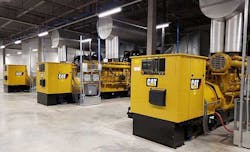
Inside a power room at Sabey Data Centers’ Intergate.Ashburn campus in Northern Virginia. (Photo: Rich Miller)
Sabey also has about 12 megawatts of space available in Quincy, a small farming town that became a surprise data center destination in 2008, when Microsoft built one of its largest cloud campuses in Quincy. Because of its cost and efficiency profile, many in the industry perceive Quincy as primarily a market for large single-tenant data centers, although Sabey operates a multi-tenant campus.
“I think Quincy is a big-deal hyperscale market,” said Rockwood. “It doesn’t get a lot of respect, since public-sector analysts don’t necessarily like low-cost solutions. I also think there’s a prejudice against it because it’s in the middle of nowhere.
“A lot of the customers that populate the multi-tenant building in Quincy, we met in Seattle.” Rockwood added. “They can operate in Quincy for half the cost of Seattle.”
In Seattle, Sabey is expanding its flagship SDC5 facility by 1.5 megawatts, adding a new generator and additional air handlers.
“Intergate.Seattle’s Building 5 is both a historical and on-going success story for our firm,” said Rockwood. “The property harkens back to our start, four decades ago, as the principal builder of ‘clean rooms’ for Boeing, to meet the demands of an aircraft industry that was becoming increasingly reliant on airborne automation hardware.
“After the implosion of many technology companies in the early 2000s, we received the building back through the bankruptcy of a large tech company with less than half of its 300,000 square feet of data center white space built-out and none of it fully commissioned,” Rockwood added. “We undertook the completion of the commissioning and have leased and managed it ever since.”
Hyperscale and the Need for Speed
One difference between the East and West coasts involves the speed with which hyperscale capacity is expected to be available.
“On the West Coast, that timeline is nine to 12 months,” said Rockwood. “In Ashburn, it’s three to 6 months. That means you have to have the resources to build a shell.”
That was one of the factors in Sabey’s decision in 2017 to arrange $250 million in financing to support new construction so it could have product ready for timely delivery in Ashburn. That’s an important factor in Data Center Alley, which is the industry’s most competitive market and seeing an influx of new players and new capital investors.
“The winners in the fight for hyperscale will have to demonstrate they are a seamless component in the hyperscale player’s process,” said Rockwood. “A bigger part of that process is being able to express SLAs (service level agreements) and security and day-to-day functioning. The new participants don’t have any experience of providing this expertise.”
As it works to add customers, Sabey recently had an unexpected opportunity to fill its space. As Christmas holiday season approached, Sabey worked with the local Marine Corps League to provide heated indoor storage that was urgently needed for the League’s annual Toys for Tots campaign.
“As late as Thanksgiving, we were still seeking at least 10,000 to 12,000 square feet of space as an operational warehouse for the thousands of toys being collected throughout the area,” said Rita Sartori, who assisted her husband, former Marine Frank Holtz, in coordinating the Toys for Tots campaign. “Finally, right around Thanksgiving Day we were put in touch with Sabey to discuss our needs and our program.”
The League worked with Michael Whitlock, Sabey’s Business Development & Operations Manager, to enable the Intergate.Ashburn security staff to maintain the data center’s high level of security while accommodating the Toys for Tots volunteers and storing 25,000 toys.
“It gave us a chance to show our community we’re not just this big building,” said Whitlock.
About the Author
 Rich Miller