TeraWulf’s Lake Mariner Campus: How a Retired Coal Plant Became an AI Factory Prototype
Key Highlights
- TeraWulf is transforming former coal plants into AI campuses by utilizing existing transmission lines and renewable energy sources, reducing capital expenditure and deployment time.
- The integration of power, cooling, and monitoring systems creates a cohesive infrastructure that supports high-density AI deployments with flexibility and resilience.
- Industrial reuse of brownfield sites offers a practical solution to power access challenges, enabling faster deployment and supporting the growth of AI and HPC workloads.
- Partnerships with companies like Schneider Electric and Motivair facilitate the development of scalable, efficient, and digitally monitored AI infrastructure.
- Strategic planning, prefabrication, and local labor utilization are key to managing large-scale AI infrastructure projects efficiently and sustainably.
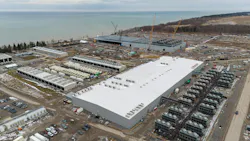
BARKER, N.Y. — Twenty-four hours before stepping onto TeraWulf's Lake Mariner campus, journalists at Schneider Electric's global press event were walking a very different kind of floor.
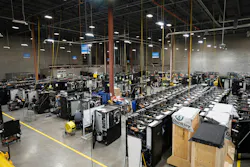
Inside Motivair's Buffalo manufacturing facility, reporters were brought directly into production areas where technicians were assembling liquid cooling infrastructure increasingly central to the AI era — coolant distribution units, heat exchangers, and cooling systems designed for high-density deployments.
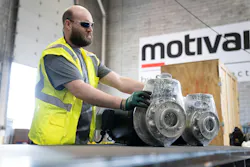
The visit provided a physical reminder that AI infrastructure growth is now extending far beyond data center campuses themselves. Factories producing power equipment and liquid cooling hardware are becoming strategic assets in their own right.
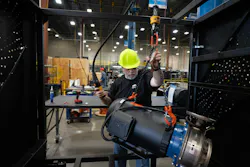
Motivair’s Buffalo-based manufacturing expansion now serves as the high-capacity thermal engine for Schneider Electric’s aggressive push into domestic liquid cooling production. Central to this strategy is the rapid scaling of megawatt-class cooling technologies, including its MCDU family of Coolant Distribution Units ranging from 105 kW systems to specifically the recently launched 2.5 MW MCDU-70 platform, which directly addresses the thermal load requirements of next-generation AI factories.
By integrating Motivair’s mission-critical CDUs with its established ChilledDoor rear-door heat exchanger line, Schneider is positioning itself to provide a unified, end-to-end cooling ecosystem for increasingly dense AI environments. For operators struggling with the power-constrained reality of modern hyperscale development, this expansion signals a vital shift toward industrial-scale, high-density cooling capable of supporting the massive power footprints required by today’s most intensive AI workloads.
The following day, the press caravan moved north along Lake Ontario toward Barker, New York, where many of those same technologies are now being deployed at scale.
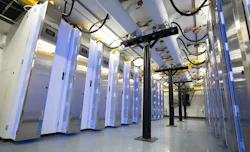
And at Lake Mariner, the larger picture came into focus.
Because TeraWulf is not simply building a data center.
It is attempting to build a new operating model around energy infrastructure itself.
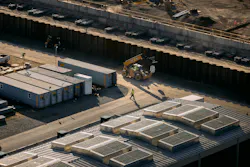
A Coal Plant Becomes an AI Campus
The transformation of Lake Mariner is happening rapidly.
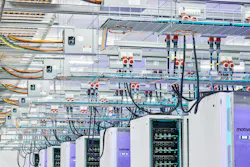
Schneider Electric and Motivair have now completed phased delivery of more than $290 million in AI infrastructure solutions at the campus, which ultimately is expected to support as much as 750 MW of power capacity serving AI and HPC workloads. The site includes long-term commitments from anchor tenants Core42 and Fluidstack, which is backed by Google.
For DCF readers, the equipment list itself tells an important story.
TeraWulf's deployment includes:
- Schneider Electric Galaxy VX UPS systems
- Schneider Electric Galaxy lithium-ion battery systems
- Motivair Coolant Distribution Units (CDUs)
- Motivair In-Rack Manifolds
- Motivair ChilledDoor rear-door heat exchangers
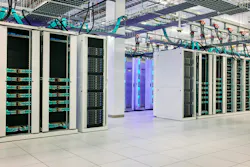
- Schneider Electric NetShelter racks and enclosures
- Schneider Electric EcoStruxure IT Data Center Expert monitoring software
- Motivair client services and lifecycle support
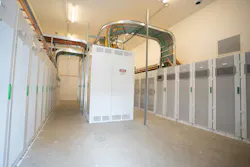
This is effectively an integrated power-and-cooling stack built around high-density AI deployments rather than a collection of standalone products.
The systems themselves are also increasingly interdependent. Liquid cooling equipment once considered specialized technology now sits much closer to the center of facility design.
“To Simply Strand It Would Have Been a Disservice”
For Terawulf COO and CTO Nazar Khan, however, the most important infrastructure at Lake Mariner may be infrastructure that already existed.
“This was a power plant site,” Khan told Data Center Frontier during the tour. “We acquired it in 2016 with a commitment to retire the coal-fired generation and repurpose the facility.”
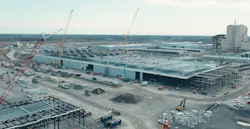
The plant retired in 2020.
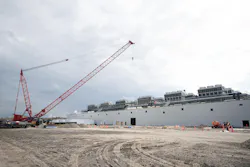
What remained was something becoming increasingly difficult to replicate anywhere in the United States: industrial-scale transmission infrastructure already in place.
The campus sits adjacent to two 345-kV transmission lines that form part of the backbone of New York's grid and benefits from connections to Niagara hydroelectric resources and imported Quebec hydropower.
“You already had New York ratepayers who funded this infrastructure over decades,” Khan said.
“To simply strand it would have been a disservice.”
Brownfields Become AI Infrastructure
During the tour, Khan repeatedly returned to a central thesis now emerging across portions of the AI infrastructure market: the next generation of AI infrastructure may increasingly depend on industrial reuse.
Rather than pursuing greenfield sites and building entirely new transmission systems, TeraWulf has focused on locations that previously generated or consumed enormous amounts of electricity.
“We focus on brownfield industrial sites that either produced power or consumed large quantities of power,” Khan explained. “Those sites already have the transmission, the substations, the switching infrastructure, the industrial zoning, and typically the local support for continued industrial use.”
That distinction matters.
As AI deployments accelerate nationally, power availability increasingly determines where data centers can actually be built. Across many markets, the challenge is no longer identifying land parcels or raising capital. It is securing transmission access and avoiding multiyear utility interconnection timelines.
For Khan, Lake Mariner represents a practical answer.
The site's existing transmission assets, combined with the New York grid's approximately 89% zero-carbon generation mix and nearby hydro resources, create conditions that are increasingly difficult to replicate from scratch.
Khan pointed to another TeraWulf project in Kentucky centered on a former aluminum smelter facility.
“For forty years that facility consumed roughly 480 megawatts continuously,” Khan said. “It already had five independent transmission lines for redundancy.”
The implication was obvious.
“If you tried to recreate that infrastructure today, the capital expenditure would be enormous.”
That line of thinking increasingly echoes conversations occurring across the wider AI infrastructure market, where retired coal facilities, heavy industrial campuses and manufacturing sites are drawing new interest from developers searching for existing power capacity.
The infrastructure backbone of twentieth-century industry may become an important foundation for twenty-first century AI growth.
From Merchant Power to AI Factories
Khan's view of AI infrastructure is rooted in an energy perspective rather than a conventional real estate perspective.
He described how deregulation in the 1980s and 1990s fundamentally reshaped power markets by separating generation from transmission ownership and changing how electricity was monetized.
By 2018, he said, TeraWulf's leadership concluded that wholesale electricity generation by itself no longer created enough value.
“We sold roughly 5,000 megawatts of generation assets because we didn't think wholesale power markets alone worked,” Khan said.
Instead, the company began looking for ways to pair energy production directly with large computational loads.
“We became interested in the intersection of energy and data,” Khan said. “The objective was synchronizing power with a specific load.”
Initially, traditional data centers did not fit.
“At that point data centers were maybe forty-megawatt facilities with dozens of customers,” Khan recalled. “That wasn't aligned with a power plant serving essentially one customer.”
Bitcoin mining changed that equation.
TeraWulf began viewing computation itself as an output commodity.
“You use local power to create data — Bitcoin hash — and that becomes a globally traded commodity,” Khan explained.
The model also introduced flexibility.
“When power prices are low, you run. When power prices are high, you shut down.”
According to Khan, the company's operations achieved greater than 98% uptime while still maintaining the ability to reduce demand during periods of grid stress.
Today he sees AI and HPC as a continuation of the same logic.
“The AI and HPC opportunity is really a natural extension of that model.”
Data Centers as Grid Resources
One of the more notable themes emerging from the discussion involved TeraWulf's view of data centers not simply as consumers of electricity, but potentially as operational assets to the grid itself.
Traditionally, data centers have been viewed as static loads — facilities drawing increasingly large quantities of power with limited flexibility.
Khan sees the relationship differently.
“These loads can actually become a resource back to the grid,” he said.
The idea is becoming increasingly relevant as utilities, regulators and hyperscalers confront the implications of gigawatt-scale AI campuses.
Intelligently managed loads could potentially reduce demand during periods of stress while operating at full capacity when conditions allow.
That capability depends heavily on integrated monitoring, power systems and controls.
At Lake Mariner, Schneider Electric's EcoStruxure IT Data Center Expert platform provides operational monitoring and digital intelligence capabilities across the deployment, while Motivair services are intended to optimize cooling performance and minimize operational risk.
Schneider framed the broader partnership as an example of a changing AI infrastructure model.
“As demand for AI infrastructure accelerates, 'time to power' has become a defining constraint on growth,” said Manish Kumar, Executive Vice President, Secure Power & Data Centers at Schneider Electric.
“Our partnership with TeraWulf establishes a strategic blueprint for pairing on-site power, AI-enabled automation, advanced liquid cooling, and digital intelligence at a legacy industrial site.”
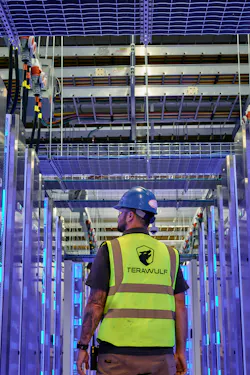
Coordinating an Industrial Machine
Khan argued that the larger challenge increasingly has less to do with designing individual buildings and more to do with coordinating enormous systems of labor, manufacturing and logistics.
“The hardest thing becomes coordinating equipment and people,” he said.
That challenge increasingly stretches beyond the boundaries of a single data center campus.
TeraWulf maintains rolling 12-to-18-month forecasts with suppliers like Schneider Electric in an effort to provide visibility into upcoming demand and avoid supply chain disruptions.
The strategy reflects a broader shift occurring throughout AI infrastructure markets.
Power systems, switchgear, liquid cooling systems, generators and mechanical equipment now increasingly require planning horizons that can stretch well beyond a year.
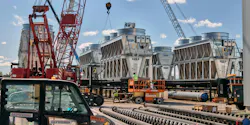
The company is also attempting to reduce onsite labor burdens through prefabrication and systems integration.
Khan described UPS systems being partially assembled offsite before arriving at the campus.
“You want as much work completed in controlled factory environments as possible,” he said.
The labor strategy extends further.
“We prioritize local labor that can drive to the site every day.”
The reasoning is partly practical.
Large traveling workforces create cost pressures and operational variability. Building around local labor can create more stable deployment conditions.
TeraWulf's phased growth strategy reflects those realities.
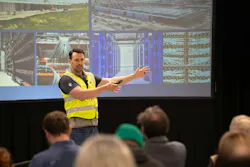
Rather than attempting hyperscale deployment all at once, Khan said the company targets roughly 250 MW to 500 MW of critical IT deployment annually.
“That scale is large enough to matter,” Khan said, “but realistic from both a supplier and labor standpoint.”
Beyond Lake Mariner
Lake Mariner increasingly appears to be less an isolated project than an early expression of TeraWulf's broader operating strategy.
The company is building around what it describes as an energy-first model — identifying large existing "load pockets" and industrial sites where transmission infrastructure and power capacity already exist, then pairing those assets with high-density computational workloads.
Khan pointed to TeraWulf's Kentucky initiative as another example of that thinking. The company recently acquired a former aluminum smelter site in Hawesville that had consumed approximately 480 MW of electricity continuously for decades.
The company's footprint now extends across multiple campuses and several gigawatts of potential capacity as TeraWulf pursues additional redevelopment opportunities involving former industrial and power-generation sites.
The Lake Mariner project also reflects the increasingly intertwined relationships emerging around large-scale AI infrastructure. The campus includes AI infrastructure provider Core42 as a tenant, while Fluidstack has become a major driver of expansion at the site. Google's financial backing of Fluidstack's Lake Mariner commitments further illustrates how capital, cloud ecosystems, infrastructure providers and energy assets are becoming tightly coupled in the race to deploy AI capacity at scale.
Increasingly, AI infrastructure development no longer looks like a single-company undertaking. It looks more like an ecosystem.
Rewiring the Future
Standing at Lake Mariner, what becomes increasingly clear is that this is not simply a story about a former coal plant becoming a data center campus.
It is a story about industrial systems changing purpose.
Much of the infrastructure supporting this AI campus was already here: the dual 345-kV transmission lines, substation assets, and the heavy electrical backbone originally built to move enormous quantities of energy across New York's grid. The industrial logic itself remains largely intact. Concentrate power in one place. Build the infrastructure to move it. Create something economically important around it.
What changed is the workload.
Where coal generation once supplied power outward to the grid, dense clusters of AI infrastructure and high-performance computing are increasingly becoming the new industrial load sitting behind those same electrical pathways.
For TeraWulf, that idea sits at the center of the Lake Mariner strategy.
“You already had New York ratepayers who funded this infrastructure over decades,” Khan said earlier during the tour. “To simply strand it would have been a disservice.” And the broader lesson from Lake Mariner may extend well beyond Barker, New York.
For much of the AI boom so far, discussion has centered on GPUs, model sizes, and eye-watering capital expenditures. But standing on a retired power plant site outside Buffalo, another reality comes into focus. AI infrastructure increasingly looks like an industrial coordination problem built around transmission corridors, cooling systems, manufacturing capacity, workforce availability, and decades-old energy assets that suddenly have new value.
Twenty years ago, the idea of turning a retired coal plant into an AI factory might have sounded improbable. Today it increasingly looks like a blueprint. The coal plant is gone but much of its infrastructure isn't. The wiring may be old, but what it powers next is something entirely different.
At Data Center Frontier, we talk the industry talk and walk the industry walk. In that spirit, DCF Staff members may occasionally use AI tools to assist with content. Elements of this article were created with help from OpenAI's GPT5.
Keep pace with the fast-moving world of data centers and cloud computing by connecting with Data Center Frontier on LinkedIn, following us on X/Twitter and Facebook, as well as on BlueSky, and signing up for our weekly newsletters using the form below.
About the Author
 Matt Vincent
Matt Vincent
Matt Vincent is Editor in Chief of Data Center Frontier, where he leads editorial strategy and coverage focused on the infrastructure powering cloud computing, artificial intelligence, and the digital economy. A veteran B2B technology journalist with more than two decades of experience, Vincent specializes in the intersection of data centers, power, cooling, and emerging AI-era infrastructure. Since assuming the EIC role in 2023, he has helped guide Data Center Frontier’s coverage of the industry’s transition into the gigawatt-scale AI era, with a focus on hyperscale development, behind-the-meter power strategies, liquid cooling architectures, and the evolving energy demands of high-density compute, while working closely with the Digital Infrastructure Group at Endeavor Business Media to expand the brand’s analytical and multimedia footprint. Vincent also hosts The Data Center Frontier Show podcast, where he interviews industry leaders across hyperscale, colocation, utilities, and the data center supply chain to examine the technologies and business models reshaping digital infrastructure. Since its inception he serves as Head of Content for the Data Center Frontier Trends Summit. Before becoming Editor in Chief, he served in multiple senior editorial roles across Endeavor Business Media’s digital infrastructure portfolio, with coverage spanning data centers and hyperscale infrastructure, structured cabling and networking, telecom and datacom, IP physical security, and wireless and Pro AV markets. He began his career in 2005 within PennWell’s Advanced Technology Division and later held senior editorial positions supporting brands such as Cabling Installation & Maintenance, Lightwave Online, Broadband Technology Report, and Smart Buildings Technology. Vincent is a frequent moderator, interviewer, and keynote speaker at industry events including the HPC Forum, where he delivers forward-looking analysis on how AI and high-performance computing are reshaping digital infrastructure. He graduated with honors from Indiana University Bloomington with a B.A. in English Literature and Creative Writing and lives in southern New Hampshire with his family, remaining an active musician in his spare time.
Related
Voices of the Industry
 Source: SNEHIT PHOTO/Shutterstock.com
 Source: Matthew G Eddy/Shutterstock.com