What Operators Get Wrong About Deploying Power Infrastructure
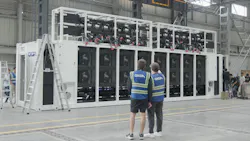

Every data center project has a moment when the rubber meets the road regarding timeline.
Someone goes to source the transformers and switchboards, runs the lead times, and realizes the equipment won't arrive in time. By that point, the design is done, and the site is committed. Your clock is already running, and you’re stuck.
I've watched this happen across some of the largest power infrastructure builds in the world. I've seen it at Google, at Tesla, and across the AI space. The engineering problems were never what stopped projects; it was the delivery system
AI infrastructure demands are compressing timelines, increasing power density, and stacking builds in parallel at a pace that legacy delivery models weren't designed to handle. Mistakes that used to cost weeks now cost months.
Here are the three I see most consistently.
Mistake 1: Starting procurement too late
The number one mistake I see operators make in AI data center builds is in their project sequencing. Many operators finalize their site design before sourcing their transformers and switchboards. That is backward.
By the time your design is finalized, your schedule is already committed. With equipment lead times running 30 weeks or more from legacy OEMs, waiting until after the design stage to source will have you pushing your schedules and leaving your GPUs sitting idle
The infrastructure conversation has to happen at the design table, not after it. Transformer lead times are a constraint that should be shaping vendor selection and sequencing from the first week of a project.
Mistake 2: Spreading the work across too many vendors
A standard data center build, following traditional processes, distributes the project across half a dozen different parties. Most builds involve suppliers for transformers and switchboards, general contractors, an engineering firm, a utility liaison, and other assorted roles. In this setup, each vendor or partner is accountable for their piece, but no one is accountable for the entire outcome.
Unfortunately, the gap between “we shipped it” and “it’s operational” is where projects are most likely to fall apart. In this traditional, fragmented model, that gap belongs to everyone, which means it’s covered by no one.
It also creates engineering handoff failures that are easy to miss until they're expensive. For example, you may have a spec that makes sense at the sales stage that gets interpreted differently by a manufacturer's engineering team. Rework follows, causing schedules to slip.
What operators need is a single partner with skin in the outcome, like Giga Energy.
At Giga Energy, we manufacture our own AI electrical infrastructure, develop and build the sites, and stay through commissioning and operations. There's no handoff where accountability disappears; one team owns the outcome from the first spec to the day the site goes live. Get in touch with our team if you’re interested in learning more.
Mistake 3: Failing to consider project economics
The lowest bid is rarely the lowest-cost project. If you choose equipment solely based on the quote, you’re missing some key elements that impact your overall project economics. Cheap equipment that arrives late or is mis-spec’d will cause you to miss your energization date, which is far more expensive in the long run. You should also consider the cost of downtime and troubleshooting that may happen if something goes wrong post-delivery and your OEM is unreachable.
For a GPU cloud operator with contracted commitments, a one-month slip means tens of millions in deferred revenue. The infrastructure decision that looked conservative on paper becomes the most expensive line item on the project the moment it costs you your timeline.
Price is an input. It shouldn't be the scorecard. Before you choose a partner, you should know how they perform on lead-time reliability, how flexible their engineering team is when your project requirements change, and whether anyone picks up the phone after the equipment ships.
The common thread between the biggest mistakes in power infrastructure deployment
Avoiding the three mistakes in this post will help your data center build go more smoothly, and, ultimately, all three mistakes have the same root cause. Many operators treat power infrastructure as a commodity-procurement challenge, but the reality is that it’s a systems-integration challenge.
Commodity thinking leads to late procurement, fragmented vendor relationships, and decisions based solely on unit cost. Systems thinking leads to a partner who owns the full process.
That's the model I joined Giga to scale. Vertically integrated manufacturing, in-house engineering, and end-to-end accountability. With all those elements in play, we can stand up a new greenfield data center in nine months.
If you're planning a deployment and have a hard deadline for energization, get in touch with our team and see how we can help you meet your timelines.
About the Author
 Angad Sandhu
Angad Sandhu
Angad Sandhu is CTO of Giga Energy. He previously led data center engineering at Google through the cloud-to-AI transition and has spent 15+ years delivering power infrastructure at scale. He joined Giga Energy in 2026 to help build a faster, more accountable model for AI infrastructure deployment.
Related
Voices of the Industry
 Source: Adobe Stock, courtesy of ebm-papst
 Source: Champion Fiberglass