Designing for Greenfield, Brownfield, and Operational Reality
This concludes our article series on practical approaches for building scalable, AI-ready environments. This week, we’ll examine designing for greenfield, brownfield and operational reality.
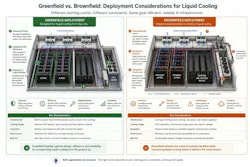
The most elegant cooling architecture on paper still has to work inside real facilities. That means different strategies for greenfield builds, brownfield retrofits, phased deployments, and live production environments.
In greenfield environments, operators have the opportunity to design for hybrid cooling from the beginning. That can include dedicated AI pods, planned CDU locations, structural support for heavier racks, liquid distribution pathways, service corridors, and coordinated airside and waterside controls. This is the ideal design condition because the facility can be shaped around the thermal profile of the workload.
Brownfield environments are more complicated, but they may also be where the greatest near-term opportunity exists. Existing floor layouts, pipe routing, ceiling heights, structural loading, power distribution, and maintenance access can constrain how liquid cooling is deployed. In these environments, the goal is rarely to redesign everything at once. The more practical path is often phased modernization that adds capacity where it is needed while preserving infrastructure that still has useful life.
For hyperscale and colocation operators, retrofitting is not just a facilities upgrade. It is a live-operations challenge. The objective is to increase capacity without undermining uptime, customer SLAs, or day-to-day service access. Modular, phased retrofit strategies can be deployed alongside existing infrastructure, using targeted liquid-cooled zones, supplemental chilled-water paths, new CDUs, controls integration, and airflow optimization rather than a disruptive rip-and-replace.
Trane’s lifecycle lens is particularly relevant here. A retrofit can address an immediate density issue while also supporting modernization, asset life extension, capital efficiency, and a longer-term roadmap toward a hybrid thermal architecture. Depending on the site, that path may involve traditional onsite construction, prefabricated or modular infrastructure, or a combination of both.
A practical brownfield cooling strategy should typically answer five questions:
- Where are the highest-density workloads located today, and where will they move next?
- Can existing airside systems support residual heat after liquid cooling is introduced?
- Where should coolant distribution infrastructure, manifolds, piping, and service access be located to support maintainability without disrupting operations?
- How will teams monitor, maintain, and operate the hybrid environment after deployment?
- What commissioning, service, and controls handoffs are needed to maintain SLA commitments once the retrofit is live?
A practical AI cooling strategy also needs to account for operational staffing realities. Uptime Institute research continues to identify staffing shortages, operational complexity, and skills gaps as growing concerns across the data center industry, particularly as facilities become more dependent on tightly integrated power and cooling systems. That makes operational simplicity more than a design preference. It is increasingly a reliability requirement.
Final Thoughts: Designing for What Comes Next
The data center industry is entering a new phase where AI and high-performance workloads are reshaping infrastructure requirements in real time. Density, power, and thermal demands are rising rapidly, making cooling an increasingly important factor in how facilities scale, operate, and protect the investments already in place.
Air cooling remains a foundational part of the modern data center, but many operators are now adopting more integrated thermal strategies that combine air and liquid cooling to support higher-density environments. As workloads intensify, cooling is evolving from a supporting utility into a more engineered, workload-aware system.
Liquid cooling has become an increasingly practical approach for managing high-density AI deployments, particularly within hybrid architectures that balance air and liquid systems together. At the same time, organizations must navigate new considerations around system integration, water management, deployment planning, controls, and operational readiness, often while maintaining uptime in live production environments.
The opportunity is especially important in brownfield environments. A hybrid strategy can help operators use existing investments more effectively, add liquid cooling where density requires it, and build a modernization path that protects uptime and capital efficiency.
That is where Trane’s differentiation matters in a practical way: combining airside and waterside expertise, controls, digital insight, commissioning rigor, and global lifecycle service with LiquidStack’s modular liquid cooling capabilities. The goal is not to sell a single cooling answer. It is to help operators choose the right architecture for the facility they have and the AI roadmap they are building.
Call to Action: Building Toward AI Readiness
For data center operators, the path forward begins with clarity and intent:
- Understand Your Trajectory: Evaluate where your infrastructure stands today and where it needs to be. AI workloads will continue to drive higher densities and more concentrated heat loads.
- Partner with Thermal Systems Experts to Define Your Cooling Strategy: Determine how and where liquid cooling fits into your environment. The right approach will depend on your workloads, facility design, and long-term growth plans.
- Design for Hybrid Reality: Most environments will not transition overnight. Building a strategy that integrates air and liquid cooling is critical for both new deployments and existing facilities.
- Treat Retrofits as Lifecycle Modernization: In existing facilities, plan for phased deployment, asset life extension, and live-operations risk management rather than disruptive rip-and-replace projects.
- Plan for Operational Readiness: Cooling is no longer just about equipment. It requires processes, visibility, controls, training, and expertise to ensure long-term reliability and performance.
- Connect Controls, Digital Visibility, and Service: Intelligent monitoring is most valuable when it is tied to commissioning rigor, expert analysis, training, and maintenance actions that protect uptime.
The direction of the industry is becoming increasingly clear. AI workloads will continue to push density and thermal intensity higher, but the path forward will not look the same in every facility. Some environments will rely on optimized airflow, others will adopt targeted liquid cooling, and many will operate hybrid architectures for years.
Download the full report, Why AI is Forcing a Rethink of Data Center Cooling Design, featuring Trane, for exclusive content, including best practices for integrating liquid cooling into existing facilities.
About the Author
 Bill Kleyman
Related
 Source: Image courtesy of Trane
 Image courtesy of Trane
Voices of the Industry
 Source: 3DAnimals/Shutterstock.com
 Source: Rob Byron/Shutterstock.com