Designing Cooling for the AI Data Center

We continue our article series on practical approaches for building scalable, AI-ready environments. This week, we’ll outline key design implications when integrating liquid cooling into a broader, resilient, hybrid operating model.
AI and high-performance computing are reshaping the thermal profile of the modern data center. Today’s workloads concentrate far more power into smaller footprints, creating heat patterns that are more intense and dynamic than traditional enterprise environments were designed to support.
As density rises, cooling becomes a more active design consideration. Airflow stability, environmental control, and thermal consistency now play a direct role in system reliability, efficiency, and long-term operational performance. In many high-density AI environments, operators are increasingly combining air and liquid cooling approaches to support evolving workload demands.
This transition introduces several new infrastructure priorities:
- More integrated hybrid cooling architectures.
- Greater focus on water quality, loop design, and serviceability.
- Increased operational visibility through centralized controls and monitoring.
- Modular deployment strategies that simplify scaling and future expansion.
That system-level mindset is where Trane helps shape a practical path forward. The combined approach centers on hybrid thermal architectures that match cooling methods to workload density, facility readiness, and long-term growth plans.
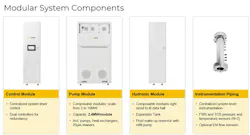
A strong example is the GigaModular™ platform, which is designed as a centralized modular liquid cooling platform built around coordinated pump, hydronic, control, and instrumentation modules. Rather than simply increasing CDU capacity, it enables operators to scale complete thermal infrastructure using a standardized, pay-as-you-grow architecture. LiquidStack positions GigaModular as a platform, not a product, delivering system-level scalability from 2.5 MW to 14 MW through centralized controls and factory-tested modular infrastructure.
The broader goal is to create repeatable, serviceable thermal systems that can evolve alongside AI environments without forcing oversized day-one infrastructure. Designing for AI ultimately requires a shift in mindset. Cooling must be engineered as an integrated system that supports both current workloads and future growth while remaining operationally practical at scale.
From Components to Integrated Cooling Systems
Industry research from Uptime Institute and Omdia shows rack density growth accelerating rapidly across AI and HPC environments, with many operators now planning for sustained deployments above 30 kW per rack and significantly higher densities in GPU-focused environments. At the same time, direct liquid cooling adoption is moving steadily into mainstream planning as operators look for more efficient ways to support concentrated thermal loads.
That data points to a clear takeaway: the cooling conversation is moving from “Do we need liquid cooling?” to “How do we integrate liquid cooling into a broader, resilient, hybrid operating model?”
Key design implications:
- Cooling architecture must be mapped to workload type and silicon profile, not just total facility capacity.
- Air and liquid systems need to be designed together so residual heat, airflow paths, and liquid loops operate as one system.
- Monitoring and controls must span the full cooling chain, including airside performance, fluid temperatures, pressure, flow rates, centralized cooling infrastructure, and system-level performance.
- Serviceability must be considered early, especially in live environments where uptime cannot be compromised.
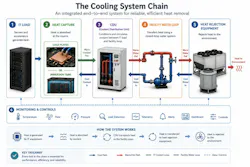
Technical guidance from ASHRAE TC 9.9 reinforces this systems-based view. ASHRAE’s water-cooled server guidance describes liquid cooling as an architecture that involves multiple connected elements, including facility water systems, technology cooling systems, heat exchangers, controls, water quality, and service processes. In other words, liquid cooling is not just a rack decision. It is a facility and operations decision.
This is also why controls are becoming part of the cooling architecture itself. As IT loads and grid conditions change, operators need visibility into temperature, flow, pressure, pump behavior, valve positions, leak detection, and airside conditions across the full chain. Through intelligent controls via Trane Cloud, Trane empowers operators with analytics that help teams identify anomalies early and connect system data to expert-led service actions before issues escalate into downtime events. For Trane, that integrated view connects equipment, controls, digital monitoring, commissioning discipline, training, and service expertise. The result is not just a cooling plant that can hit a design point. It is an operating environment that can be measured, tuned, and improved over its lifecycle.
Scaling with Modularity, Repeatability, and Global Execution
As data center development rapidly expands beyond traditional geographies, operators may encounter a wider set of site-specific variables that challenge one-size-fits-all cooling strategies. Cooling architectures may need to be expanded and repeated across facilities while still allowing flexibility for local site conditions.
This is where partnering with Trane becomes especially valuable. Trane brings global thermal management expertise, manufacturing scale, controls, lifecycle services, and a 6,000+ technician network, while LiquidStack contributes advanced liquid cooling design, modular CDU architecture, and practical experience supporting high-density environments. The focus is on helping operators move from bespoke deployments toward repeatable infrastructure models that can be commissioned, supported, and improved over time.
LiquidStack frames this clearly with the GigaModular platform, positioned as a centralized modular liquid cooling platform that enables system-level scalability through coordinated controls, modular pump and hydronic infrastructure, pay-as-you-grow expansion, and repeatable deployment models. That matters because the operational burden of AI cooling grows quickly when every pod, row, or data hall is engineered differently. Repeatability reduces deployment risk, modularity accelerates expansion, and centralized system-level controls simplify commissioning, operations, maintenance, and long-term scalability.
Operators should look for the following in scalable liquid-cooling designs:
- Right-sized capacity that can grow with demand rather than forcing oversized day-one infrastructure.
- Modular CDU building blocks that support phased expansion.
- Centralized controls that simplify system-level management.
- Flexible distribution architectures that can adapt to different data hall layouts.
- Repeatable deployment models that support both single-site and multi-site growth.
- A lifecycle support model that covers commissioning, monitoring, service access, training, and continuous optimization.
The broader market is moving in this direction as well. Research from McKinsey and Dell’Oro Group points to increasing investment in modular infrastructure, prefabricated mechanical systems, and scalable cooling architectures as operators race to deploy AI capacity faster while reducing construction and commissioning complexity.
So … What’s Next?
The industry is quickly moving beyond theoretical discussions about AI cooling. Operators are now building, scaling, and refining real-world environments designed around hybrid thermal architectures and high-density compute.
The organizations seeing the most success are not necessarily the ones deploying the most aggressive technologies first. They are the ones building scalable, operationally practical cooling strategies that can evolve alongside AI demand.
That ultimately becomes the defining challenge of the AI data center era: not simply supporting higher densities but creating infrastructure that can continue to adapt as workloads themselves evolve.
Download the full report, Why AI is Forcing a Rethink of Data Center Cooling Design, featuring Trane, to learn more. In our next article, we’ll examine designing for greenfield, brownfield and operational reality.
About the Author
 Bill Kleyman
Related
 Image courtesy of NVIDIA Corporation and nVent Management Company
 Image courtesy of Trane
Voices of the Industry
 Source: Rob Byron/Shutterstock.com
 Source: Shutterstock, courtesy of nVent Data Solutions