The Case for Prefabricated Power in AI Data Centers
Key Highlights
- Prefabricated power modules integrate critical electrical systems into factory-tested, cohesive solutions.
- Off-site assembly can cut deployment timelines in half compared to traditional construction.
- Factory testing reduces on-site complexity, commissioning delays and unexpected construction costs.
- Modular infrastructure enables flexible capital investment and more efficient long-term operations.
- Power skids and outdoor modules offer deployment flexibility for different site requirements.

The AI boom has placed data center operators in a historic squeeze. CTOs and infrastructure managers are under pressure to bring massive, high-density computing capacity online faster than ever, even as the grid struggles to keep up. And as demands intensify, there’s very little room for error. The question now is how the industry can scale AI infrastructure without putting reliability, power availability, and the grid itself at risk.
In this high-stakes environment, power-related challenges represent a massive business risk. They remain the leading cause of impactful data center outages and cost the world’s 500 largest companies an estimated $1.4 trillion annually. That makes the way power infrastructure is designed, built and deployed more important than ever. The industry is beginning to rethink the traditional approach to building power infrastructure. To scale rapidly without compromising reliability, the industry is shifting toward prefabricated, factory-tested power modules. By moving complex electrical assembly off-site, operators can balance the competing demands of deployment speed, financial risk, and total cost of ownership.
The Technical Reality: A Power Module Is a Cohesive System
A prefabricated power module is more than a group of components assembled on a metal floor. It’s an integrated system that is engineered and tested to operate as a single unit. In a typical deployment, a weather-proof outdoor module or an indoor structural skid houses:
- Medium Voltage (MV) Switchgear: The entry point for utility power, providing robust protection and control.
- Low Voltage (LV) Distribution Switchboards: Directs large blocks of power to the server rooms.
- High-Efficiency UPS Systems: Industrial-grade systems operating at optimized efficiency to minimize energy waste.
- Energy Storage: Long-life valve regulated lead‐acid (VRLA) or high-density Lithium-Ion battery cabinets.
- Auxiliary Systems: Factory-installed direct expansion (DX) cooling, clean-agent fire suppression, security cameras, and comprehensive environmental monitoring.
The critical engineering value lies in factory-level integration. When these systems are designed, wired, piped, and programmed under controlled factory conditions, the complex electrical and digital interactions between them are fully validated before shipping.
For example, coordination between an MV switchgear’s circuit breaker trip settings, a UPS’s transient response, and a Lithium-Ion battery’s management system is highly sensitive. Resolving a communication mismatch or tight clearance issue on-site during commissioning can delay a project by weeks. Resolving it on the factory floor, where engineers have specialized diagnostics and direct manufacturer support, takes hours instead of weeks and eliminates on-site construction errors.
Balancing the Tradeoffs: Speed vs. Cost vs. Risk
Infrastructure buyers prioritize outcomes differently. Hyperscalers might value pure speed to market, while colocation providers and enterprise operators may be highly sensitive to upfront CapEx, long-term OpEx, or project risk. Prefabricated modular infrastructure shifts the traditional trade-off curve across all three variables:
1. Speed: Accelerating Time-to-Market
For AI developers chasing first-mover advantages, speed is often the primary metric. By moving much of the electrical work off-site, prefabricated power modules can significantly shorten deployment timelines. For example, Schneider Electric’s power skids can be operational in half the time of traditional “stick-built” electrical rooms. A new research paper co-authored with hyperscale developer Compass Datacenters also highlights the quantitative deployment efficiency gains of shifting from traditional white space builds to prefabricated modular IT pods. According to the study performed at a Compass hyperscale data center campus, prefabricated modular pods shorten onsite installation time from 75.5 hours to just 15 hours per pod, delivering an 80% reduction in onsite installation duration. By shifting critical assembly, integration and verification to a controlled factory environment, data center operators can reduce on-site labor and complexity while bringing AI compute capacity online faster.
2. Risk: Shifting Complexity Off-Site
On-site construction is inherently unpredictable, plagued by weather delays, labor shortages, and variable craft quality. Shifting assembly to an ISO-certified manufacturing facility replaces field variables with standardized quality control. Factory-tested validation ensures that the module arrives as a "plug-and-play" asset, eliminating unexpected construction expenses and ensuring the system works flawlessly from day one.
3. Cost: Granular CapEx, Reduced OpEx, and Environmental Impact
From a financial perspective, modular construction also gives operators more flexibility with capital. Instead of building massive, over-engineered structures on day one to accommodate growth that may not happen for years, they can add capacity as demand materializes. That means capital can be deployed when it is actually needed, rather than tying up millions in infrastructure long before the servers — and the revenue they generate — are ready.
There are operational savings, too. Pre-engineered systems can be paired with cloud-based monitoring and intelligent management platforms that give operators a much clearer view of system health in real time. Teams can use condition-based maintenance to identify potential issues earlier, reduce unnecessary maintenance and get more life out of critical equipment. Viable results from this approach are easy to come by. For example, using condition-based maintenance, Compass Data Centers reduced intrusive on-site maintenance by 40% and cut OpEx spending by 20%.
In another example, Nestle’s Nescafe plant in Toluca, Mexico, used alerts to avoid five major stoppages between 2020 and 2024, saving around $2 million thanks to data from intelligent switchgear.
From a sustainability standpoint, a modular approach also fundamentally transforms the construction footprint. By concentrating assembly in a factory setting, modular power significantly reduces on-site material waste and scrap compared to traditional stick-built methods, lowering the carbon impact of the construction phase itself.
Implementation: Choosing the Right Modular Architecture
To execute a modular strategy, operators must choose between two primary form factors depending on their site constraints: power skids or power modules.
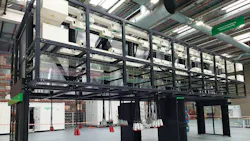
Constructed on an open structural frame, power skids (indoor deployments) integrate the UPS, batteries, and switchboards back-to-back. The upper frame is utilized for integrated cable management, making transport and indoor positioning straightforward. Skids represent a highly cost-effective method to rapidly deploy critical power inside an existing building envelope.
On the other hand, housed in a weather-proof, walk-in enclosure, outdoor power modules optimize valuable indoor building space exclusively for high-yield IT and server racks. They arrive with integrated environmental controls (cooling, fire detection, and physical security), meaning they require minimal site preparation and can be placed directly on an outdoor concrete pad.
Future-Proofing AI Infrastructure: The Strategic Value of Modular Power
Prefabricating and factory-testing critical power systems, including LV and MV switchgear, UPS and back-up storage, replaces workflow bottlenecks with manufacturing precision and efficiency. In a race defined by speed, reliability, and efficiency, modular power systems deliver a high-impact solution underscored by rapid deployment, minimized operational risk, and optimized costs from day one.