OCP 2026: Cooler Master Scales Liquid Cooling from Cold Plates to 2.5 MW CDUs
Key Highlights
-
Cooler Master's new 2.5 MW in-row CDU separates facility water from the IT coolant loop, with centralized management supporting up to 32 interconnected units.
-
The 300 kW air-assisted liquid cooling system targets facilities without dedicated water infrastructure, featuring modular radiator racks and hot-swappable components.
-
The portfolio extends liquid cooling beyond CPUs and GPUs to optical modules, networking hardware, and other rack-level components.
-
Specialized filling, flushing, and leak-testing tools support liquid cooling deployment and maintenance, while factory equipment handles cold-plate drying and validation.
-
Manufacturing operations in China and expanding production capacity in Vietnam support Cooler Master's growing portfolio of data center cooling equipment.
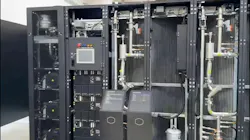
Cooler Master used the OCP Global Summit 2026 to introduce a 2.5-megawatt coolant distribution unit (CDU), extending a growing portfolio of liquid cooling technologies aimed at the increasingly demanding thermal requirements of AI infrastructure.
The new 2,500 kW liquid-to-liquid in-row CDU anchors a product lineup that now spans facility-level heat transfer, rack-level coolant distribution, direct-to-chip cold plates, manifolds, and the specialized equipment needed to fill, test, and commission liquid cooling systems.
For a company long associated with PC cooling and enthusiast hardware, the breadth of the offering reflects a substantial evolution. Cooler Master began developing data center products for hyperscale customers in 2018, building on its experience with liquid cooling in consumer and server markets. Its own branded data center infrastructure products have emerged more recently.
During a guided showroom tour conducted in conjunction with OCP 2026, Data Center Frontier examined an assortment of the company's cooling systems, including modular liquid-to-air CDUs designed for existing data centers, rack-level cooling hardware, and equipment intended to streamline manufacturing and deployment.
The most revealing aspect of the tour was the attention given to the practical requirements of operating liquid-cooled infrastructure. Alongside increasing thermal capacity, Cooler Master is emphasizing modular equipment, replaceable components, redundant systems, and the processes needed to prepare liquid cooling loops for service.
The resulting product strategy addresses two distinct challenges facing data center operators: scaling liquid cooling for new AI deployments while finding ways to accommodate increasingly dense computing systems in facilities originally designed around air cooling.
That integrated approach reflects the shift from scaling to coordination identified in DCF's OCP 2026 reporting, as computing, power, cooling, and operations become increasingly interdependent.
A 2.5 MW CDU Anchors the Portfolio
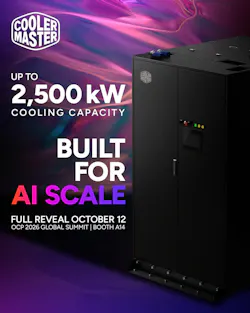
At the upper end of the lineup, Cooler Master's 2.5 MW liquid-to-liquid in-row CDU is designed to manage heat loads approaching 2,500 kW through a heat exchanger that separates facility water from the secondary coolant loop serving IT equipment.
The system is rated for a 4–5°C approach temperature difference at its advertised cooling capacity. Its architecture incorporates redundant pumping, fluid monitoring, and centralized management intended to support deployments involving multiple cooling units.
Cooler Master says the management architecture can coordinate as many as 32 interconnected CDUs, allowing operators to monitor and manage coolant distribution across larger installations. The system also incorporates remote management capabilities, including support for standard data center communications protocols.
Mass production was targeted for the fourth quarter of 2026.
The significance of the new platform lies partly in its scale. As AI infrastructure moves toward increasingly dense rack-level configurations, CDU capacity has become a critical consideration in the design of liquid cooling distribution systems. Larger cooling units can serve multiple racks or computing clusters, but their integration also places greater demands on pumping capacity, filtration, monitoring, redundancy, and facility piping.
Cooler Master's approach extends beyond simply increasing the size of the heat exchanger. Its product strategy encompasses the supporting equipment needed to move coolant reliably through the system and maintain operating conditions as thermal loads change.
The company also offers smaller liquid-to-liquid CDU configurations, including in-rack equipment for applications that do not require a multi-megawatt installation.
In its OCP announcement, Cooler Master CEO Thomas Chen emphasized deployment flexibility as a priority, particularly for customers balancing new construction with the need to expand AI capacity inside existing facilities.
That distinction becomes especially relevant in the company's liquid-to-air product lineup.
Modular Air-Assisted Cooling Targets Existing Data Centers
One of the most instructive systems examined during the tour was Cooler Master's 300 kW Air-Assisted Liquid Cooling (AALC) CDU, a modular liquid-to-air design intended for data centers without an existing facility water distribution system.
Rather than transferring server heat into a building's chilled-water or facility-water loop, the AALC system circulates coolant through the IT equipment and rejects the captured heat through fan-driven radiators.
The distinction matters for operators seeking to introduce liquid-cooled AI racks into facilities that were not built with dedicated liquid cooling infrastructure. Although air-assisted systems still require sufficient facility airflow and heat rejection capacity, they offer an alternative to extending a new water distribution network throughout the data hall.
The approach is already finding applications in the field. As DCF recently reported, Corvex deployed liquid-cooled NVIDIA Blackwell infrastructure inside an existing air-cooled data center, using Lenovo Neptune technology to avoid a conventional facility-wide liquid cooling conversion.
Cooler Master's 300 kW design separates the pumping equipment from its radiator assemblies. During the tour, a company representative explained that the system can be configured with a central pump rack and either one or two radiator racks, each providing a nominal 150 kW of cooling capacity.
This modular arrangement allows cooling capacity to be matched more closely to the installation, rather than requiring every deployment to use the full 300 kW configuration.
Serviceability is a major feature of the design. The system uses redundant pumps in a 2+1 arrangement, with two pumps supporting normal operation and a third providing standby capacity. Pump modules are designed for replacement without interrupting cooling operations.
Other field-replaceable components include fans, filters, expansion tanks, and power-related assemblies. The product also incorporates redundant filtration and monitoring capabilities intended to help operators identify faults and maintain cooling performance.
The company specifies UPS support for up to 90 seconds, providing a limited bridge during a power interruption or transfer to another available power source. It is an availability feature rather than a substitute for the facility's broader backup power infrastructure.
The modular construction also addresses the physical handling of increasingly substantial cooling equipment. During the tour, Cooler Master demonstrated how an automated guided vehicle could move beneath a rack assembly to assist with positioning and transportation.
Together, these features reflect a design philosophy familiar to mission-critical infrastructure operators: isolate failures where possible, simplify component replacement, and reduce the operational disruption associated with maintenance.
Cooler Master says the 300 kW AALC platform is already in production.
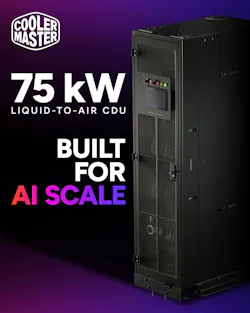
The same retrofit-oriented strategy extends to the company's smaller 75 kW liquid-to-air in-row CDU. That system uses V-pattern radiator assemblies, redundant pumping, and 16 replaceable fans within a rack-sized enclosure. Cooler Master also displayed 150 kW and 230 kW in-rack CDU configurations during the tour, illustrating the range of capacities the company is developing for high-density computing environments.
At the smaller end of its liquid-to-air portfolio, a 30 kW in-rack CDU is aimed at more limited cooling loads, including enterprise and edge-oriented applications. Production of that model was targeted for the fourth quarter of 2026.
The range provides operators with different approaches to liquid cooling deployment depending on rack density, available mechanical infrastructure, and the amount of heat that must ultimately be rejected.
Liquid Cooling Moves Beyond Processors and GPUs
The tour also highlighted the continuing expansion of liquid cooling inside AI server racks.
Cold plates attached to CPUs and GPUs remain central to direct-to-chip cooling systems, but the thermal requirements of high-bandwidth networking and increasingly integrated rack-scale architectures are extending liquid cooling into additional components.
Cooler Master displayed cooling assemblies for optical modules, along with rack manifolds and other components used to distribute coolant through high-density computing systems. Company representatives also discussed cooling applications for memory, network switches, and power delivery hardware.
These developments track the increasing integration of computing, networking, and power infrastructure in NVIDIA's rack-scale AI architectures. As system designs evolve, thermal management must account for components beyond the primary processors, particularly where elevated power densities and tightly packed hardware limit the effectiveness of conventional airflow.
For Cooler Master, that creates opportunities to supply multiple elements of the liquid cooling circuit. The company manufactures cold plates and component-level assemblies as well as the manifolds that connect them to rack-level distribution systems.
The design requirements for these products are frequently dictated by the underlying computing platform. During the tour, a company representative explained that much of the cold-plate architecture for NVIDIA systems follows platform-specific reference designs, making manufacturing execution and production capacity important areas of differentiation.
The company is also exploring refrigerant-based cooling through a Liquid Refrigerant Distribution Unit and a refrigerant-to-liquid cold-plate loop demonstration.
Those technologies investigate the use of refrigerant phase change to absorb processor heat, offering another potential approach to higher thermal loads. They remain developmental offerings rather than established production alternatives to the company's single-phase liquid cooling portfolio.
From the Factory to the Coolant Loop
While CDU capacity and rack-level hardware dominated the product discussion, some of the most revealing equipment on the tour addressed a less visible aspect of liquid cooling: the work required to prepare systems for operation.
"The story begins in the factory," a Cooler Master representative said while introducing the company's manufacturing and commissioning equipment.
The first example was a nitrogen charging system used to identify potential leaks and prepare cooling assemblies for shipment. The equipment allows components to be pressurized for testing, while nitrogen can also be used to protect internal surfaces during storage and transportation.
Nearby, the company demonstrated specialized equipment for filling, flushing, and draining coolant loops.
Its Loop Charge Kit is designed for cold plates and manifolds within the secondary cooling circuit. The unit incorporates a coolant reservoir, pumping and filtration equipment, and provisions for fluid recovery and pressure management.
The larger Feeder Kit handles coolant filling and circulation for equipment such as CDUs and rack manifolds. The system includes a 150-liter reservoir, filtration, pressure regulation, and monitoring functions intended to support controlled filling and commissioning.
The distinction between these tools reflects the different coolant volumes and service requirements encountered throughout a liquid cooling installation.
Cooler Master also offers a smaller Mini-Charge Tool for portable filling and draining operations. The company reported that the Mini-Charge Tool was already in production, with several additional commissioning systems targeted for production during the fourth quarter of 2026.
Another device shown during the tour was a cold-plate drying system used in manufacturing. The equipment employs vacuum, heat, and nitrogen to remove moisture after testing and assembly, while also supporting leak checks. A representative described the system as primarily intended for internal production processes, with possible applications in returned-material inspection and repair.
These products underscore the growing importance of commissioning and maintenance as liquid cooling moves beyond individual deployments and becomes a routine part of data center operations.
The same industrialization of cooling was evident in DCF's recent tour of CoolIT's Calgary manufacturing and R&D operations, where component validation, system-level testing, and manufacturing scale emerged as essential elements of the AI infrastructure supply chain.
Filling a coolant circuit, removing trapped air, maintaining fluid cleanliness, verifying pressure integrity, and preparing equipment for service are all necessary steps before a cooling system can reliably support production computing workloads.
They also create recurring maintenance requirements long after the initial installation.
For Cooler Master, supplying this equipment extends its role beyond manufacturing individual thermal components into the processes surrounding their deployment and operation.
Manufacturing Scale Becomes Part of the Strategy
Cooler Master's manufacturing capabilities form another important part of its expansion into data center infrastructure.
The company has established production operations in China and is expanding its manufacturing footprint in Vietnam. Its facility in Bac Ninh province includes production of cooling modules for AI servers and liquid cooling equipment for data centers.
According to information published by the Bac Ninh provincial government, the first phase of the Vietnam operation entered service in July 2025. The development reflects a broader effort to expand manufacturing capacity for advanced thermal management products as AI infrastructure demand increases.
During the OCP tour, company representatives emphasized the use of integrated manufacturing processes for cold plates and manifolds, including precision joining, inspection, and validation.
That emphasis is significant because increasing liquid cooling adoption creates requirements that go beyond thermal performance alone. Large-scale deployments depend on repeatable manufacturing quality, reliable sealing and connections, consistent component specifications, and predictable delivery schedules.
The ability to manufacture and validate multiple elements of the cooling circuit also provides an opportunity to coordinate component design with system-level requirements.
Cooler Master's product strategy therefore combines several activities that have often been handled by different suppliers: component cooling, coolant distribution, rack integration, and commissioning.
Whether an operator chooses equipment from one supplier or integrates products from several vendors, the underlying requirements remain the same. The entire cooling circuit must be designed, installed, tested, and maintained as a functioning system.
The Next Phase of AI Cooling Is Operational
The equipment demonstrated by Cooler Master at OCP 2026 illustrates how liquid cooling is moving from a specialized response to extreme processor heat toward a more comprehensive data center infrastructure discipline.
The company's 2.5 MW CDU addresses the increasing scale of AI computing installations. Its modular liquid-to-air systems offer an approach for introducing direct liquid cooling where facility water infrastructure is unavailable. Cold plates, manifolds, and component-level cooling assemblies extend thermal management throughout increasingly integrated racks.
Just as importantly, the company's commissioning and validation products address the less visible work required to make these systems operational.
The broader challenge for operators is no longer simply whether liquid cooling can remove heat from today's most demanding processors. It is how to deploy cooling infrastructure at the required scale, adapt it to existing facilities, and maintain dependable service throughout its operating life.
Cooler Master's expanding portfolio is a product-level response to that challenge, connecting thermal capacity with the practical mechanics of installation, maintenance, and manufacturing as AI infrastructure continues to evolve.
At Data Center Frontier, we talk the industry talk and walk the industry walk. In that spirit, DCF Staff members may occasionally use AI tools to assist with content.
Keep pace with the fast-moving world of data centers and cloud computing by connecting with Data Center Frontier on LinkedIn, following us on X/Twitter and Facebook, as well as on BlueSky, and signing up for our weekly newsletters using the form below.
About the Author
 Matt Vincent
Matt Vincent is Editor in Chief of Data Center Frontier, where he leads editorial strategy and coverage focused on the infrastructure powering cloud computing, artificial intelligence, and the digital economy. A veteran B2B technology journalist with more than two decades of experience, Vincent specializes in the intersection of data centers, power, cooling, and emerging AI-era infrastructure. Since assuming the EIC role in 2023, he has helped guide Data Center Frontier’s coverage of the industry’s transition into the gigawatt-scale AI era, with a focus on hyperscale development, behind-the-meter power strategies, liquid cooling architectures, and the evolving energy demands of high-density compute, while working closely with the Digital Infrastructure Group at Endeavor Business Media to expand the brand’s analytical and multimedia footprint. Vincent also hosts The Data Center Frontier Show podcast, where he interviews industry leaders across hyperscale, colocation, utilities, and the data center supply chain to examine the technologies and business models reshaping digital infrastructure. Since its inception he serves as Head of Content for the Data Center Frontier Trends Summit. Before becoming Editor in Chief, he served in multiple senior editorial roles across Endeavor Business Media’s digital infrastructure portfolio, with coverage spanning data centers and hyperscale infrastructure, structured cabling and networking, telecom and datacom, IP physical security, and wireless and Pro AV markets. He began his career in 2005 within PennWell’s Advanced Technology Division and later held senior editorial positions supporting brands such as Cabling Installation & Maintenance, Lightwave Online, Broadband Technology Report, and Smart Buildings Technology. Vincent is a frequent moderator, interviewer, and keynote speaker at industry events including the HPC Forum, where he delivers forward-looking analysis on how AI and high-performance computing are reshaping digital infrastructure. He graduated with honors from Indiana University Bloomington with a B.A. in English Literature and Creative Writing and lives in southern New Hampshire with his family, remaining an active musician in his spare time.
Related

Voices of the Industry
 Source: Rob Byron/Shutterstock.com
 Source: Shutterstock, courtesy of nVent Data Solutions