Oak Ridge's AI Factory Moment: Lux, Nuclear Power, and the Next Data Center Frontier
Key Highlights
- ORNL’s 4,032-GPU Lux system opened to scientific users as the first dedicated AI factory supporting the DOE’s Genesis Mission.
-
Oak Ridge is attracting billions of dollars in proposed nuclear generation, uranium enrichment, fuel manufacturing, and recycling projects.
-
TVA’s Clinch River SMR has received a construction permit but awaits a final build decision, while Kairos Power advances a Google-backed demonstration reactor.
-
DOE is seeking private AI data center development on federal land, but no Oak Ridge developer has been publicly selected.
-
Power availability, licensing timelines, and skilled-worker shortages remain key constraints on the region’s ambitions.

Oak Ridge, Tennessee, has spent more than eight decades at the intersection of American scientific ambition and national energy priorities. Now, a major new supercomputing deployment is bringing the historic center of nuclear research into sharper focus as a potential proving ground for the infrastructure technologies that will define the AI era.
On November 16, during the SC26 supercomputing conference in Chicago, the Department of Energy's Oak Ridge National Laboratory (ORNL) announced that its new Lux supercomputer had opened to scientific users, becoming the first dedicated AI factory supporting the DOE's Genesis Mission. The system debuted at No. 14 on the latest TOP500 supercomputer rankings, recording 220.79 petaflops of performance on the High Performance Linpack benchmark.
Developed in partnership with AMD and Hewlett Packard Enterprise (HPE), Lux represents a significant addition to the computing resources available at Oak Ridge. But its importance extends beyond another entry on the global supercomputing rankings. The system arrives as the surrounding region experiences a surge of nuclear energy investment, advanced fuel manufacturing, research infrastructure development, and federal initiatives aimed at connecting artificial intelligence with the nation's future energy systems.
According to HPE's November 16 technical announcement, Lux is built on HPE ProLiant Compute XD685 infrastructure, equipped with AMD Instinct MI355X GPUs, AMD EPYC CPUs, AMD Pensando networking technology, and the AMD ROCm software stack. The direct-liquid-cooled platform incorporates HPE Juniper Networking technology, including Ethernet switches supporting 800-gigabit connectivity, addressing the network performance, thermal management, and GPU utilization challenges associated with large-scale AI computing.
The system comprises 504 compute nodes and 4,032 GPUs, according to ORNL's Lux system documentation. Its architecture is designed to support both traditional high-performance computing and AI workloads, including model training, inference, and scientific applications that combine simulation, experimental data, and machine learning. Its TOP500 performance score measures conventional high-performance computing capability rather than AI training throughput, but the underlying architecture offers a useful view of how AI and scientific computing infrastructure are beginning to converge.
Lux is also intended to provide a flexible, multi-tenant computing environment. Approximately half of its annual allocation of 3.5 million node-hours will support the Genesis Mission, while the remaining capacity is reserved for proprietary partner access, including AMD's development and testing work. The mission itself is intended to accelerate discovery in fields including fusion energy, critical materials, manufacturing, and scientific modeling by combining AI, advanced computing, and experimental research.
Among the initial research directions is AI-driven forecasting of water availability, river temperatures, and streamflow, with applications for hydropower and thermoelectric generation in the Tennessee Valley Authority (TVA) region. Other work addresses fusion technology, materials development, and computational methods that could help improve the performance and efficiency of future energy systems.
For the data center industry, Lux offers an immediate example of the convergence occurring between AI computing, high-density liquid cooling, high-performance networking, and energy research. What makes its arrival especially significant, however, is the wider industrial transformation already underway around Oak Ridge.
The same region that now operates one of the nation's newest AI computing systems is also attracting billions of dollars in small modular reactor development, nuclear fuel enrichment, advanced manufacturing, fuel recycling, and related infrastructure. In parallel, DOE is pursuing the development of privately operated AI data centers on portions of its Oak Ridge Reservation.
Taken together, the developments suggest that Oak Ridge could become an important center for technologies that will eventually be deployed at AI data centers well beyond Tennessee.
From Manhattan Project Infrastructure to a New Energy Development Campus
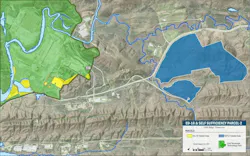
For much of its history, Oak Ridge has been associated with the Manhattan Project and the subsequent development of America's nuclear research and production capabilities. Established during World War II, the community became home to major facilities for uranium enrichment, nuclear materials processing, scientific research, and ultimately high-performance computing.
Today, that legacy is being repurposed for a new generation of industrial development. The former K-25 uranium enrichment complex, once a critical part of the nation's atomic weapons program, has been transformed into the East Tennessee Technology Park (ETTP), where extensive environmental cleanup and redevelopment have made former federal property available for commercial use.
At an October 27 gathering in Oak Ridge, federal officials and nuclear industry representatives highlighted more than $15 billion in announced nuclear-related projects across the region, an investment wave subsequently documented in a November 17 DOE report on Oak Ridge's emerging energy hub. The investment figure largely represents planned private-sector development rather than completed capital spending. Regional officials also anticipate demand for thousands of construction workers over the next five years, with additional permanent manufacturing and operating positions potentially following as projects advance.
In March, DOE completed its largest Oak Ridge land transfer to date, conveying more than 700 acres for economic reuse. The transfer included a 624-acre parcel designated for Orano USA's planned uranium enrichment complex and a 77-acre parcel associated with Oklo's proposed nuclear fuel recycling development. Overall, more than 2,500 acres have been transferred from federal ownership for redevelopment, following decades of cleanup and the demolition of hundreds of former industrial structures.
For nuclear developers, the appeal is straightforward: large industrial sites, existing utility and transportation infrastructure, proximity to federal laboratories, and an established community of nuclear engineers, technicians, researchers, and specialized manufacturers.
For data center developers, the implications are somewhat different but no less relevant. Large AI campuses increasingly require industrial-scale sites with access to electrical infrastructure, water and cooling resources, and a workforce capable of constructing and maintaining highly specialized facilities. Brownfield redevelopment offers one potential alternative to entirely new industrial development, although it does not eliminate interconnection, environmental, or permitting requirements.
Oak Ridge's advantage is not simply available land. It is the concentration of technical capabilities and energy-related industries taking shape around that land.
TVA's Clinch River Project Marks a New Nuclear Milestone
One of the most consequential developments is occurring at TVA's Clinch River Nuclear Site near Oak Ridge.
On September 29, 2026, the U.S. Nuclear Regulatory Commission (NRC) announced that it had approved a construction permit for Clinch River Unit 1, a planned 300-megawatt GE Vernova Hitachi BWRX-300 small modular reactor (SMR). As Reuters reported at the time, the decision represented a major regulatory milestone for the commercialization of smaller nuclear generating units. The permit was formally issued on September 28.
The NRC completed its review in approximately 14 months, ahead of its original schedule. The approval is especially important because it establishes a licensing precedent for a reactor design that utilities and developers hope can eventually be deployed in multiple locations using standardized engineering and modular construction techniques.
The BWRX-300 is based on established boiling-water reactor technology but incorporates a smaller generating unit and greater reliance on modular construction than conventional large nuclear plants. Its nominal 300-MW output could offer utilities a means of adding substantial firm generation capacity without undertaking the construction of a traditional gigawatt-scale reactor.
That prospect has obvious significance for utilities serving fast-growing data center markets. AI infrastructure projects are creating demand for continuous, reliable power at scales that can exceed the capacity available from existing local electrical systems.
However, a construction permit is not equivalent to an operating reactor. TVA must still make a final investment decision, complete construction, and secure a separate operating license before Clinch River can generate commercial electricity. In its November 2026 financial filing, TVA confirmed that it had not yet decided whether to proceed with construction.
The project has also become part of a much larger international nuclear investment discussion. In March, the United States and Japan announced a proposed strategic investment initiative involving up to $40 billion in GE Vernova Hitachi BWRX-300 projects in Tennessee and Alabama. The prospective development would encompass approximately 3 GW of generation, equivalent to ten 300-MW reactor units.
Federal officials have discussed the potential for additional reactor development in Tennessee and at TVA's Bellefonte site in Alabama. Those plans remain prospective and should not be confused with fully financed or approved construction projects. The $40 billion initiative also falls outside the approximately $15 billion in regional nuclear projects highlighted at the October Oak Ridge event.
Nevertheless, the proposal illustrates the scale of interest in creating a repeatable SMR deployment model that could eventually support expanding industrial and computing loads across the TVA service territory.
Kairos Power Connects Advanced Nuclear Development to Google's AI Infrastructure
While Clinch River represents an evolutionary approach to commercial nuclear generation, another Oak Ridge development is pursuing a more unconventional reactor technology with a direct connection to hyperscale data center energy procurement.
In April 2026, Kairos Power broke ground on its Hermes 2 Demonstration Plant at the former K-33 uranium enrichment site. The project is the company's first power-producing reactor deployment and a central component of its agreement with Google to develop advanced nuclear generating capacity.
Hermes 2 is designed to provide up to 50 MW of electricity to the TVA grid, helping support Google's data center operations in Tennessee and Alabama. Under the arrangement, TVA will purchase the electricity generated by the plant, with Google supporting the commercial development of the advanced nuclear technology.
The project is scheduled to begin operations in 2030, although that timeline remains subject to successful construction, licensing, testing, and commissioning.
As Data Center Frontier previously examined in David Chernicoff and Matt Vincent's Google Backs Advanced Nuclear at TVA's Clinch River as ORNL Pushes Quantum Frontiers, the arrangement reflects a growing convergence between hyperscale computing requirements and the development of advanced nuclear technologies.
Kairos is developing a fluoride salt-cooled, high-temperature reactor that uses TRISO fuel particles embedded in fuel pebbles. Rather than employing the pressurized water systems common to most existing commercial nuclear plants, the technology uses molten fluoride salt as a coolant.
Hermes 2 follows Hermes 1, a low-power demonstration reactor also under construction at Oak Ridge. Together, the projects are intended to establish the technical and operating foundation for larger commercial deployments.
Kairos is also investigating construction approaches that could influence the economics of future nuclear development, including factory-built components, modular assembly, precast concrete structures, and seismic isolation systems. Components are being manufactured at the company's Albuquerque, New Mexico, campus before shipment to Tennessee.
The significance for Google and the broader data center industry lies in the commercial structure as much as the reactor technology. Hyperscalers are increasingly becoming participants in the development of new generating resources, helping support projects whose capital costs and development risks historically would have been carried primarily by utilities and energy companies.
At the same time, the distinction between contracted nuclear energy and physically dedicated generation remains important. Hermes 2 is not a standalone plant supplying a single isolated Google data center. Its electricity will enter the TVA system, supporting a broader regional grid that serves Google's facilities alongside other customers.
Rebuilding the Nuclear Fuel Supply Chain
The expansion of advanced nuclear generation depends on another capability now receiving substantial investment around Oak Ridge: the domestic production of nuclear fuel.
Many proposed small modular reactors and microreactors require high-assay low-enriched uranium (HALEU), enriched to higher concentrations than the fuel typically used in conventional U.S. commercial nuclear reactors. Domestic production capacity remains limited, creating potential bottlenecks for reactor developers seeking to move from demonstration projects into commercial deployment.
The challenge extends beyond HALEU. According to the U.S. Energy Information Administration's 2025 Uranium Marketing Annual Report, U.S.-origin enrichment services accounted for only 23% of separative work units purchased by operators of American civilian nuclear reactors in 2025. Foreign enrichment facilities provided the remaining 77%, underscoring the country's continued reliance on overseas capabilities.
Much of Oak Ridge's latest industrial development is directed toward addressing that imbalance.
Orano, LIS Technologies, Centrus, and BWXT
Orano USA is developing Project IKE, a planned $5 billion uranium enrichment complex on the 624-acre parcel transferred by DOE. The proposed 750,000-square-foot development is intended to become one of North America's largest enrichment operations.
DOE announced a $900 million award to Orano Federal Services earlier in 2026 to expand domestic low-enriched uranium production capacity. The NRC accepted the Project IKE license application for detailed technical review in May.
A more recent development illustrates the complexities of translating these investments into operating infrastructure. In November, the NRC's projected completion of the technical review shifted from April to June 2027 after the regulator granted additional time for Orano to respond to requests for information. As Nuclear Newswire reported November 13, the adjustment represents approximately two months of additional licensing review. Orano has indicated that the revised review schedule is not expected to delay its target for initial enrichment operations in 2031, although that remains dependent on licensing and execution.
Other manufacturers are advancing projects of their own.
In January, LIS Technologies announced approximately $1.38 billion in planned investment for a laser uranium enrichment facility at the former K-25 site, a project expected to create about 203 jobs. The company is pursuing a commercial application of laser isotope separation technology.
Centrus Energy announced plans to invest more than $560 million in an expansion of its Oak Ridge centrifuge manufacturing operations, with nearly 430 additional jobs anticipated. On October 29, Centrus reached a tangible manufacturing milestone when it began shipping newly manufactured centrifuges from Oak Ridge to Ohio for its uranium enrichment expansion.
BWX Technologies (BWXT) added another element in January with the opening of its Centrifuge Manufacturing Development Facility, supporting a National Nuclear Security Administration program to rebuild domestic enrichment capabilities for national security purposes. The company is participating in a federal program valued at approximately $1.5 billion.
These projects illustrate how Oak Ridge is becoming a manufacturing center for technologies essential to the long-term expansion of nuclear generation, even when the eventual power plants will be located elsewhere.
TRISO-X, Standard Nuclear, and the Advanced Fuel Market
Advanced reactor development also depends on the ability to manufacture specialized fuels at commercial scale.
TRISO-X, an X-energy subsidiary, completed vertical construction of its 214,000-square-foot TX-1 fuel fabrication plant in September and moved into interior construction and equipment installation. Once operational, the facility is expected to manufacture approximately 700,000 TRISO fuel pebbles annually, equivalent to five metric tons of uranium and enough fuel to support as many as eleven Xe-100 reactors.
In February, the NRC granted TRISO-X a 40-year special nuclear material license covering its TX-1 and planned TX-2 facilities. The company has also expanded its Oak Ridge property holdings and announced further fuel manufacturing and research development, with Tennessee officials associating the broader expansion with more than 1,100 prospective jobs.
As Chernicoff has examined in DCF's earlier feature, Nuclear's Next AI Test: Building at Scale, reactor technology is only one component of the emerging nuclear infrastructure equation. Commercializing advanced nuclear generation will also require fuel supply, manufacturing capacity, licensing, financing, and repeatable construction processes to develop in parallel.
Standard Nuclear is developing additional advanced fuel capacity in the same region. Construction is substantially complete at its new Oak Ridge production facility, with commissioning and authorization activities continuing. In its November 12 third-quarter update, the company reported progress toward a February 2027 target for DOE authorization to operate its new Tennessee and Idaho plants. Its existing Oak Ridge operation already manufactures TRISO fuel, and the company has established relationships with reactor developers including Radiant and Antares.
The downstream connections to data center power are beginning to emerge. Equinix has signed a preorder agreement for 20 of Radiant's planned Kaleidos microreactors, each designed to provide approximately 1 MW of electricity. Radiant announced a $280 million investment in 2025 to establish microreactor manufacturing and research operations in Oak Ridge, and is targeting expanded local assembly operations by late 2028.
Radiant is also participating in a significant federal microreactor initiative. In August, the company announced a U.S. Army agreement valued at up to $750 million under the Janus program, tied to development and deployment milestones for its Kaleidos units.
Although these compact reactors are not intended to replace the large power systems serving hyperscale campuses, they could eventually provide options for remote facilities, military installations, specialized industrial loads, and applications requiring resilient localized generation.
Oklo's Nuclear Fuel Recycling Ambitions
Oklo is pursuing a different part of the nuclear fuel cycle, with plans for an advanced fuel center involving investment of up to $1.68 billion at Oak Ridge.
The company has identified approximately 250 acres at the East Tennessee Technology Park for the proposed development, including property transferred from DOE to the community. The facility is intended to recover usable nuclear materials and support fuel production for Oklo's Aurora reactor technology and potentially other advanced nuclear systems.
Oklo has also been pursuing power arrangements with data center operators and other large electricity customers. Its recycling initiative adds another dimension to Oak Ridge's industrial development, connecting proposed reactor deployments with the longer-term challenge of fuel availability and management.
The broader significance is that Oak Ridge is assembling several components of an advanced nuclear supply chain within one region: enrichment technology, centrifuge manufacturing, specialized fuel fabrication, microreactor manufacturing, and potential fuel recycling.
Whether this industrial concentration can substantially accelerate commercial reactor deployment remains an open question. But the underlying capabilities address constraints that will matter increasingly as utilities and data center developers look toward nuclear energy for future capacity.
DOE Opens the Door to Commercial AI Data Centers at Oak Ridge
Alongside the nuclear investment, DOE is pursuing a separate initiative that could bring privately operated AI data centers directly onto federal property at Oak Ridge.
In September 2025, the department issued a request for proposals seeking private-sector partners interested in developing AI data centers and associated energy infrastructure on portions of the Oak Ridge Reservation. Two locations were identified: one at the East Tennessee Technology Park and another adjacent to Oak Ridge National Laboratory.
Oak Ridge was one of four DOE locations selected nationally for potential AI data center development, alongside Idaho National Laboratory, the Paducah Gaseous Diffusion Plant, and the Savannah River Site.
The prospective arrangements would place responsibility for financing, permitting, construction, operations, and eventual decommissioning on commercial developers. Those companies would also need to establish the necessary utility interconnection and power supply arrangements.
DOE has not publicly identified a developer selected for either Oak Ridge location.
That qualification matters. The designation of federal land for potential AI infrastructure development is not equivalent to a committed data center construction project, nor does it establish the availability of sufficient electrical capacity.
Still, the initiative represents a potentially important expansion of Oak Ridge's role. The region could become not only a research and manufacturing center for energy technologies used by data centers, but also a location for large-scale commercial computing facilities themselves.
ORNL Builds a Research Center for the Next Generation of Data Centers
The regional transformation is also taking place inside Oak Ridge National Laboratory.
In February 2026, ORNL launched its Next-Generation Data Centers Institute, an initiative specifically intended to address the technical challenges arising from the rapid growth of AI computing infrastructure.
The institute brings together researchers working in electrical engineering, thermal management, grid science, cybersecurity, materials, and high-performance computing. Tom King, a longtime leader in electric grid research, was appointed its director in July.
Unlike research programs focused principally on semiconductor or processor performance, the institute is examining the computing facility as an integrated energy system.
That distinction is increasingly important for AI data centers. Modern rack-scale computing systems are pushing cooling, power distribution, and facility design requirements well beyond those of traditional enterprise computing environments. Direct-to-chip liquid cooling, high-capacity coolant distribution networks, higher-voltage electrical architectures, and more sophisticated control systems are moving toward the center of facility engineering.
ORNL's existing supercomputing infrastructure offers a valuable environment for studying those challenges.
Frontier, the laboratory's exascale supercomputer, already provides extensive experience with large-scale high-performance computing operations and liquid cooling. Lux adds another AI-oriented platform with substantial GPU capacity, direct-liquid-cooled server infrastructure, and advanced Ethernet networking.
The Next-Generation Data Centers Institute is investigating cooling techniques that include direct-to-chip and two-phase liquid systems, improved thermal recovery, and methods of coordinating facility cooling operations with computing workloads. It is also examining how increasingly large computing loads can interact more flexibly with electrical networks.
For commercial data center operators, these are practical research questions. Higher rack densities have made cooling and power distribution fundamental determinants of achievable computing capacity. At the same time, utilities are looking for ways to accommodate large, concentrated electrical loads without undermining grid reliability or imposing excessive infrastructure costs.
The institute's work could help establish approaches for connecting workload scheduling, thermal management, and electricity consumption more directly to grid conditions.
Lux and the institute are distinct initiatives, but together they illustrate an important shift: AI infrastructure is becoming both the object of scientific research and a tool for conducting that research.
Fusion Adds Another Long-Term Energy Dimension
Oak Ridge's energy research ambitions also extend into fusion technology, although commercial deployment remains considerably further away than the nuclear fission projects currently under development.
In August, ORNL and Kyoto Fusioneering announced plans to establish UNITY-3, an advanced fusion breeding blanket test facility in East Tennessee. Kyoto Fusioneering is relocating its U.S. headquarters to Tennessee as part of the collaboration.
The project will investigate technologies intended to capture energy from fusion reactions and support the production of tritium fuel, addressing engineering challenges that must be resolved before fusion can become a practical commercial energy source.
The collaboration combines ORNL's expertise in materials science, neutron research, and high-performance computing with advanced fusion engineering capabilities. AI-enabled modeling and digital twin techniques will also support development and analysis.
Fusion should not be regarded as a near-term solution for data center power demand. However, its inclusion in the expanding Oak Ridge research ecosystem underscores the region's longer-term role in developing technologies that could eventually influence industrial energy systems.
Workforce Development Becomes a Critical Constraint
The region's growing concentration of nuclear projects presents a substantial workforce challenge.
In October, Oak Ridge Associated Universities (ORAU) released its East Tennessee Nuclear Workforce Demand Assessment, projecting that employment among participating nuclear industry companies could increase from approximately 17,000 workers to 21,000 by 2032.
The assessment identified potential shortages in several occupations, including nuclear reactor operators, chemical plant operators, electricians, pipefitters, and production supervisors. Construction labor demand is expected to become especially pronounced around the end of the decade, while the need for specialized operating personnel will continue beyond that period.
The problem is familiar to data center developers. Large AI campuses require many of the same skilled trades and technical professionals needed to construct nuclear facilities, electrical substations, manufacturing plants, and other industrial infrastructure.
Electricians, mechanical contractors, controls specialists, commissioning professionals, and experienced project managers are already important constraints on large data center construction schedules.
The concentration of new nuclear projects around Oak Ridge could intensify competition for these workers even as regional institutions seek to expand training capacity.
That challenge prompted another significant development on November 18, when the U.S. Department of Commerce and Tennessee announced a new nuclear workforce partnership. Under the arrangement, the state will align more than $12 million in workforce training funds with broader federal nuclear workforce development efforts, while the Economic Development Administration intends to provide a $750,000 technical-assistance grant.
Regional institutions, including the University of Tennessee, Roane State Community College, ORAU, and other technical education providers, are also expanding their involvement in workforce preparation.
Kairos Power's Nuclear Center for Advanced Manufacturing and Precast initiative brings together the company, ORNL, educational institutions, construction organizations, and regional schools to investigate advanced manufacturing techniques and train workers for the construction of nuclear facilities.
These initiatives could improve the region's capacity to deliver complex energy projects. In the near term, however, the pace of announced development may continue to exceed the available supply of qualified personnel.
Power Availability Remains the Central Development Question
The most important limitation facing Oak Ridge's emergence as an AI infrastructure center is also the challenge confronting the broader data center industry: when sufficient electricity will actually become available.
TVA's 2026 Integrated Resource Plan, approved by the utility's board in August, identifies a potential need for approximately 11 GW to 32 GW of additional generating capacity through 2040, depending on future demand and resource assumptions.
The utility is pursuing a combination of natural gas generation, storage, solar power, demand-side resources, and longer-term nuclear technologies. The strategy reflects the practical reality that different technologies operate on very different development schedules.
New natural gas generation and grid infrastructure may be capable of addressing some nearer-term requirements. Large-scale nuclear development, including SMRs now advancing through regulatory and demonstration stages, is generally associated with longer construction and commercialization timelines.
For AI data center developers seeking electricity within the next two or three years, many of Oak Ridge's proposed advanced nuclear projects will not provide an immediate answer.
This is a crucial distinction in evaluating the region's prospects. Announced generating capacity is not the same as available capacity, and an approved reactor design does not automatically translate into electrical service for a commercial facility.
Transmission infrastructure, utility interconnection, financing, equipment availability, environmental requirements, and workforce capacity remain important variables.
As Chernicoff and Vincent have previously emphasized in DCF's Nuclear Momentum Meets the Megawatt Test, the industry's next challenge is not simply announcing nuclear projects, but converting regulatory approvals, investment commitments, demonstration systems, and fuel development into reliable commercial generation.
Even the DOE initiative to make federal property available for private AI data center development must contend with those requirements. A suitable industrial site does not necessarily come with the power capacity required to support a substantial computing campus.
The opportunity at Oak Ridge is therefore best understood as a long-term industrial and technological development rather than an immediate solution to the AI industry's power constraints.
What Oak Ridge Means for the Next Data Center Frontier
For much of the data center industry's history, facility operators could assume that electric utilities would provide sufficient power to support development, allowing data center engineering to concentrate principally on reliability, efficiency, computing capacity, and mechanical infrastructure.
The scale of modern AI computing is challenging that separation.
Hyperscalers and other large operators are increasingly participating in discussions about new generation projects, transmission expansion, energy procurement, fuel availability, and the operation of large electrical networks. At the same time, advanced nuclear developers are looking toward data centers as potential long-term customers capable of supporting substantial capital investment.
Oak Ridge offers an unusually concentrated example of these developments coming together.
The region now hosts operational AI and exascale computing infrastructure, advanced nuclear demonstration projects under construction, commercial fuel manufacturing expansion, proposed microreactor facilities, prospective nuclear recycling operations, and a federal initiative to attract private AI data centers onto DOE property.
The opening of Lux is significant because it adds another tangible computing capability to that ecosystem. The system is operational today, unlike many of the proposed energy projects whose commercial impact will depend on years of construction, licensing, and investment decisions.
The significance of Oak Ridge may ultimately have less to do with how many commercial AI data centers are built within its boundaries than with how many of the technologies used to power, cool, connect, and operate data centers elsewhere are developed and demonstrated there.
Advanced cooling architectures, grid-responsive computing, modular nuclear generation, high-performance networking, and domestic fuel manufacturing all address constraints that increasingly determine where and how AI infrastructure can expand.
Oak Ridge is beginning this transition with something many proposed energy and computing hubs lack: a long-established foundation of scientific research, industrial infrastructure, specialized manufacturing, and institutional experience.
The community that helped establish the technological foundations of the nuclear age is now positioning itself to influence another industrial transformation.
With Lux joining Frontier at the center of its computing infrastructure, Oak Ridge is demonstrating that the relationship between energy and artificial intelligence runs in both directions: AI requires increasingly sophisticated power and cooling systems, while AI itself is becoming a tool for developing the energy technologies that may eventually support its continued expansion.
For the data center industry, that convergence may prove to be Oak Ridge's most important contribution to the next frontier of digital infrastructure.
Inside Lux: Powering the Genesis Mission
In this Oak Ridge National Laboratory video, Scott Atchley, chief technology officer of the National Center for Computational Sciences, explains how the new Lux AI supercomputer is helping advance the Department of Energy's Genesis Mission, combining advanced computing and artificial intelligence to accelerate scientific discovery.
At Data Center Frontier, we talk the industry talk and walk the industry walk. In that spirit, DCF Staff members may occasionally use AI tools to assist with content.
Keep pace with the fast-moving world of data centers and cloud computing by connecting with Data Center Frontier on LinkedIn, following us on X/Twitter and Facebook, as well as on BlueSky, and signing up for our weekly newsletters using the form below.
About the Author
 David Chernicoff
 Matt Vincent
Matt Vincent is Editor in Chief of Data Center Frontier, where he leads editorial strategy and coverage focused on the infrastructure powering cloud computing, artificial intelligence, and the digital economy. A veteran B2B technology journalist with more than two decades of experience, Vincent specializes in the intersection of data centers, power, cooling, and emerging AI-era infrastructure. Since assuming the EIC role in 2023, he has helped guide Data Center Frontier’s coverage of the industry’s transition into the gigawatt-scale AI era, with a focus on hyperscale development, behind-the-meter power strategies, liquid cooling architectures, and the evolving energy demands of high-density compute, while working closely with the Digital Infrastructure Group at Endeavor Business Media to expand the brand’s analytical and multimedia footprint. Vincent also hosts The Data Center Frontier Show podcast, where he interviews industry leaders across hyperscale, colocation, utilities, and the data center supply chain to examine the technologies and business models reshaping digital infrastructure. Since its inception he serves as Head of Content for the Data Center Frontier Trends Summit. Before becoming Editor in Chief, he served in multiple senior editorial roles across Endeavor Business Media’s digital infrastructure portfolio, with coverage spanning data centers and hyperscale infrastructure, structured cabling and networking, telecom and datacom, IP physical security, and wireless and Pro AV markets. He began his career in 2005 within PennWell’s Advanced Technology Division and later held senior editorial positions supporting brands such as Cabling Installation & Maintenance, Lightwave Online, Broadband Technology Report, and Smart Buildings Technology. Vincent is a frequent moderator, interviewer, and keynote speaker at industry events including the HPC Forum, where he delivers forward-looking analysis on how AI and high-performance computing are reshaping digital infrastructure. He graduated with honors from Indiana University Bloomington with a B.A. in English Literature and Creative Writing and lives in southern New Hampshire with his family, remaining an active musician in his spare time.
Related
 dreamstime_xxl_353372080


Voices of the Industry
 Source: Phonlamai Photo/Shutterstock.com
 Source: gualtiero boffi/Shutterstock.com
 Source: Gorodenkoff/Shutterstock.com, courtesy of FM Intellium