TeraWulf’s $19B Anthropic Lease Puts Its Brownfield AI Strategy to the Test
Key Highlights
- TeraWulf signed a 20-year, $19 billion lease with Anthropic for 401 MW at its Kentucky campus, with initial capacity expected to be operational by late 2027.
- The company is converting former industrial sites, like the Hawesville aluminum smelter, into AI data centers by leveraging existing electrical infrastructure to accelerate deployment.
- Sale of its 50.1% interest in the Abernathy joint venture in Texas frees capital for wholly owned projects, emphasizing a strategic shift towards direct control of AI infrastructure assets.
- The move highlights the growing trend of AI companies seeking dedicated campuses rather than traditional multitenant data centers, driven by power availability and infrastructure readiness.
- TeraWulf’s strategy focuses on owning and operating critical infrastructure, maintaining direct customer relationships, and controlling long-term campus development to meet the demands of AI model developers.
TeraWulf has secured one of the largest dedicated artificial intelligence infrastructure leases announced to date, signing Anthropic to a 20-year, $19 billion agreement for approximately 401 MW of critical IT capacity at the company’s Justified Data campus in Hawesville, Kentucky.
At the same time, TeraWulf is selling its 50.1% interest in the 168-MW Abernathy data center joint venture in Texas to an investor group led by Fluidstack, TeraWulf’s partner in the project.
Taken together, the two transactions represent a significant reshaping of TeraWulf’s AI infrastructure portfolio. The company is exchanging a majority position in a jointly controlled development for a long-duration, direct relationship with one of the world’s leading AI model developers, at a campus that TeraWulf expects to own, develop and operate.
The Anthropic lease is expected to generate approximately $19 billion in contracted revenue over its initial 20-year term. Initial capacity is scheduled to enter service during the second half of 2027, with the entire 401-MW deployment expected to ramp by early 2028. Anthropic’s payment obligations are expected to receive investment-grade credit support, according to TeraWulf.
The scale of the agreement places the Justified Data campus squarely within the emerging class of several-hundred-megawatt AI factories being developed for a single anchor customer. It also represents a quick commercial outcome for a site TeraWulf acquired only in February 2026.
Paul Prager, Chairman and Chief Executive Officer of TeraWulf, had this to say:
“When we announced the Justified Data campus acquisition in February, we told investors that we expected to secure a major customer commitment by around the end of the second quarter of 2026. The timing of today's announcement reflects the completion of final documentation and customary transaction processes, and we are proud to announce this landmark partnership with Anthropic.”
TeraWulf paid $200 million in cash for the former industrial property in Hawesville and granted the seller a 6.8% non-dilutive minority interest in the subsidiary established to develop the campus. Including the estimated value of that interest and transaction costs, TeraWulf reported total acquisition consideration of approximately $301.9 million.
The property includes more than 250 buildable acres, multiple high-voltage transmission lines, an energized onsite substation and direct access to the regional transmission system. Historically, the site supported an aluminum smelting operation that consumed hundreds of megawatts of electricity, explaining why such extensive transmission infrastructure was already in place. The property illustrates how former energy-intensive industrial sites can find a second life as high-density computing campuses.
For the data center industry, the announcement illustrates how rapidly the combination of existing transmission infrastructure, industrial zoning and large contiguous power positions can be converted into long-term AI infrastructure value.
From Aluminum Smelter to Anthropic AI Campus
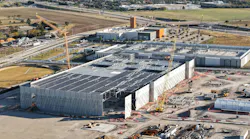
Justified Data is being developed on the site of the former Century Aluminum smelter in Hawesville, a small Ohio River community in western Kentucky.
The property had reportedly consumed approximately 480 MW continuously during its industrial operating life. Rather than beginning with a raw greenfield parcel and waiting years for new transmission facilities, TeraWulf acquired a location where the electrical backbone required to support a hyperscale AI deployment was already substantially present.
The campus has access to as much as 480 MW of gross power capacity, supported by multiple transmission connections and existing substation infrastructure. Under the Anthropic agreement, approximately 401 MW will be delivered as critical IT load.
TeraWulf said the campus will be developed in phases, with initial delivery during the second half of 2027. The company expects to complete the ramp to 401 MW by early 2028. The lease also includes two successive five-year renewal options, potentially extending Anthropic’s occupancy to 30 years. Rent will begin as each portion of the leased premises is delivered.
Anthropic is best known for Claude, its family of large language models and AI assistants. Like other frontier-model developers, the company requires increasingly large clusters of accelerators, high-performance networking and specialized cooling infrastructure for model training and inference.
In 2025, the company announced plans to invest $50 billion in American computing infrastructure, including purpose-built data centers developed with Fluidstack in Texas and New York. The Justified Data lease appears to broaden that infrastructure strategy by establishing a direct, long-term relationship with TeraWulf at a separate Kentucky campus.
The transaction also demonstrates the increasingly complicated network of relationships connecting AI model companies, neocloud providers, data center developers, infrastructure investors and large technology companies.
Fluidstack is a tenant and development partner at several TeraWulf projects. Google has provided financial backing for portions of Fluidstack’s infrastructure commitments and has received an equity interest in TeraWulf through warrants associated with those arrangements. Anthropic, meanwhile, has identified Fluidstack as a development partner for other U.S. infrastructure investments. At Justified Data, however, TeraWulf is emphasizing that it will maintain a direct customer relationship with Anthropic.
TeraWulf Moves Toward Direct Ownership and Control
CEO Prager framed the paired transactions as a deliberate move toward infrastructure platforms where the company controls the assets, operations and customer relationships. He said:
“The Anthropic lease validates our strategy and establishes a long-duration revenue stream with one of the world’s leading AI companies.”
He added that the company’s strategy is centered on owning and operating critical infrastructure, maintaining direct relationships with customers and controlling the long-term evolution of its campuses.
This Model Differs Significantly from the Previous Abernathy JV
TeraWulf and Fluidstack created the Abernathy venture in 2025 to develop a 168-MW critical IT load campus on approximately 120 acres near Abernathy, Texas. The project’s total utility requirement has been described as approximately 240 MW.
Fluidstack committed to a 25-year lease at the campus, with Google providing approximately $1.3 billion of credit support for Fluidstack’s obligations. TeraWulf acquired a 50.1% interest in the joint venture through an investment of approximately $450 million. The project subsequently issued $1.3 billion in senior secured notes to support construction and related expenses.
The Abernathy agreements were expected to produce approximately $9.5 billion in contracted revenue for the joint venture over the initial 25-year term. Construction has been advancing toward delivery during the second half of 2026. Following the sale, Fluidstack and the other purchasers will control the project.
TeraWulf agreed to sell its Abernathy interest for approximately $530 million, compared with its $450 million investment in the joint venture. The consideration is scheduled to be paid in three installments through April 2027, with the proceeds expected to support investment in infrastructure opportunities that TeraWulf intends to own and operate directly.
The decision does not necessarily indicate that TeraWulf has become less interested in partnerships with Fluidstack. Fluidstack remains an important tenant at TeraWulf’s Lake Mariner campus in New York, and the companies have built a substantial pipeline of AI infrastructure together.
In infrastructure terms, TeraWulf is acting as both developer and capital allocator. It originated the Abernathy project, helped secure the customer and financing structure, advanced construction and is now monetizing its interest before the campus begins full operations. As the sale proceeds are received, the capital can be redirected toward sites such as Justified Data, where TeraWulf expects to maintain direct ownership and operational control.
Industrial Reuse Becomes an AI Development Strategy
The Hawesville project extends an operating strategy Data Center Frontier examined during a recent visit to TeraWulf’s Lake Mariner campus in Barker, New York.
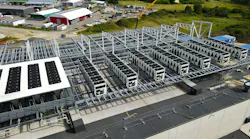
As DCF previously reported, Lake Mariner occupies the site of a retired coal-fired power plant and is being transformed into a large AI and high-performance computing campus. The location retains two 345-kV transmission lines, substation assets and other electrical infrastructure originally built to support industrial-scale power generation. TeraWulf expects the campus ultimately to support as much as 750 MW of capacity.
TeraWulf executives told DCF that the company is deliberately targeting brownfield industrial properties that either generated or consumed substantial quantities of electricity. Such sites frequently include many of the assets that have become the most difficult and time-consuming elements of new data center development: high-voltage transmission access, large substations, industrial zoning, water infrastructure, utility rights-of-way and community familiarity with heavy industrial operations.
During DCF’s Lake Mariner tour, TeraWulf COO and CTO Nazar Khan specifically cited the Kentucky smelter site as an example of the company’s broader approach.
“For forty years that facility consumed roughly 480 megawatts continuously,” Khan told DCF. “It already had five independent transmission lines for redundancy.”
“If you tried to recreate that infrastructure today, the capital expenditure would be enormous,” he added.
TeraWulf closed on the Hawesville acquisition in February and announced the Anthropic commitment roughly five months later, providing commercial validation of its strategy. Although extensive due diligence and customer discussions likely preceded the closing, the speed between acquisition and lease announcement highlights the strategic value of controlling a power-ready industrial location.
For AI developers, the attraction is not merely cheaper real estate. It is the opportunity to address the time-to-power problem. Across North America, proposed hyperscale and AI campuses are encountering utility interconnection studies, transmission constraints, generation shortages and equipment lead times that can delay projects by several years.
A site with existing high-voltage connections and a history of operating as a 400- to 500-MW industrial load begins from a materially different position than an undeveloped parcel seeking an entirely new utility service.
The product changes, but the underlying infrastructure logic remains recognizable: concentrate enormous amounts of energy at an industrial site and convert that energy into a valuable output.
A $19 Billion Contract, With Qualifications
The headline figure attached to the Anthropic lease is approximately $19 billion in revenue over 20 years. Dividing the headline contract value by the initial 20-year term produces a simple average of approximately $950 million annually. That is not necessarily the project’s stabilized annual revenue, however, because rent begins as individual phases are delivered and the revenue profile will reflect contractual escalators, operating terms and other lease provisions.
TeraWulf will still have to finance and construct the campus, purchase or coordinate the delivery of electrical and mechanical systems, meet Anthropic’s technical specifications and operate the infrastructure over the life of the agreement.
At 401 MW of critical IT load, the capital requirement will be substantial.
TeraWulf has already arranged financing capacity associated with Hawesville. In March 2026, the company entered a $500 million delayed-draw senior secured bridge facility whose proceeds could be used to finance construction at the site. The company has also raised capital through securities offerings as it builds its multi-campus HPC platform.
The investment-grade credit support expected behind Anthropic’s rent obligations should make the project more financeable. Long-term leases with creditworthy tenants are generally essential to securing construction loans, private credit, project bonds or other forms of infrastructure capital.
Nevertheless, execution risk remains significant.
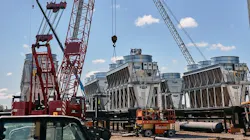
The former smelter site must now be converted into an operating data center. That will require the coordinated delivery of switchgear, transformers, cooling systems, generators, network infrastructure and construction labor before the IT equipment can be installed.
Supply-chain timing remains particularly important for transformers, medium- and high-voltage equipment, chillers, cooling distribution systems and backup-power components. This means that TeraWulf’s experience at Lake Mariner could become an important advantage.
At that campus, the company has worked with Schneider Electric and Motivair on more than $290 million of power, monitoring and liquid-cooling infrastructure. The deployment includes Galaxy VX uninterruptible power supplies, lithium-ion battery systems, coolant distribution units, in-rack manifolds, rear-door heat exchangers and EcoStruxure monitoring software.
What the Transactions Signal for the AI Data Center Market
The Anthropic lease and the Abernathy sale highlight several significant developments in the AI infrastructure sector.
First, AI companies are increasingly seeking dedicated campuses rather than incremental capacity in traditional multitenant data centers.
Second, power-secured sites are becoming financial assets in their own right.
Third, the transactions demonstrate the growing role of capital recycling.
AI infrastructure developers cannot indefinitely retain every project they originate. The cost of building several hundred megawatts at multiple campuses can quickly exceed the balance-sheet capacity of even well-funded public companies.
By selling its interest in Abernathy, TeraWulf can monetize the value created through the project, simplify its reporting and redirect capital toward assets it considers more strategically valuable.
TeraWulf does not describe its primary advantage as access to metropolitan fiber routes, enterprise customers or conventional colocation markets. Its strategy begins with electricity: where large loads can connect, how quickly they can be energized, and which existing industrial assets can be repurposed.
That energy-first model is increasingly relevant as AI campuses grow from tens of megawatts to hundreds of megawatts and, in some proposed developments, multiple gigawatts.
The Next Test Is Execution
The Justified Data announcement gives TeraWulf a marquee AI customer, a 20-year revenue framework and a path toward establishing western Kentucky as a major AI infrastructure market.
TeraWulf must deliver the first capacity during the second half of 2027 and complete the 401-MW ramp by early 2028. The schedule leaves little margin for delays in equipment procurement, utility work, construction or customer deployment.
The project will test whether TeraWulf can reproduce the industrial redevelopment model now underway at Lake Mariner on a larger, customer-dedicated basis.
About the Author
 David Chernicoff