Land & Expand: North America's Data Center Pipeline Expands Under Pressure
Key Highlights
- Large-scale projects like Fluidstack's 1.5 GW AI data center in Texas exemplify the industry's move toward industrial-scale infrastructure supporting advanced computing needs.
- Community opposition and regulatory scrutiny are increasingly influencing project approvals, as seen in Mahomet, Illinois, where public opposition halted negotiations.
- Developers are securing land, power, and water infrastructure while addressing local concerns about environmental impact, noise, and costs, reflecting a more complex development environment.
- Major tech companies like Microsoft, Google, and AWS are expanding their regional footprints with multi-phase campuses, often integrating renewable energy and onsite generation.
- The data center pipeline remains robust, with projects at various stages—from land acquisition to construction—highlighting ongoing industry growth despite rising development challenges.
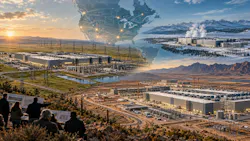
Land & Expand is Data Center Frontier's periodic look at the latest data center development news, including new sites, land acquisitions and campus expansions across North America.
This latest installment finds the development pipeline continuing to expand, even as the requirements for bringing large-scale projects online grow more complicated. Developers are securing land, planning new power infrastructure and advancing campuses measured in hundreds of megawatts or more. At the same time, local governments and residents are demanding greater clarity on electricity costs, water consumption, noise, tax incentives and the long-term effects of industrial-scale computing facilities.
A succession of development disclosures and project milestones through September and early October 2026 illustrates both the geographical reach of North America's expanding data center pipeline and the growing difficulty of measuring how much proposed capacity will ultimately be delivered.
The projects range from preliminary discussions and newly secured development sites to campuses already under construction. Some are advancing through formal permitting and power studies; others remain contingent on customers, financing or local approvals. Together, they reveal an industry still expanding aggressively, but operating under increasingly complex development conditions.
Fluidstack: Cameron County, Texas — Up to 1.5 GW
One of the largest newly disclosed projects is Fluidstack's AI data center development in Cameron County in the Rio Grande Valley. The project surfaced publicly September 10 when Cameron County announced that it had issued Fluidstack a worksite permit for property near Harlingen. The permit authorizes preliminary site work, including grading, utilities and related infrastructure, rather than construction of the data center buildings themselves.
Fluidstack subsequently disclosed considerably more detail on September 21, saying construction had begun on a $4 billion first phase capable of supporting as much as 1.5 GW.
Fluidstack expects the project to generate more than 2,500 construction jobs and several hundred permanent positions. The company has placed unusual emphasis on the project's local infrastructure impact. It says it requested no local property-tax abatements and intends to pay for the energy, water and infrastructure necessary to serve the campus. Cooling will use a recirculating closed-loop system.
At up to 1.5 GW in its announced first phase, Cameron County represents a major addition to the Texas AI development pipeline, reflecting the increasingly industrial scale of projects designed to support advanced computing.
Microsoft ATL50: Union City, Georgia
A new filing for Microsoft's ATL50 campus entered Georgia's Development of Regional Impact review process on September 15. Microsoft filed plans for ATL50, a new data center campus at 5235 Stonewall Tell Road in Union City, southwest of Atlanta. Plans call for two three-story data center buildings totaling approximately 910,000 square feet on 88 acres. The filing projects completion in 2032.
Microsoft already has a substantial Georgia footprint, with development activity in Fairburn, Douglasville, Palmetto, Rome, East Point and other communities. ATL50 represents another proposed campus in the greater Atlanta market rather than entry into a new region. No electrical capacity has been disclosed.
Project Gravel: Pima County, Arizona
Another proposed development emerged through public-records reporting rather than a corporate announcement. Documents obtained in September disclosed Project Gravel, an eight-building data center campus being evaluated on approximately 160 acres of vacant land in unincorporated Pima County west of Sahuarita, Arizona.
Plans show eight buildings of roughly 203,000 square feet each, producing a potential campus of approximately 1.6 million square feet, along with a dedicated electrical substation, roads and parking infrastructure. Project documents contemplate full buildout by 2029, contingent on the development advancing through the necessary approvals.
County staff had reportedly been evaluating the proposal for months before details became public. Neither the developer nor a prospective tenant has been publicly identified, and the planned electrical load remains undisclosed. The disclosure has already generated local concern: Residents gathered September 29 to discuss the project's potential effects on water, energy use and the surrounding environment. Sahuarita officials subsequently clarified that the proposed site lies outside town boundaries, under Pima County jurisdiction.
Project Gravel also illustrates the difficulty in determining the true size of the U.S. development pipeline. Large sites can remain in engineering, environmental and land-use review for months before appearing in conventional industry announcements.
Gray Oak Power: Undisclosed South Texas Campus
Another visible development appeared September 25, although considerably less is known about it. Gray Oak Power disclosed that a South Texas data center campus had advanced through ERCOT's Studied Load Batch Zero process. The company has not disclosed the community, tenant or ultimate campus capacity.
Advancement through ERCOT's Studied Load Batch Zero process confirms that another large-load development is progressing through the Texas interconnection review system, although it does not represent final grid-connection approval. Gray Oak's proposed strategy calls for the campus to begin operating with dedicated onsite generation, followed by a utility grid connection and the eventual ability to supply electricity back to the grid. The company targets initial power in 2028 and utility grid service in 2029. Until the location, electrical load and customer are disclosed, the project remains an early-stage development.
Lambda: Mayes County, Oklahoma
On September 27, AI cloud provider Lambda announced an entirely new data center at the MidAmerica Industrial Park in Mayes County, Oklahoma, near Chouteau.
Lambda has not disclosed either the capital cost or megawatt capacity of the facility, but expects development to support as many as 1,000 construction jobs and 100 permanent positions. The company estimates the project could produce approximately $500 million in taxes over its first decade at current rates.
Unlike many data center announcements of several years ago, Lambda's disclosure immediately addressed electricity costs and water consumption. The company says it will pay the full cost of the energy and infrastructure required to serve the facility, consistent with Oklahoma's Data Center Customer Ratepayer Protection Act. Lambda also plans to use closed-loop cooling to reduce water consumption and is examining ways to shift or reduce certain computing workloads during periods of peak grid demand.
Google/Crusoe: Armstrong County, Texas
One of September's most consequential disclosures concerned a project already well into construction. Google had announced plans for an Armstrong County data center in November 2025, but on September 28, Crusoe identified itself as the developer of the Google AI campus outside Amarillo. Crusoe said construction began in June 2025 and that more than 5,500 skilled workers were now on site daily.
The campus has direct connections to Serena's adjacent 265.5 MW Goodnight 1 wind farm and the 265.5 MW Goodnight 2 project now under construction. Crusoe says excess wind generation can flow to the grid when production exceeds campus requirements. Neither Google nor Crusoe has disclosed the full electrical capacity of the data center campus. Those generation figures should not be confused with the data center's electrical load, which has not been publicly disclosed.
The disclosure illustrates how construction can advance well beyond the initial project announcement before the full development structure becomes public. It also reflects the growing importance of colocating AI infrastructure with large-scale energy resources.
Clean Cloud Energy: Mahomet, Illinois
Illinois offered a different illustration of the pressures shaping data center development. On September 28, the Village of Mahomet disclosed that Clean Cloud Energy had approached the community about a potential data center campus on rural property west of Champaign. Discussions were preliminary but had advanced to include draft language for a possible development agreement. No formal project capacity or investment amount had been announced.
Those discussions came to an abrupt end. On October 5, the village announced that it would no longer pursue the development opportunity with Clean Cloud Energy, citing extensive public opposition. Residents had raised concerns about proximity to homes, noise, lighting, infrastructure requirements and potential impacts on the Mahomet Aquifer. Village President Jason Tompkins said community feedback had played a significant role in the decision not to proceed.
Mahomet provides a counterpoint to the larger projects advancing elsewhere.
The village's decision ended its negotiations with the developer, although it does not establish that Clean Cloud Energy has abandoned broader development ambitions in the region. It also demonstrates that community opposition is no longer simply a public-relations challenge. In some jurisdictions, it can decisively alter the development process before formal permitting begins.
Zone Frontier: Potter County, Texas — 200 MW to 500+ MW
Zone Frontier announced a 30-year ground lease covering approximately 4,077 acres in Potter County, Texas, including land that could support as much as 800 acres of data center development.
The initial concept is approximately 200 MW, with the potential to expand beyond 500 MW. At least 1,800 acres could be used for solar generation, battery storage and associated energy infrastructure. The company has also secured a long-term water agreement. The property also surrounds Southwestern Public Service Company's existing 345 kV Potter County substation, which Zone Frontier identifies as a potential route to grid interconnection alongside its proposed onsite generation resources.
Zone Frontier has not yet secured a tenant, and construction remains contingent on customer commitments, permitting, power arrangements and financing. The lease establishes substantial site control, not a committed construction schedule. Nevertheless, securing more than 4,000 acres with an envisioned development path beyond 500 MW places Potter County firmly within the emerging hyperscale development pipeline.
Beyond the Initial Disclosures: North America's Development Pipeline Widens
The latest development news extends well beyond the projects disclosed during September. Across North America, hyperscalers and infrastructure developers are advancing additional campuses, expanding power commitments and exploring new regional markets. The activity ranges from redevelopment of former industrial properties to sovereign AI infrastructure and entirely new greenfield projects.
AWS Details 36-Building Plan at Pennsylvania's Homer City
In Pennsylvania, additional details have emerged about Amazon Web Services' proposed campus at the former Homer City coal-generating station. An October 6 report described AWS's preliminary land-development plan for 36 data center buildings spread across approximately 1,100 acres in Indiana County, divided among six development areas.
The proposed buildings would each encompass approximately 225,000 square feet, with construction proceeding in four phases. Under the submitted schedule, work could begin in December 2026, with the final phase starting in 2032 and overall completion targeted for 2036. The proposal also includes electrical substations, supporting infrastructure and redundant generation.
As DCF previously reported, Homer City Redevelopment is building a multigigawatt natural-gas generating complex at the former coal plant site, with AWS positioned as a prospective principal power customer. The power development is already under construction, while AWS's data center plans remain subject to the applicable land-use and construction approvals.
The newly detailed building program underscores the scale of the transformation: A retired coal-generation complex could become a long-term, integrated power and computing campus, provided the development and generation timelines converge.
Bell Expands Saskatchewan AI Ambitions Toward 1.2 GW
Canada's emerging AI infrastructure market produced another major development in September when Bell Canada and the Government of Saskatchewan announced a nonbinding agreement to explore up to 900 MW of additional capacity for Bell AI Fabric.
The proposed expansion would build on Bell's previously announced 300 MW campus near Regina, creating a potential 1.2 GW AI infrastructure hub. The company says total investment associated with a full buildout, including data centers, tenant computing equipment and related power generation, could exceed C$50 billion.
The additional capacity is expected to depend on partner-developed natural-gas generation, while Bell says its proposed facilities will use closed-loop cooling without municipal water requirements. Expansion timing will depend on securing customer commitments.
The significance extends beyond the capacity figure. Bell is positioning Saskatchewan as a center of Canadian-controlled AI infrastructure, reflecting the growing importance of data sovereignty alongside power availability and computing scale. However, the additional 900 MW remains a development objective under a nonbinding agreement, not committed operating capacity.
TeraWulf Accelerates Kentucky's Muskie Campus Toward 1 GW
In eastern Kentucky, TeraWulf announced October 5 that it had expanded its contracted power arrangements with Kentucky Power for the Muskie Data Campus from 500 MW to 1 GW.
The amended agreements also accelerate the proposed second 500 MW phase from 2030 to 2029. The first phase remains targeted to begin ramping in 2028, while the revised second-phase schedule depends on Kentucky Public Service Commission approval and the utility's construction timetable.
Unlike an early-stage land acquisition, Muskie's latest development milestone concerns the amount and timing of contracted electrical service. That distinction matters as developers increasingly compete to establish credible schedules for delivering large blocks of power to AI infrastructure customers.
The amendment does not mean the full gigawatt is available today. It does, however, mark a substantive step in transforming an announced campus into a phased development with defined utility-service arrangements.
Mexico: Cuasar Targets 300 MW in Durango
Mexico's data center development pipeline is also extending beyond its established concentration in Querétaro.
Cuasar Capital, associated with Spain's EOSOL group, and infrastructure developer KA URBE IT have announced a partnership to market a proposed AI-oriented data center campus in Durango. The principal facility, DC Norte Uno, is designed for 300 MW of total capacity, including approximately 250 MW of IT load, on a 20-hectare site.
A second proposed facility, DC Norte Dos, would provide approximately 7.74 MW for edge computing and industrial applications. The developers are positioning the campus around high-density AI workloads and connectivity routes linking Durango with established Mexican and cross-border digital infrastructure markets.
The project remains at an early development and commercialization stage. Nevertheless, its proposed scale illustrates how AI infrastructure demand is encouraging developers to explore Mexican markets beyond the country's existing hyperscale clusters.
Ontario: A 400 MW Proposal Confronts Local Planning Questions
In Sault Ste. Marie, Ontario, Algoma Steel and Red Jar Energy Partners have discussed a potential 400 MW AI data center development, illustrating another approach to converting established industrial locations into digital infrastructure.
The parties have sought an early position in Ontario's Independent Electricity System Operator connection process to evaluate the feasibility of the project. An October 2029 operating date has been discussed, but the companies have not announced a binding construction commitment.
Municipal planning presents another obstacle. Sault Ste. Marie's council moved toward preparing an interim-control bylaw that could pause data center development while the city establishes a local regulatory framework.
The proposal therefore remains preliminary. Its significance lies partly in the opportunity to reuse industrial infrastructure, and partly in the challenge of reconciling large new electrical loads with provincial grid planning and municipal approval requirements.
Google Explores New Mexico's Lea County
Google is considering a new data center development in Lea County, New Mexico, potentially establishing its first self-built data center in the state.
In a September 14 announcement, the company acknowledged that discussions were underway but declined to provide a precise site, proposed electrical capacity or development schedule. Instead, Google emphasized early public engagement, responsible water management and commitments to cover the energy and infrastructure costs required by the project.
Lea County's location along the Texas border places the potential development within a broader Southwest corridor attracting increasingly large investments in computing and energy infrastructure.
At this stage, Google's interest represents market exploration rather than a committed construction project. It is nonetheless another indication that hyperscale site selection is moving into regions beyond the industry's traditional development centers.
Additional Projects to Watch: Filings, Expansions and Capacity Milestones
A further group of developments illustrates how much activity is moving through permitting, construction and utility planning outside the industry's largest headline announcements.
Project Longhorn, Bastrop County, Texas: An October filing identifies a proposed $366 million first data center building in Cedar Creek, encompassing approximately 498,000 square feet. The broader development has been linked in reporting to a proposed gas-fired power complex capable of supporting approximately 490 MW of IT load. Anthropic has been identified as a possible tenant in related reporting, but its participation has not been confirmed. The filing supplies a more concrete development marker than the previously reported tenant discussions.
Microsoft, Prince William County, Virginia: Microsoft has filed plans for the MNZ07 Wellington Data Center, consisting of two single-story buildings and an onsite substation on approximately 123 acres near Gainesville. The proposal includes federal environmental review because of potential impacts on wetlands and streams. It represents additional hyperscale development in Northern Virginia even as local governments tighten rules governing where new campuses can be built.
Skybox and Prologis, Hutto, Texas: The partners have filed plans for Skybox Hutto 4, an approximately 846,300-square-foot building with a reported development cost of $550 million. The fourth facility would become the largest building proposed at their PowerCampus development, which is targeting 600 MW of IT capacity across the broader site.
Applied Digital, Ellendale, North Dakota: Not every milestone concerns proposed capacity. Applied Digital announced that another 75 MW of critical IT load had reached ready-for-service status at its CoreWeave-leased Polaris Forge 1 campus. The milestone brings completed campus capacity to 250 MW, toward a planned 400 MW full buildout. This is a more tangible measure of deployment progress than an early-stage site announcement.
ThisWay Global, Bryan, Texas: A proposed 73 MW Research and AI Compute Center at Texas A&M-RELLIS would provide computing infrastructure for research, government and industry users. Planned for phased development on approximately 25 acres, the project would use direct-to-chip liquid cooling and remains subject to the necessary approvals.
Taken together, these additional developments reinforce the central distinction emerging across North America. Some developers are acquiring land or introducing proposals; others are securing power agreements, advancing environmental reviews or completing facilities capable of serving customers. The pipeline continues to grow, but the distance between an announced megawatt and an operational one remains a defining measure of development progress.
The Pipeline Grows Under Closer Scrutiny
These development disclosures arrive amid intensifying scrutiny of the industry's expansion. On July 18, opponents organized 142 demonstrations across 42 states in a coordinated national protest of data center development. A Reuters/Ipsos survey published in June found that only about one-third of Americans supported the rapid pace of construction, while just 14% said they would welcome a data center in their own community.
The pressure continued into September. On September 15, Loudoun County, Virginia, supervisors voted to consider a resolution that could pause final action on certain data center and electrical substation applications requiring legislative approval for up to 12 months. The resolution is scheduled for consideration October 20. In Chicago, Mayor Brandon Johnson introduced a proposal for a one-year moratorium on permits and approvals for new or expanded data centers while city officials study their power, water and community impacts. Neither action represented an enacted moratorium as of October 12.
The pressure continued into September. Loudoun County, Virginia voted September 15 to develop a process that could pause final action on certain new data center and substation applications for as long as 12 months while the county rewrites its policies. Chicago Mayor Brandon Johnson has proposed a 12-month moratorium on new data centers within the city while officials study their power, water and community impacts.
Yet the flow of development announcements continues. What has changed is the level of scrutiny that accompanies them. New project disclosures increasingly address ratepayer protection, closed-loop cooling, onsite generation, water availability and infrastructure financing alongside investment, construction schedules and job creation. Those commitments reflect an industry adjusting to the realities of developing power-intensive infrastructure at unprecedented scale.
The emerging distinction is between securing a development opportunity and demonstrating that it can be delivered. Land, electrical capacity, financing, permitting and community acceptance are increasingly interdependent requirements. As the latest projects illustrate, the North American data center pipeline remains substantial, but the path from proposed campus to operating infrastructure is becoming more demanding.
At Data Center Frontier, we talk the industry talk and walk the industry walk. In that spirit, DCF Staff members may occasionally use AI tools to assist with content.
Keep pace with the fast-moving world of data centers and cloud computing by connecting with Data Center Frontier on LinkedIn, following us on X/Twitter and Facebook, as well as on BlueSky, and signing up for our weekly newsletters using the form below.
About the Author
 David Chernicoff
David Chernicoff
 Matt Vincent
Matt Vincent
Matt Vincent is Editor in Chief of Data Center Frontier, where he leads editorial strategy and coverage focused on the infrastructure powering cloud computing, artificial intelligence, and the digital economy. A veteran B2B technology journalist with more than two decades of experience, Vincent specializes in the intersection of data centers, power, cooling, and emerging AI-era infrastructure. Since assuming the EIC role in 2023, he has helped guide Data Center Frontier’s coverage of the industry’s transition into the gigawatt-scale AI era, with a focus on hyperscale development, behind-the-meter power strategies, liquid cooling architectures, and the evolving energy demands of high-density compute, while working closely with the Digital Infrastructure Group at Endeavor Business Media to expand the brand’s analytical and multimedia footprint. Vincent also hosts The Data Center Frontier Show podcast, where he interviews industry leaders across hyperscale, colocation, utilities, and the data center supply chain to examine the technologies and business models reshaping digital infrastructure. Since its inception he serves as Head of Content for the Data Center Frontier Trends Summit. Before becoming Editor in Chief, he served in multiple senior editorial roles across Endeavor Business Media’s digital infrastructure portfolio, with coverage spanning data centers and hyperscale infrastructure, structured cabling and networking, telecom and datacom, IP physical security, and wireless and Pro AV markets. He began his career in 2005 within PennWell’s Advanced Technology Division and later held senior editorial positions supporting brands such as Cabling Installation & Maintenance, Lightwave Online, Broadband Technology Report, and Smart Buildings Technology. Vincent is a frequent moderator, interviewer, and keynote speaker at industry events including the HPC Forum, where he delivers forward-looking analysis on how AI and high-performance computing are reshaping digital infrastructure. He graduated with honors from Indiana University Bloomington with a B.A. in English Literature and Creative Writing and lives in southern New Hampshire with his family, remaining an active musician in his spare time.
Related
Voices of the Industry
 Source: SNEHIT PHOTO/Shutterstock.com
 Source: Matthew G Eddy/Shutterstock.com