When the Project Comes Back
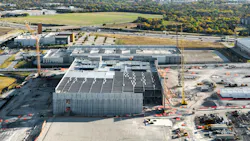

The project was moving. Then it stopped.
Power permitting stalled. A supplier hit a production delay. Financing got restructured. The reasons vary, but the outcome is the same: a data center build that was in progress goes on hold, sometimes for weeks, sometimes for months.
When the project restarts, the assumption is that the plan picks up where it left off. The drawings are the same. The equipment is the same. The installation sequence was documented. The lift plans were written.
The assumption is wrong.
The Scale of the Problem
Paused and delayed data center projects are no longer the exception. According to analysis by Sightline Climate published earlier this year, approximately half of the data centers planned to come online in the US in 2026 are likely to face delays or cancellations. Project cancellations in 2025 reached 25, up from six the year prior. Transformer lead times, which ran 24 to 30 months before 2020, now stretch to five years in some cases.
The industry built its project planning assumptions around continuous momentum. Supply chain constraints, permitting delays, power access timelines, and local opposition have broken that assumption for a significant share of active projects.
The question of what happens to rigging and installation planning when a project pauses and restarts has not received much attention. It should.
A Paused Site Does Not Stay Still
A construction site in a pause state is not frozen. It continues to change.
Steel that was open when the pause began may be enclosed when work resumes. MEP rough-in may have advanced in one phase while another was on hold. Ductwork, conduit, and cable tray alter overhead clearances and affect haul paths. Structural elements that were not yet in place when the original lift plans were written are now permanent fixtures that define what can move where and how.
Equipment that was staged on site during the pause has been repositioned to accommodate other trades, exposed to additional weather cycles, or moved to offsite storage without a clear plan for how it returns. Vendor relationships have shifted. Lead times have lengthened. The crew that originally planned the work may not be the crew that executes it.
When a project restarts, the plan that was written to govern installation was written for a site that no longer exists.
Lift Plans Expire
A lift plan is a document built for specific conditions. It reflects a specific crane, a specific rigging configuration, a specific haul path, a specific below-the-hook assembly designed for a specific unit with specific lifting points.
Change any one of those variables and the plan requires re-evaluation. On a paused project, multiple variables change simultaneously.
The haul path that was walked and confirmed before the pause may now pass through an enclosed space, under a lower ceiling, or through an opening that has been framed differently than planned. The crane position that was selected based on site conditions at the time of planning may be occupied by other equipment or no longer accessible from the same approach. The lift sequence that was written to align with a specific installation schedule may no longer be valid because that schedule has been restructured.
Treating a pre-pause lift plan as a current document is not a procedural shortcut. It is a safety risk. The plan describes conditions that no longer exist.
The Restart Pressure Problem
Projects that resume after a pause face a specific kind of schedule pressure. There is lost time to recover. There are stakeholders and owners who have been waiting. There is momentum to rebuild.
That pressure is precisely the environment in which planning discipline erodes. The instinct is to move quickly, to demonstrate progress, to avoid what feels like delay. Re-walking haul paths, reconfirming crane selection, and re-engineering lift sequences can look like overhead when the priority is forward motion.
In heavy rigging, that trade-off is false. The delays that come from inadequate planning do not show up during the planning phase. They show up during execution, when correcting them is more expensive, more disruptive, and more visible to everyone on the job.
Moving fast through a restart without resetting the rigging plan does not accelerate the project. It transfers the cost of that speed to a later moment when there is less room to absorb it.
What a Rigorous Restart Actually Looks Like
Restarting a paused project is not a matter of issuing a notice to proceed and picking up from the last documented milestone. From a rigging and installation standpoint, it is a replanning event.
That means walking every haul path from scratch, with current site conditions, not the conditions that existed at the last site visit. It means reconfirming crane selection against the actual rigging configuration for each lift, accounting for any changes to access, ground conditions, or adjacent structures since the original plan was developed.
It means verifying that equipment that was staged or stored during the pause is still in the condition the plan assumed, that lifting points have not been compromised, that center-of-gravity information is still valid, and that below-the-hook configurations designed for original specifications still apply.
It also means resetting sequencing assumptions. The installation order that made sense against the original schedule may not make sense against the revised one. Crane windows, trade coordination, and commissioning dependencies may all have shifted.
None of this is complex in concept. All of it requires discipline in execution, especially under the schedule pressure that a restart typically carries.
Involving the Rigging Contractor Early in the Restart
The projects that restart most effectively are the ones that bring the rigging contractor into the conversation before the notice to proceed, not after it.
At ProLift Rigging, the projects we have seen recover fastest from a pause are the ones where the replanning conversation starts while the scope of change is still being assessed. That timing matters because it allows the rigging plan to inform decisions about sequencing and access, rather than accommodate them after those decisions have already been made.
A rigging contractor re-engaged late in the restart process inherits a set of constraints that were established without rigging input. Those constraints are manageable in most cases. But managing them is not the same as designing around them.
The cost of that difference is not always visible in the budget. It shows up in crane time, in field engineering hours, in rehandling, and in the small delays that accumulate into schedule erosion over the back half of the project.
The Industry Is Entering a New Phase
The pause-and-restart dynamic is not a temporary condition. It reflects a structural shift in the environment that data center construction is operating in.
Power permitting timelines are not getting shorter. Supply chain lead times for critical electrical equipment remain extended. Local opposition to large data center projects is increasing in a growing number of markets. The volume of projects announced far exceeds the volume that will build on schedule.
Project teams that develop the discipline to manage pauses well, and to treat restarts as replanning events rather than resumptions, will recover faster and lose less ground than those that carry forward assumptions that no longer hold.
In rigging and installation, that discipline starts with a simple acknowledgment: the plan written before the pause was written for a different project.
Treat the restart as a new planning event. Build the plan for the site as it exists now. The rest of the recovery depends on that foundation.
About the Author
 Bill Tierney_PLR
Bill Tierney_PLR
Bill Tierney is Chief Strategy Officer (CSO) | Project Development | Branch Leadership for The ProLift Rigging Company. Bill is a rigging and heavy transport leader with experience in the industry since 1999, including project development and branch management roles since 2010. He has deep background delivering engineered rigging, crane, and heavy transport solutions for complex work at U.S. refineries, nuclear facilities, and large-scale data center new-builds. Bill is known for developing alternative rigging approaches that overcome severe site constraints and improve safety, feasibility, and execution.
Voices of the Industry
 Source: Nimbus Advanced Process Cooling
 Image courtesy of Bell & Gossett