ISE Expo 2026: DCF Takes Stage with JLL, TIA

AI Infrastructure’s New Calculus: Speed, Quality and the Race to Revenue
NASHVILLE — The defining question in data center development has become brutally simple: How quickly can a site get to revenue?
Power availability sits at the center of that calculation. But as AI pushes development into new geographies and compresses construction schedules, an increasingly complicated set of infrastructure dependencies sits behind the megawatts — equipment, suppliers, construction capacity, fiber, optical connectivity, workforce and the quality systems needed to make all of it work reliably.
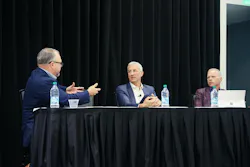
That tension framed a Data Center Frontier-led fireside discussion at EndeavorB2B's ISE Expo 2026 between Sean Farney, Vice President of Data Center Strategy at JLL, and Dave Stehlin, CEO of the Telecommunications Industry Association (TIA).
The conversation began with a new data center quality initiative. It quickly expanded into something larger: an examination of what happens when time to revenue becomes the organizing principle for an entire infrastructure industry.
“There is absolutely, positively no room for pause right now,” Farney said.
DCE 9000 Meets the AI Buildout
For TIA, the answer begins with a problem Google brought to the association last year.
According to Stehlin, Google was seeing recurring quality and delivery problems among operational technology suppliers — the companies providing equipment such as generators, cooling systems and other physical infrastructure required to make a data center operate.
TIA responded by developing DCE 9000, or Data Center Excellence 9000, a third-party-certifiable quality management standard for the data center infrastructure supply chain.
Stehlin said more than 70 companies are now participating in the effort, ranging from hyperscalers and data center operators to major infrastructure manufacturers. The first draft is expected in September.
That is an unusually compressed development cycle for an industry standard.
“Typically standards take five years to get implemented,” Stehlin said. “In nine months, we’re getting the first standard draft out, because we’ve got to get to revenue fast.”
DCE 9000 is not intended to prescribe how an individual manufacturer designs a generator, chiller or electrical system. Instead, it establishes measurable processes around areas such as supplier management, software control, failure response, corrective action and continual improvement.
Third-party certification would then allow an owner or operator to require suppliers to become DCE 9000 certified — or demonstrate that they are working toward certification.
For suppliers, Stehlin said the potential advantage is equally important. A common framework could replace layers of customer-specific qualification requirements with a more consistent set of expectations.
That could ultimately shorten product-development cycles rather than extend them.
The Speed-Quality Paradox
That proposition produced the central tension of the conversation.
Data center operations have always been deeply procedural. Facilities run on methods of procedure, standard operating procedures, service-level agreements, maintenance schedules and meticulous tracking of equipment performance.
Farney said the mechanical and electrical side of the industry is therefore likely to embrace a framework that can improve reliability.
Development is another matter.
Those teams are operating under extraordinary schedule pressure as hyperscalers, neocloud providers and AI companies compete for capacity.
“They’re being driven at the speed of Wall Street to get this facility up, lights on, into production,” Farney said.
The pressure has become visible at the highest corporate levels, with infrastructure delivery schedules increasingly discussed on earnings calls.
JLL's latest North America market research puts the scale in perspective. More than 66 GW of data center capacity is now under construction in North America, with the overwhelming majority already committed.
Against that backdrop, Farney said anything perceived as adding time to a development schedule will face resistance.
“There is absolutely, positively no room for pause right now,” he said. “The delivery schedules are full for the next three years.”
That means DCE 9000 may ultimately need major customers to create the adoption pressure.
Farney suggested Google and other large buyers could establish a future date after which certification becomes part of their supplier requirements. Stehlin described a similar progression: establish the framework, allow an initial voluntary period and eventually move toward broader requirements.
The wager is that the industry eventually gets the time back.
Common qualification standards could reduce redundant audits, clarify supplier expectations and limit failures and rework — turning quality management into another tool for accelerating deployment.
“You have to do it right the first time,” Stehlin said.
Fiber Becomes Table Stakes
The same speed-to-revenue logic is changing another longstanding element of data center site selection: Fiber.
Farney deliberately put the point provocatively.
“Fiber doesn’t matter anymore,” he said.
His larger point was exactly the opposite. Fiber matters so much that it has effectively become table stakes.
Data center developers increasingly assume that if a site offers the land and power required for a major development, connectivity can be extended to reach it.
“If I’ve got to drag fiber, I’m going to drag fiber in there,” Farney said.
That represents a significant change from an earlier generation of site selection, when developers clustered around established network hubs and major metropolitan markets.
The AI buildout is increasingly reaching places such as Abilene and Amarillo in Texas, Wisconsin Rapids, Fort Wayne and locations across Louisiana and rural Ohio — markets where infrastructure may have to follow the project rather than precede it.
In some respects, Farney said, building fiber into those markets can actually be easier. Rural rights-of-way and trenching can present fewer obstacles than dense metropolitan construction.
“We can run it, we can get it going, we can connect it,” he said. “Power takes 10 years if you want 500 megawatts.”
The surprising connectivity bottleneck may increasingly be inside the data center itself.
Stehlin pointed to the growing role of optical connectivity within AI infrastructure as copper links give way to fiber deeper into the compute environment.
Farney said the transformation is already visible inside GPU facilities.
“Layer 1 is cool again inside the data center,” he said.
The quantities of cabling, transceivers and associated components required for AI systems have grown dramatically, creating situations where the backlog for components inside the building may present a greater challenge than extending a large fiber route to the campus.
That turns the conventional connectivity discussion on its head: the long-haul network may be ready before all of the pieces required to connect the AI hardware inside the facility.
From Frontier Markets to ‘Insta-Markets’
Power availability is also breaking apart the traditional geography of the data center industry.
Farney recalled an earlier model built around a long list of site-selection variables — power, connectivity, land, taxes, labor, regulation and proximity to established infrastructure.
Today, those variables remain relevant. Their hierarchy has changed.
“Now it’s, well, if we can get this site up, we’ll figure out some of the deficiencies,” Farney said.
He described the result as the rise of “insta-markets”: data center clusters emerging rapidly around unusually strong combinations of land, development conditions and access to energy.
Farney cited Quincy, Washington — where inexpensive hydroelectric power helped create one of the early frontier data center markets — as a precursor to what is now occurring on a much larger scale.
JLL sees the trend accelerating across Texas, Ohio, Louisiana, Indiana and the Carolinas.
The surrounding infrastructure ecosystem increasingly gets built around the opportunity.
Farney pointed to Abilene, where large projects required companies to recruit and relocate workers, create training pipelines and even provide temporary housing for the construction and technical workforce.
“The industry is very resilient in figuring this out if there’s a place identified where you can get to revenue,” he said.
That resilience is also changing the weight assigned to mature data center ecosystems.
A market may be short on labor, carrier density or experienced contractors. If developers believe those shortcomings can be solved faster than the power problem somewhere else, the site remains in play.
Power Moves Behind the Meter
No infrastructure problem in the discussion, however, carried the weight of power.
Farney said he is seeing significant development in which natural gas generation is being incorporated directly into the data center power strategy.
Initially, behind-the-meter generation was commonly framed as bridge power — a way to begin operating before the utility completed the transmission, generation and substation infrastructure required for the full campus.
Longer grid timelines are changing that calculation.
“As the story gets gloomier and gloomier with expected wait times for the buildout of large-scale transmission and production for utilities, it’s becoming the source,” Farney said.
He described projects contemplating natural gas as primary generation, with other fuels or utility service providing additional resilience.
For the near term, Farney sees natural gas playing a major role in markets with abundant supply, particularly Texas.
Longer term, he expects advanced nuclear generation to become increasingly important as operators seek large quantities of reliable power with greater independence from existing grid constraints.
For developers chasing AI demand today, however, the immediate requirement remains simpler: find a credible path to electrons and move.
Community Acceptance Enters the Equation
There is another constraint that developers cannot engineer away as easily.
Both Farney and Stehlin pointed to increasing community resistance to data center development.
Stehlin said the tone of his discussions with policymakers has changed sharply during 2026 as concerns around power, water, noise and local development have become more prominent.
Farney argued that the industry has historically done a poor job communicating the infrastructure investment, tax base, construction activity and other economic benefits associated with data center development.
The consequence is increasingly tangible in site selection.
Community acceptance, permitting risk and local political conditions are becoming part of the same first-pass calculation as power and land.
Developers facing prolonged opposition can simply look elsewhere.
That dynamic matters as the industry becomes less dependent on a handful of traditional markets. The ability to create infrastructure around new sites gives developers more geographic optionality — and gives communities more influence over whether investment arrives.
The Risk of Moving Too Slowly
The conversation ultimately returned to the same pressure that had surfaced around standards, fiber, geography and power.
Speed.
Asked what risk currently weighs most heavily on developers, Farney did not point to fiber shortages, equipment failure or even power itself.
“The number one perception of risk today to data center developers and operators is not moving fast and getting usurped by a competitor,” he said.
That pressure explains much of the experimentation underway across the industry: new power architectures, compressed construction schedules, phased commissioning, new markets, alternative suppliers and increasingly aggressive infrastructure development.
It also explains why the DCE 9000 discussion matters.
The AI infrastructure race has created enormous incentives to move faster. Sustaining that pace will eventually require making the underlying process more repeatable.
Stehlin's argument is that quality management becomes part of that infrastructure.
Farney's argument is that the industry first has to demonstrate that quality can be incorporated without stopping the machine.
The session pointed toward a harder definition of speed-to-market.
Finding land is not enough. Securing power is not enough. Extending fiber is not enough.
The finish line is a facility that is powered, connected, commissioned and reliably producing compute.
AI may have simplified the opening question in data center site selection to “Where can I get to revenue fastest?”
Everything required to answer it is getting more complicated.
At Data Center Frontier, we talk the industry talk and walk the industry walk. In that spirit, DCF Staff members may occasionally use AI tools to assist with content.