OCP 2026: AI Infrastructure Moves From Scaling to Coordination
Key Highlights
-
Microsoft's Maia 300 roadmap and full-stack co-design strategy reflect the industry's shift toward optimizing AI inference performance per watt and per dollar.
-
Oracle calls for standardized interfaces between AI data centers and power grids as hyperscale loads create new challenges for utilities and operators.
-
Intel and HPE emphasize heterogeneous, workload-specific computing architectures rather than one-size-fits-all AI infrastructure.
-
Google advances the concept of AI for systems, applying artificial intelligence to hardware design, data center operations, capacity planning, and infrastructure efficiency.
The next phase of AI infrastructure development may depend less on building bigger systems than on making increasingly complex systems work together.
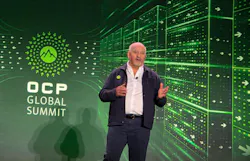
That was a central message running through the second day of keynotes at the 2026 Open Compute Project (OCP) Global Summit in San Jose, where executives from Microsoft, Oracle, HPE, Intel, Google, and the electrical infrastructure industry described an emerging need to coordinate computing, networking, power, cooling, security, and operations as parts of a unified architecture.
The discussions extended the opening day's focus on the transformation of data centers into AI factories, shifting attention from the architectural scale of the challenge toward the standards, interfaces, and management capabilities required to make that scale operationally sustainable.
Across the presentations, several themes converged. AI inference is increasingly shaping hardware decisions. Power delivery must be engineered in concert with utility infrastructure. Accelerators, CPUs, and networks must operate within more heterogeneous environments. And artificial intelligence itself is becoming a tool for designing and operating the infrastructure on which it depends.
Together, these developments suggest that the industry's next competitive frontier will be defined not simply by installed compute capacity, but by how effectively that capacity can be delivered, managed, and converted into useful work.
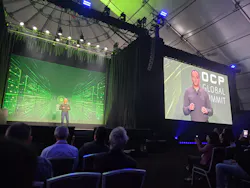
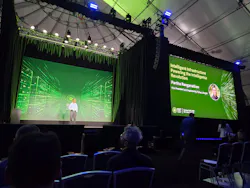
Reynold D’Sa, Microsoft Corporate Vice President of Silicon, Cloud Hardware, and Infrastructure Engineering, addresses the Day 2 keynotes at OCP Global Summit 2026, outlining Microsoft's full-stack AI infrastructure strategy, including its Maia accelerators, 800V DC power architecture, advanced cooling, and open standards for scaling AI from chip to grid.
Microsoft: From Frontier Models to Frontier Infrastructure
Microsoft Corporate Vice President Reynold D'Sa framed the shift around the transition from increasingly powerful frontier models toward their broader deployment throughout enterprise applications and workflows.
The goal, D'Sa argued, is not simply to produce more intelligence, but to make AI useful and accessible across an expanding range of applications.
"There can be no frontier firm without a frontier infrastructure," he told attendees.
That infrastructure must be optimized for more than raw computational performance. Microsoft is increasingly measuring its architecture in terms of useful intelligence delivered from every watt, byte, chip, and dollar invested.
Central to the strategy is full-stack co-design, bringing silicon, software, models, networking, power distribution, and cooling into a coordinated engineering process.
D'Sa highlighted Microsoft's newly announced Maia 300 accelerator, its next-generation inference system scheduled to begin production deployments in 2027.
Microsoft expects Maia 300 to deliver up to seven times the rack-scale token throughput of Maia 200, its current-generation accelerator, while providing approximately 40% more tokens per megawatt than leading GPU-based systems. The company plans to scale its Maia infrastructure to multi-gigawatt deployments beginning in 2027.
The architectural significance extends beyond Microsoft's custom silicon.
D'Sa pointed to the Cobalt 200 CPU, designed for the orchestration, retrieval, memory management, and service calls associated with agentic workloads, as another example of infrastructure requirements moving beyond conventional GPU-centric computing.
In networking, Microsoft's multipath reliable connection technology is intended to support clusters exceeding 100,000 GPUs using a two-tier network architecture. The company also continues to advance open optical interconnect specifications and Ethernet-based scale-up networking through OCP.
Power and cooling are receiving similar attention.
Microsoft's Mount Diablo architecture separates power conversion from compute racks, enabling the two systems to scale independently while supporting 800-volt DC distribution. The company is also participating in efforts involving solid-state transformers and common utility-grid interface specifications.
Meanwhile, its third-generation Mount Atlas heat exchanger unit is designed to nearly double cooling capacity within the same operational footprint.
Taken together, the efforts represent a broader change in infrastructure planning: individual components are no longer sufficient units of optimization. The efficiency of the complete system increasingly determines the economics of the AI service it supports.
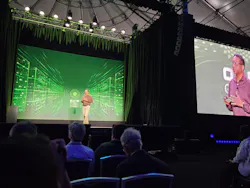
Pradeep Vincent, Vice President of Compute and AI Infrastructure at Oracle Cloud Infrastructure (OCI), addresses the Day 2 keynotes at OCP Global Summit 2026, calling for industry-wide standards governing how large-scale AI data centers interact with power grids, while emphasizing energy efficiency, cooling reliability, and responsible infrastructure development.
Oracle: The Grid Interface Becomes an Infrastructure Standard
Oracle Executive Vice President Pradeep Vincent brought a different emphasis to the discussion, arguing that the consequences of AI infrastructure engineering now extend directly into surrounding communities and regional power systems.
As data centers grow toward hundreds of megawatts and beyond, their power characteristics become important not only to the operator, but also to the utility or microgrid supporting the facility.
This creates an expanding responsibility for the data center industry to coordinate its engineering decisions with the infrastructure outside its property boundaries.
Vincent described a growing need for common standards governing how large AI facilities interact with power providers.
Historically, cloud operators could make individual engineering decisions about equipment, cooling, and electrical infrastructure without significantly affecting the wider power grid. That separation is becoming increasingly difficult to maintain.
AI workloads introduce rapid changes in power consumption, requiring closer coordination among chip designers, UPS and battery energy storage vendors, data center operators, and utilities.
Vincent noted that grid interconnection requirements are still evolving on a site-by-site basis, creating uncertainty for equipment manufacturers and infrastructure developers.
A standardized approach could establish common expectations for load ramp rates, frequency response, power controls, and the behavior of data center equipment during grid disturbances.
The implications extend into how the industry measures efficiency.
Vincent questioned the adequacy of relying primarily on Power Usage Effectiveness (PUE), suggesting that operators must increasingly evaluate efficiency in terms of actual AI output, including the energy required to generate tokens.
Cooling reliability also featured prominently. Vincent warned that increasingly complex liquid cooling systems introduce additional operational risks that must be addressed through common specifications and engineering practices.
Likewise, the enormous number of optical connections in AI clusters creates new requirements for fault detection, telemetry, and rapid isolation of failing components.
For Oracle, the common issue across these disciplines is the need to move from isolated engineering solutions toward repeatable industry-wide standards.
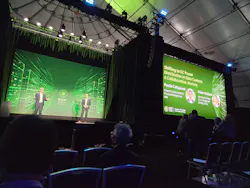
800V DC: From Concept Toward Interoperable Deployment
The argument for standardized power infrastructure was reinforced by ABB's Paolo Catapane and Eaton's Peter De Bock, who examined the industry's transition toward higher-voltage direct-current distribution.
As AI racks advance from power densities measured in tens of kilowatts toward hundreds of kilowatts and potentially megawatt-scale configurations, traditional low-voltage distribution becomes increasingly difficult to scale efficiently.
Higher voltages reduce the electrical current required to deliver a given amount of power, creating opportunities to reduce copper requirements, resistive losses, and heat.
De Bock emphasized that 800V DC should be understood not as a standalone product, but as an architecture supporting more efficient delivery of power into increasingly concentrated computing environments.
The larger challenge now involves establishing a sufficiently broad ecosystem of interoperable components.
Catapane outlined the work underway through OCP's power distribution initiative, including common requirements for voltage tolerances, connectors, protective devices, and system behavior under fault conditions.
Safety remains a critical dimension. Solid-state circuit breakers and other power electronics can respond to electrical faults much faster than traditional mechanical devices, providing new options for protection and fault management.
The speakers emphasized that the industry has developed an initial collaborative foundation for DC distribution but must now advance more detailed system-level specifications.
For data center developers, that work could prove essential to reducing the risks associated with adopting power architectures that will require equipment from numerous suppliers to operate together over extended infrastructure lifecycles.
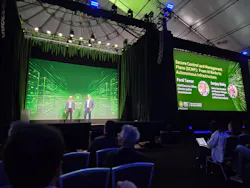
Toward the Self-Managing AI Data Center
The growing complexity of AI infrastructure also creates a management problem.
During a joint presentation, Lattice Semiconductor CEO Ford Tamer and AMI executive Sanjoy Maity introduced the Secure Control and Management Plane (SCMP), a new OCP workstream intended to support more autonomous infrastructure operation.
The initiative addresses a structural challenge in modern AI data centers: computing, networking, cooling, firmware, and security systems have traditionally been managed through separate mechanisms, even as their operations become increasingly interdependent.
SCMP seeks to establish common interfaces and an open framework for coordinating those systems from silicon through racks and pods.
Microsoft's Naga Gurumurthy reinforced the need for infrastructure capable of detecting, diagnosing, and responding to problems with less human intervention.
The objective is not simply automated monitoring. It is an environment in which trusted telemetry, firmware controls, security policies, and operational systems can support coordinated decisions across large fleets.
The initiative complements Microsoft's own work on self-managing infrastructure, which D'Sa described as progressing from automated diagnosis and repair toward predicting potential failures before they interrupt customer workloads.
As the economic value of individual AI clusters increases, the reliability of the management architecture becomes increasingly consequential.
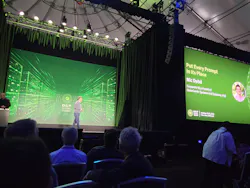
Intel and HPE: The Case for Heterogeneous AI
If Microsoft emphasized full-stack optimization, Intel and HPE made a complementary argument: the future of AI infrastructure will not be served by a single computing architecture.
Intel Corporate Vice President Nic Dubé characterized the industry's recent development as an AI gold rush, dominated by the rapid deployment of increasingly large training systems.
The next phase, he suggested, will require a more sustained and economically disciplined approach.
Not every request needs to be processed by the largest available model, and not every workload belongs in a massive centralized AI factory.
Intel's answer includes workload-aware routing, open software, and a broader mix of computing resources tailored to different inference requirements.
At OCP, the company presented new details of its GPU D-series, previously code-named Crescent Island, designed for memory-intensive inference using an air-cooled PCIe architecture operating within a 350-watt power envelope.
The platform supports configurable memory capacities, with partner designs allowing up to 480 GB, and is intended to make substantial inference workloads practical within existing data center environments.
Dubé also highlighted the continuing importance of Xeon CPUs for agent orchestration, code execution, retrieval, and other operations surrounding accelerator-intensive inference.
His larger argument was that AI infrastructure should be capable of placing each workload on the most appropriate computing resource, rather than assuming every application requires the same expensive accelerated architecture.
HPE Senior Vice President Trish Damkroger echoed the need for architectural diversity.
She described a future in which AI increasingly operates as a service across cloud, enterprise, sovereign, and edge environments, with different requirements for processors, memory, networking, and system integration.
HPE is applying its supercomputing heritage to that emerging environment through modular hardware systems, open Ethernet networking, and direct liquid cooling.
The company's Cray Supercomputing GX5000 platform, which will underpin Oak Ridge National Laboratory's planned Discovery system, illustrates the convergence of traditional high-performance computing and modern AI infrastructure.
Both Intel and HPE positioned open standards as a means of preventing the next generation of AI infrastructure from becoming fragmented across incompatible hardware and software ecosystems.
Google: Using AI to Engineer the AI Factory
Google Vice President and Engineering Fellow Parthasarathy Ranganathan closed the keynote program by extending the discussion beyond infrastructure designed for AI toward infrastructure increasingly designed and operated with AI.
The distinction was central to his presentation.
For several years, hyperscalers have pursued progressively more sophisticated custom systems to meet the demands of artificial intelligence. Google's own approach has included TPUs, custom CPUs, optical networking, power distribution, liquid cooling, and extensive hardware-software co-design.
But Ranganathan argued that the next opportunity involves applying AI directly to the processes of systems engineering.
Google has already been pursuing the concept of agile and fungible data centers, capable of accommodating changing generations of computing hardware without requiring fundamental redesigns of every supporting system.
Its OCP contributions include Project Deschutes, an open cooling distribution unit architecture; Project Brazos, intended to bring liquid cooling capabilities into existing air-cooled facilities; and power distribution specifications supporting higher-voltage DC architectures.
Ranganathan also highlighted collaborative work involving Google, Meta, Microsoft, and NVIDIA on specifications intended to improve coordination between AI data centers and utility systems.
Those efforts address the physical infrastructure required to support AI.
The next stage, he suggested, is to apply AI to the engineering processes themselves.
Google is exploring AI-assisted hardware architecture, automated software vulnerability detection and repair, data center climate modeling, and infrastructure capacity planning.
Among the examples Ranganathan discussed were agentic systems capable of evaluating computer architecture choices and accelerating engineering workflows, alongside AI-assisted tools for software maintenance and operational optimization.
In data center design, the company is applying AI and climate modeling to decisions involving cooling capacity, extreme weather risk, and long-term infrastructure investment.
The approach could enable more site-specific designs, reducing the need to rely on broad assumptions about operating conditions throughout a facility's useful life.
Ranganathan also emphasized AI's potential to improve manufacturing, supply chain management, deployment planning, and the delivery of new data center capacity.
These applications suggest an expanding role for AI within the infrastructure development cycle itself.
Rather than functioning solely as a workload consuming increasingly large amounts of computing infrastructure, AI could become a means of reducing the cost, complexity, and time required to build that infrastructure.
Open Infrastructure Enters Its Next Phase
Across the OCP keynotes, the most important development was not a single accelerator, power specification, or cooling system.
It was the increasing recognition that AI infrastructure must be designed around the coordinated behavior of the entire system.
The challenges extend from silicon and networking through rack-level power and cooling to utility interconnections, security frameworks, and autonomous operations.
Open standards are becoming important not only because they allow individual components to be manufactured by multiple suppliers, but because they establish the common interfaces needed to make increasingly complex infrastructure operate predictably.
For an industry attempting to deploy AI capacity at unprecedented speed and scale, that interoperability carries direct consequences for reliability, cost, energy efficiency, and the ability to bring new capacity online.
The first phase of the AI infrastructure buildout has demonstrated how much computing capacity the industry can assemble.
The next will test how effectively it can make that capacity work together.
At Data Center Frontier, we talk the industry talk and walk the industry walk. In that spirit, DCF Staff members may occasionally use AI tools to assist with content.
Keep pace with the fast-moving world of data centers and cloud computing by connecting with Data Center Frontier on LinkedIn, following us on X/Twitter and Facebook, as well as on BlueSky, and signing up for our weekly newsletters using the form below.
About the Author
 Matt Vincent
Matt Vincent
Matt Vincent is Editor in Chief of Data Center Frontier, where he leads editorial strategy and coverage focused on the infrastructure powering cloud computing, artificial intelligence, and the digital economy. A veteran B2B technology journalist with more than two decades of experience, Vincent specializes in the intersection of data centers, power, cooling, and emerging AI-era infrastructure. Since assuming the EIC role in 2023, he has helped guide Data Center Frontier’s coverage of the industry’s transition into the gigawatt-scale AI era, with a focus on hyperscale development, behind-the-meter power strategies, liquid cooling architectures, and the evolving energy demands of high-density compute, while working closely with the Digital Infrastructure Group at Endeavor Business Media to expand the brand’s analytical and multimedia footprint. Vincent also hosts The Data Center Frontier Show podcast, where he interviews industry leaders across hyperscale, colocation, utilities, and the data center supply chain to examine the technologies and business models reshaping digital infrastructure. Since its inception he serves as Head of Content for the Data Center Frontier Trends Summit. Before becoming Editor in Chief, he served in multiple senior editorial roles across Endeavor Business Media’s digital infrastructure portfolio, with coverage spanning data centers and hyperscale infrastructure, structured cabling and networking, telecom and datacom, IP physical security, and wireless and Pro AV markets. He began his career in 2005 within PennWell’s Advanced Technology Division and later held senior editorial positions supporting brands such as Cabling Installation & Maintenance, Lightwave Online, Broadband Technology Report, and Smart Buildings Technology. Vincent is a frequent moderator, interviewer, and keynote speaker at industry events including the HPC Forum, where he delivers forward-looking analysis on how AI and high-performance computing are reshaping digital infrastructure. He graduated with honors from Indiana University Bloomington with a B.A. in English Literature and Creative Writing and lives in southern New Hampshire with his family, remaining an active musician in his spare time.