DCF Global: Britain’s New Bargain With the AI Data Center Industry
Key Highlights
-
Britain's new Data Centre Covenant offers faster paths to power and planning for strategically important projects in exchange for commitments on electricity costs, environmental performance, jobs, community benefits, and national security.
-
Drax, Brookfield, Radiant, and Qatar's Qai are pursuing a potentially £20 billion, gigawatt-scale AI data center development in North Yorkshire, beginning with a proposed 100 MW phase targeting 2028.
-
Approximately 72.8 GW of proposed data center capacity sits in Britain's electricity connection queue, underscoring the extraordinary gap between development ambitions and the infrastructure likely to reach operation.
-
New projects in Yorkshire, Durham, and Teesside illustrate Britain's effort to move AI infrastructure beyond London, while grid constraints and speculative financing remain significant obstacles.
-
The emerging British model offers a revealing international comparison as U.S. policymakers and communities reconsider the costs and conditions of data center growth.

Britain is making a new offer to the global data center industry: Build the AI infrastructure the country needs, and the government will help accelerate access to electricity, planning approvals, and other critical requirements for development.
But there is a condition. Developers must demonstrate that the infrastructure they build serves broader national interests, rather than simply adding another enormous electrical load to an already constrained grid. The timing is revealing.
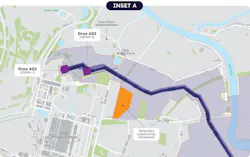
On November 3, Drax Group announced a strategic partnership with Brookfield Asset Management and Radiant to pursue more than 1 GW of potential AI data center capacity at Drax Power Station in North Yorkshire. Backed by a Brookfield joint venture with Qatar's Qai, the project could attract more than £20 billion in total investment, including semiconductor equipment.
Its first phase targets up to 100 MW of compute capacity, with commercial operations envisioned for early 2028. Later phases could expand the campus substantially, eventually drawing directly on the power station's generation capabilities.
The agreement arrived less than a week after the British government published its Data Centre Covenant, a new policy framework linking government support for strategic data centers to commitments on electricity costs, local investment, environmental standards, domestic industrial development, and national security.
And it followed another development that complicates the picture.
Just weeks earlier, the government had rejected an AI Growth Zone proposal involving Drax, North Yorkshire Council, and the University of York. That proposal had envisioned a substantially larger initial commitment to the site as a center for AI computing powered by biomass generation.
The earlier bid and the newly announced partnership are not the same project, nor does the Growth Zone decision amount to a rejection of the current development. But their proximity illustrates the questions now confronting Britain's AI ambitions.
The government wants more computing capacity, faster. It also wants credible energy arrangements, sustainable development, substantial domestic economic benefits, and assurance that electricity consumers will not subsidize speculative infrastructure.
For developers, the message is increasingly obvious: An ambitious capacity announcement is no longer sufficient. Projects must demonstrate how they will become operating infrastructure—and what the public receives in return.
A Power Station at the Crossroads of Britain's AI Ambitions
Few locations better illustrate the collision between Britain's industrial past and its digital ambitions than Drax Power Station.
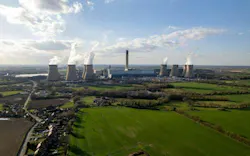
The sprawling North Yorkshire facility has supplied electricity to the country for more than half a century. Originally built as a coal-fired generating station, it has since been converted to biomass generation and remains a major source of dispatchable electricity.
Today, the estate offers approximately 1,000 acres of land, 4 GW of grid access, 2.6 GW of active generating capacity, established cooling infrastructure, and proximity to fiber networks. For AI infrastructure developers, that combination is unusually attractive.
Large data centers increasingly require not merely land and connectivity, but substantial electricity capacity that can be delivered within commercially useful timelines. In markets where new transmission infrastructure can take years to construct, existing energy facilities are becoming valuable development assets. The Drax partnership seeks to capitalize on that advantage.
Under the announced arrangement, Drax would contribute the land, energy infrastructure, and power integration capabilities. Brookfield would bring investment capital and infrastructure expertise, while Radiant, its UK-headquartered AI infrastructure platform, would oversee data center design, commercialization, and customer engagement.
Qai, headquartered in Qatar, participates through its previously announced AI infrastructure joint venture with Brookfield. The structure reflects a broader transformation in AI infrastructure financing, in which development capital, energy assets, land, and compute equipment are increasingly being assembled as components of a single investment strategy.
As Data Center Frontier reported in October, Brookfield has been extending its investments across the AI infrastructure value chain, including its agreement to acquire a minority interest in American Real Estate Partners and its PowerHouse Data Centers platform.
The Drax partnership represents another expression of that strategy, this time combining an existing British power-generation site with international capital and a sovereign AI development agenda.
Yet the project's scale requires careful qualification. The £20 billion figure is an estimate of potential investment over the full development, including computing equipment. It is not a finalized construction budget or a committed capital expenditure.
Nor is the entire gigawatt under construction. The proposed first phase remains subject to planning, regulatory, and network approvals, the identification of a suitable tenant, commercial agreements, and final investment decisions. Drax expects to begin public consultation during November.
Those distinctions are central to the story because Britain's new policy framework is intended, in part, to separate credible projects from increasingly enormous speculative development pipelines.
The relationship between Drax and the government also contains an important recent precedent.
On October 16, Data Center Dynamics reported that the government had declined to designate an earlier proposal involving the site as an AI Growth Zone. According to local reporting cited by DCD, the application failed to satisfy selection requirements addressing credible energy delivery, environmental considerations, and local economic benefit.
Drax subsequently emphasized a smaller, grid-supplied initial phase rather than immediately developing the much larger behind-the-meter concept.
The November 3 partnership therefore suggests a more staged commercial development strategy, backed by major infrastructure investors. Whether that approach ultimately satisfies Britain's emerging requirements remains to be determined.
The Data Centre Covenant: Government Support Comes With Conditions
The government's new Covenant represents an explicit attempt to place AI infrastructure development within a wider national economic framework.
Britain has long been one of Europe's most important data center markets, supported by London's financial sector, network connectivity, cloud ecosystem, and concentration of enterprise demand.
But the government increasingly regards domestic AI computing capacity as a matter of national competitiveness and strategic independence.
Its UK Compute Roadmap forecasts a need for at least 6 GW of AI-capable data center capacity by 2030, roughly three times the capacity available when the roadmap was published.
The objective is not simply to attract additional hyperscale investment. It is to ensure that British businesses, researchers, public institutions, and government agencies retain access to advanced computing resources within the country.
The Covenant advances that objective through five broad expectations.
First, developers should pay their fair share of energy-system costs, avoiding additional burdens on households and other businesses. They are also expected to support grid resilience, flexibility, and clean power.
Second, strategic developments should make substantial investments in their host communities through locally developed benefit plans, in addition to existing planning obligations.
Third, data centers should meet demanding environmental standards. The Covenant calls for new facilities to be designed for a Power Usage Effectiveness of 1.3 or better, minimize demand on public water supplies, and capture waste heat for beneficial use wherever practical.
Fourth, developers should support domestic employment, apprenticeships, supply chains, and British AI technologies, with the most strategically important projects making meaningful contributions to the country's computing capabilities.
Fifth, facilities should strengthen national security and resilience, including secure access to computing infrastructure for critical services.
The distinction between broad industry expectations and formal requirements is central. The Covenant encourages all data centers to meet these standards, while strategically important projects must satisfy the applicable tests to qualify for additional government assistance.
In return, the government proposes a new Ministerial Control Centre to coordinate support for qualifying projects.
Potential measures include reallocating available grid connections, identifying capacity that could become accessible before 2030, transferring certain existing connection agreements to strategically important developments, and allowing tightly controlled temporary onsite power generation where necessary.
The government has not yet finalized the definition of a strategic data center or all the additional criteria projects must satisfy.
It has also published a draft National Policy Statement for Data Centres, establishing a proposed framework for projects seeking approval through the nationally significant infrastructure planning process.
The consultation remains open until January 8, 2027.
Taken together, these measures reveal a government attempting to do two things at once: reduce barriers to investment while establishing clearer expectations for the infrastructure receiving preferential attention.
That is an ambitious proposition.
It also introduces a difficult policy question. How does the government decide which privately financed data centers are strategically important enough to receive faster access to scarce electricity capacity?
The answer could have significant consequences for developers, utilities, competing industrial electricity users, and communities.
Video: In this November 2026 report, Tom Scott visits Britain's national electricity system operator to examine the growing complexity of balancing generation and demand—an important backdrop to the country's expanding AI infrastructure requirements.
A 73-GW Connection Queue Meets a 6-GW National Objective
The scale of Britain's electricity challenge helps explain why the government is intervening.
In a September parliamentary response, the Department for Energy Security and Net Zero confirmed that National Energy System Operator data collected in 2025 showed approximately 72.8 GW of capacity allocated to data centers across Britain's transmission and distribution connection queues.
The number is extraordinary. It is also easy to misunderstand. The 72.8 GW figure represents capacity associated with proposed developments in the connection queue. It is not a measure of operating data center load, completed facilities, or projects with secured financing and customers.
Nor is it directly comparable with the government's 6 GW forecast for AI-capable data center capacity by 2030, which concerns a different measure of the market.
Nevertheless, the queue demonstrates how aggressively developers have sought to reserve electricity capacity as the AI infrastructure boom expands.
The resulting oversubscription presents a challenge for electricity planning. Utilities and grid operators must evaluate requests for substantial new loads while attempting to distinguish projects likely to proceed from those that remain speculative.
Capacity reserved for an unlikely development can complicate decisions affecting other potential users, including manufacturing facilities, housing, and electrification projects.
In July, energy regulator Ofgem proposed reforms intended to address that problem. Its data center connection consultation outlined a commitment fee and new queue-management milestones that would require developers to demonstrate progress toward actual delivery.
Among the proposed tests are evidence of credible end users, procurement of long-lead electrical equipment, and sufficient financial and technical capability. Projects failing to progress could face penalties or lose their positions. The consultation closed in September, with final decisions still pending.
These proposals create a potential complement to the government's Covenant. One mechanism seeks to identify projects worthy of strategic assistance; the other seeks to remove speculative demand from the queue.
Neither creates electricity that does not exist. Britain still must address the physical work of expanding transmission networks, substations, generation, and other infrastructure required to serve rapidly growing loads. That distinction between administrative access to power and physically deliverable electricity will determine how effective the new policy framework becomes.
For data center developers, it means that securing a grid connection agreement remains necessary but increasingly insufficient evidence of a project's ultimate viability.
From Grid Supply to Behind-the-Meter Power
The electrical arrangements envisioned at Drax illustrate the transition from conventional grid-connected development to more integrated energy infrastructure. According to the company's November 3 regulatory announcement, the initial phase would draw electricity directly from the national grid, using existing infrastructure at the power station estate.
That arrangement is distinct from the later phases. Between 2028 and 2031, the partners envision developing approximately 500 MW of additional data center capacity, potentially supported through direct electricity supply from Drax's existing generating facilities under a long-term power purchase agreement.
Further expansion could follow after 2031. This later approach would constitute a form of behind-the-meter generation, in which electricity is supplied directly to a colocated facility rather than purchased entirely through the conventional grid supply arrangement.
But the proposed configuration is not simply a private transaction between a generator and a data center. Drax operates under government-backed electricity support arrangements, including a Contract for Difference covering biomass generation from April 2027 through March 2031.
That agreement provides for approximately 6 terawatt-hours of annual supported generation, according to Drax. It also includes a mechanism allowing the company to request the use of up to 500 MW of generating capacity to serve a data center during that period.
Any such arrangement would require agreement from the government and the Low Carbon Contracts Company, with considerations including consumer value, energy security, and sustainability. In other words, Drax cannot simply redirect supported generating capacity to an AI campus without further scrutiny.
The situation demonstrates why behind-the-meter development does not necessarily eliminate the wider questions surrounding grid obligations, energy-system costs, or regulatory oversight.
As DCF Editor at Large Melissa Farney examined in Data Center Private Power: Who Regulates Behind-the-Meter Generation?, the increasing convergence of private generation and hyperscale computing is creating new questions about standby capacity, reliability obligations, and the allocation of infrastructure costs.
Drax adds another dimension: the interaction between private AI power consumption and an existing government-supported generation asset.
The Biomass Question
There is also an unresolved environmental tension. Drax characterizes its biomass generation as sustainable, dispatchable renewable electricity and emphasizes the power station's role in supporting British energy security.
Critics dispute whether large-scale biomass combustion delivers the climate benefits attributed to it, particularly when imported wood pellets, supply-chain emissions, and the timing of forest carbon recovery are considered.
In July, energy think tank Ember reported that Drax emitted approximately 14.1 million metric tons of carbon dioxide equivalent in 2025, using a methodology that includes biogenic emissions from biomass combustion.
Drax disputes the implications of treating those emissions as equivalent to fossil-fuel emissions, pointing to sustainable biomass sourcing and the carbon accounting framework applied to renewable generation. That distinction is important because the project's environmental credentials cannot be established simply by describing its electricity source as renewable.
The earlier AI Growth Zone proposal also contemplated carbon capture as part of its environmental strategy. Such capabilities should not be confused with demonstrated carbon removal at a future operating data center campus.
The Covenant's environmental expectations introduce a practical test of these competing claims. If a project seeks preferential government support based partly on its contribution to sustainable growth, its underlying power supply, emissions accounting, water demands, and energy-system impacts will all be relevant.
Nor is Drax the only British development confronting difficult choices over electricity generation. In a November 6 report, the Financial Times examined the growing interest in gas-fired generation among UK data center developers.
The newspaper reported that the number of data center projects seeking gas-network connections had risen from five to 24, according to National Gas, as developers explored alternatives to long electricity-grid connection delays.
Of course, those requests do not represent 24 completed generating plants. But they underscore the tension between accelerating AI development and maintaining Britain's broader energy and climate objectives.
The Covenant contemplates temporary onsite generation for exceptionally strategic projects that cannot obtain timely grid access through other measures. Whether such arrangements become limited exceptions or a more important feature of Britain's AI infrastructure buildout remains an open question.
Beyond Yorkshire: Britain's Development Map Expands
The Drax partnership is part of a broader effort to expand British data center development beyond the established London market. That effort is being driven by two intersecting forces.
The first is the government's desire to distribute the economic benefits of AI infrastructure across more regions. The second is the increasingly practical need to locate large developments where electricity, land, and network infrastructure can accommodate them.
London remains Britain's dominant data center hub. According to CBRE's 2026 midyear market review, the capital accounted for approximately 83% of UK data center supply as of the first quarter.
CBRE forecast London take-up exceeding 212 MW during 2026, driven by hyperscalers, neocloud providers, and demand for AI-capable facilities.
But power constraints are pushing some development toward adjacent markets, while the largest prospective AI campuses increasingly look farther afield. Northern England is becoming a particularly important testing ground.
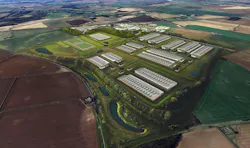
On November 3, U.S. data center park developer Tract disclosed plans for a proposed 500 MW campus in County Durham. As reported by Data Center Dynamics, the Durham Technology Park would potentially include seven data center buildings and an onsite substation.
The project remains in planning, with a formal application targeted for December 2026. Its proximity to the Hawthorn Pit substation and associated transmission development is a central consideration.
A day earlier, DCD reported that National Grid had acquired land at Teesside for a proposed substation capable of supporting up to 3.2 GW.
The project is associated with the redevelopment of the former steelmaking area at Teesworks, where AI infrastructure has become part of the region's industrial regeneration strategy.
The land acquisition is a meaningful step toward the development of physical grid infrastructure. It should not, however, be mistaken for completion of the substation or delivery of the proposed computing capacity.
Together, the Drax, Durham, and Teesside developments illustrate the increasingly close relationship between data center site selection and Britain's existing industrial geography.
Former or operating energy and industrial sites offer large parcels of land, established utility infrastructure, and potential opportunities for economic redevelopment.
But their availability does not eliminate the need for new investment, permitting, suitable network connectivity, or credible demand. CBRE's assessment provides a useful counterweight to the development announcements.
The firm found that Britain's AI Growth Zones had produced uneven results, with some developments progressing while others had yet to attract significant data center investment.
London's established concentration of customers, connectivity, and cloud infrastructure continues to provide commercial advantages that government designation alone cannot reproduce elsewhere.
The regional expansion strategy therefore depends on more than securing land and power.
Developers must also demonstrate that the proposed facilities can attract tenants, operate economically, and support the technical requirements of the workloads they intend to host.
Financial Scrutiny Reaches the AI Buildout
That commercial question is receiving increasing attention from financial regulators. On November 5, Bloomberg reported that the Bank of England had been questioning market participants about loans supporting data center projects without committed tenants.
The inquiry forms part of the central bank's broader examination of financing risks associated with rapidly expanding AI infrastructure investment. The Bank has not prohibited speculative data center lending, nor does the reporting indicate that it views every such loan as inherently problematic.
Its interest nevertheless highlights the risks associated with financing expensive infrastructure before securing the revenues expected to support it. The issue is especially relevant as AI campuses grow from tens or hundreds of megawatts toward gigawatt-scale developments.
Construction financing, electricity procurement, equipment purchases, and long-term customer commitments must ultimately support one another. A project with approved land and a connection agreement is not necessarily a financeable development. A financeable development is not necessarily one that can be commissioned on its advertised schedule.
This is the commercial dimension of the same credibility problem Ofgem is attempting to address in the electricity queue.
Britain is seeking to accelerate strategically valuable investment at precisely the moment when regulators and financiers are paying closer attention to whether proposed infrastructure can actually be delivered.
The Global Perspective: A New Bargain for the AI Economy?
Britain's new Data Centre Covenant may ultimately prove important well beyond the United Kingdom. Governments across the world are attempting to reconcile the economic promise of AI infrastructure with the extraordinary physical requirements of building it.
Electricity networks must accommodate loads measured in hundreds of megawatts. Utilities must plan transmission and generation investments years in advance. Communities are being asked to host facilities whose construction costs can run into billions, but whose permanent employment footprints may be relatively modest.
At the same time, national governments increasingly view domestic computing capacity as a strategic asset. Britain is attempting to connect those issues within a single policy framework.
Its approach differs in important respects from the fragmented regulatory environment in the United States, where utility commissions, state governments, local authorities, and regional grid operators exercise separate—and sometimes competing—powers over development.
Nevertheless, the underlying questions are increasingly similar.
In DCF's October examination of Virginia's changing data center policies, the industry's largest established market was confronting new expectations concerning infrastructure costs, utility commitments, community impacts, and the conditions under which large facilities should receive development approval.
Britain's Covenant addresses comparable pressures through a more coordinated national initiative. It effectively proposes that preferential treatment for strategically important data center development should be accompanied by demonstrable public value.
That is a meaningful evolution in the relationship between government and the industry. For years, data center investment announcements have emphasized capital expenditure, construction employment, technological leadership, and economic development.
Those considerations remain important. But Britain's emerging framework asks a more demanding set of questions: Can the project obtain real electricity capacity? Will it pay its fair share of infrastructure costs? Does it contribute to domestic capability? What obligations does it have to its host community? And can it demonstrate environmental and commercial credibility?
The proposed Drax development provides an immediate test. The partnership brings together a major electricity generator, global infrastructure capital, a British AI development platform, and sovereign investment from Qatar. It offers an established industrial site, significant grid infrastructure, and the prospect of a substantial new computing campus.
It also faces the questions that increasingly determine whether major AI infrastructure projects reach operation: committed customers, regulatory approvals, energy economics, environmental scrutiny, and the allocation of costs and benefits.
This pattern is not unique to Britain.
As the previous installment of DCF Global documented in the Nordic countries, access to electricity and industrial infrastructure can attract enormous AI development pipelines without guaranteeing that the proposed capacity will be financed, constructed, or commercially absorbed.
Britain is confronting a variation of the same challenge, with an additional layer of explicit national industrial policy.
The government's wager is that more selective assistance, clearer development expectations, and greater coordination across electricity and planning systems can accelerate the infrastructure that matters most.
Whether that strategy succeeds will depend on execution.
The Covenant remains new. Important implementation details are unresolved. Major projects are still awaiting approvals, investors, tenants, and physical electricity connections. Yet the direction of policy is becoming clearer.
The next phase of the global AI infrastructure boom may be defined less by which countries can announce the largest development pipelines than by which can establish durable agreements among developers, utilities, investors, governments, and communities.
Britain is attempting to write those terms into national policy. The Drax partnership, and the broader development pipeline taking shape around it, will help determine whether that bargain can turn projected gigawatts into operating infrastructure.
DCF Global is an ongoing Data Center Frontier series examining the international markets, investments, infrastructure strategies, and policy decisions shaping the worldwide data center economy.
At Data Center Frontier, we talk the industry talk and walk the industry walk. In that spirit, DCF Staff members may occasionally use AI tools to assist with content.
Keep pace with the fast-moving world of data centers and cloud computing by connecting with Data Center Frontier on LinkedIn, following us on X/Twitter and Facebook, as well as on BlueSky, and signing up for our weekly newsletters using the form below.
About the Author
 Matt Vincent
Matt Vincent is Editor in Chief of Data Center Frontier, where he leads editorial strategy and coverage focused on the infrastructure powering cloud computing, artificial intelligence, and the digital economy. A veteran B2B technology journalist with more than two decades of experience, Vincent specializes in the intersection of data centers, power, cooling, and emerging AI-era infrastructure. Since assuming the EIC role in 2023, he has helped guide Data Center Frontier’s coverage of the industry’s transition into the gigawatt-scale AI era, with a focus on hyperscale development, behind-the-meter power strategies, liquid cooling architectures, and the evolving energy demands of high-density compute, while working closely with the Digital Infrastructure Group at Endeavor Business Media to expand the brand’s analytical and multimedia footprint. Vincent also hosts The Data Center Frontier Show podcast, where he interviews industry leaders across hyperscale, colocation, utilities, and the data center supply chain to examine the technologies and business models reshaping digital infrastructure. Since its inception he serves as Head of Content for the Data Center Frontier Trends Summit. Before becoming Editor in Chief, he served in multiple senior editorial roles across Endeavor Business Media’s digital infrastructure portfolio, with coverage spanning data centers and hyperscale infrastructure, structured cabling and networking, telecom and datacom, IP physical security, and wireless and Pro AV markets. He began his career in 2005 within PennWell’s Advanced Technology Division and later held senior editorial positions supporting brands such as Cabling Installation & Maintenance, Lightwave Online, Broadband Technology Report, and Smart Buildings Technology. Vincent is a frequent moderator, interviewer, and keynote speaker at industry events including the HPC Forum, where he delivers forward-looking analysis on how AI and high-performance computing are reshaping digital infrastructure. He graduated with honors from Indiana University Bloomington with a B.A. in English Literature and Creative Writing and lives in southern New Hampshire with his family, remaining an active musician in his spare time.
Related



Voices of the Industry
 Source: 3DAnimals/Shutterstock.com
 Source: Rob Byron/Shutterstock.com