Beyond Announced Megawatts: Metlen's Lillian Kasa on Delivering AI Infrastructure
Key Highlights
-
Announced capacity is not deliverable capacity. Data center projects require more than available land and ambitious power commitments. Infrastructure, permitting, financing, and customer deployment must converge on a credible schedule.
-
Oil and gas offers a development playbook. Metlen's Lillian Kasa argues that AI infrastructure developers should manage project pipelines as portfolios, progressively reducing uncertainty and concentrating capital on the most viable opportunities.
-
Speed requires commercial discipline. Staged commitments, clearly allocated risks, and power architectures designed around customer requirements can help developers move faster without exposing themselves to unjustified investment.

For an industry racing to build infrastructure at unprecedented scale, the most consequential question may no longer be how many megawatts can be announced. It is how many can actually be delivered—and which projects deserve the investment required to get there. As hyperscalers, neoclouds, and data center developers assemble increasingly ambitious capacity pipelines, the distinction between potential and execution has become central to the economics of AI infrastructure. Announcements routinely involve hundreds of megawatts or gigawatts. But behind those numbers lie unresolved questions about power availability, equipment procurement, customer commitments, construction schedules, and financing.
For Lillian Kasa, Head of Energy and Data Center Infrastructure Origination for North America at Metlen, these are not simply obstacles to be overcome in pursuit of speed. They are the fundamental questions that determine whether an infrastructure opportunity is worth developing in the first place. In a new episode of the Data Center Frontier Show, Kasa joined DCF Editor in Chief Matt Vincent to examine how developers can distinguish viable projects from speculative pipelines, allocate capital under uncertainty, and build commercial structures capable of supporting the next generation of AI computing infrastructure.
The conversation follows Kasa's participation at September's Data Centre West conference in Calgary, where she moderated a panel on Solving for Power. As DCF reported in its Data Centre West 2026 conference analysis, the industry is increasingly discovering that power availability and delivery certainty—not simply land or market demand—determine which projects can proceed. Kasa brings an additional perspective to that conversation: years spent in offshore oil and gas exploration, where capital-intensive investment decisions must routinely be made with incomplete information. Her argument is that AI infrastructure development can benefit from much the same discipline.
The Difference Between Announcing Power and Delivering It
"When I hear an announcement involving hundreds of megawatts or gigawatts, I really want to understand where those megawatts are, when they'll be available, and what's actually been secured," Kasa told Vincent.
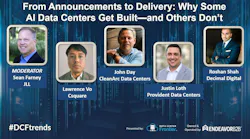
An announcement, she explained, can represent widely different stages of development. It might involve an identified site, an interconnection application, or a generation project still years from commercial operation. There is nothing inherently wrong with announcing early-stage opportunities. Every infrastructure project begins somewhere. But the distinction between identifying potential capacity and demonstrating deliverability is becoming increasingly important. Indeed, that distinction was also at the center of DCF's recent Trends Summit analysis, From Announcements to Delivery: What Separates Real AI Data Center Projects From the Rest, which examined the widening gap between ambitious development pipelines and projects with credible paths to construction.
A credible project requires land control, a workable pathway to power, permitting, infrastructure equipment, a clear customer requirement, and the commercial commitments needed to justify substantial investment. More importantly, these elements must converge on one realistic development schedule. "You could have a great site and a viable power solution, but if those timelines don't line up, you still don't have a deliverable project," Kasa said.
That scheduling challenge is particularly acute in AI infrastructure. AI hardware and computing architectures are advancing at extraordinary speed, while the electrical systems supporting them operate on much longer development cycles. Substation upgrades, transmission expansion, and new generation infrastructure can take years to engineer, permit, procure, and construct. As DCF has examined in its reporting on transmission as a defining constraint for AI data centers, these infrastructure timelines are increasingly shaping where and when new computing capacity can be deployed. A developer may secure an attractive parcel of land and identify a technically feasible power solution, only to discover that the electricity cannot be delivered when the customer needs to deploy its computing equipment.
The result is a growing premium on evidence: not simply how much capacity a developer controls or proposes, but how much can realistically be energized within a customer's required timeframe.
What AI Developers Can Learn From Offshore Exploration
Kasa's proposed framework comes from an industry accustomed to managing enormous financial commitments amid significant uncertainty. Before joining Metlen, she spent much of her career at Equinor, including work involving offshore oil and gas exploration. Such projects can require substantial investment in seismic analysis, subsurface studies, and drilling before the commercial value of a resource is established. The objective is not to eliminate uncertainty before making a decision. That is rarely possible. Instead, developers progressively invest in the information needed to decide whether the next commitment is justified.
"One of the biggest lessons I took from oil and gas exploration is that you're almost always making decisions without having all of the information at hand," Kasa said.
Applied to AI infrastructure, that means treating development opportunities as a portfolio rather than assuming every promising project must ultimately proceed to construction. A company might begin with numerous prospective sites, investing relatively modest amounts in land control, geotechnical studies, and power feasibility assessments. As additional information becomes available, developers can identify which projects merit further investment, which should be deferred, and which no longer make commercial sense.
A site with favorable geography and interested customers might initially look compelling. But further engineering could reveal extensive electrical upgrades, unavailable generation capacity, or infrastructure costs that undermine its economics. In that situation, preserving the option to develop later—or abandoning the opportunity altogether—may be more valuable than forcing the project forward.
"The objective isn't to advance every project in your portfolio," Kasa said. "It's really to identify which ones have the strongest prospects and then really concentrate your resources there."
Her conclusion challenges a familiar assumption of the AI development boom: a large pipeline is not necessarily a commercially valuable one. It also reflects the systems-oriented perspective Kasa developed through her background in computer science. A data center is not simply a building with a power connection, but an interconnected collection of electrical, mechanical, networking, and computing systems whose individual development paths must ultimately converge. That systems thinking, combined with the investment discipline of offshore exploration, informs her approach to evaluating large-scale AI infrastructure opportunities.
Three Questions Every Infrastructure Investment Must Answer
To evaluate whether an opportunity deserves additional capital, Kasa reduces the development process to three questions: Can we build it? Should we build it? And can we support the investment?
The first concerns technical feasibility. Does the project have a suitable site, an achievable power solution, required permits, access to equipment, and a construction schedule that can meet its commitments? The second concerns commercial viability. Is there a real customer requirement? Do the economics support development? Have the parties established arrangements that make sense for both the customer and the infrastructure provider? The third concerns financing and investment discipline. Are anticipated returns sufficient to justify the capital and risks involved? Are the necessary financial resources and commitments available?
These distinctions matter at a time when enormous sums are flowing into AI-related infrastructure, accompanied by growing scrutiny of the assumptions supporting those investments. DCF has recently examined this convergence of capital, power, and development risk in AI Infrastructure's Next Phase: Capital, Power and the Right to Build. A technically viable data center is not automatically a commercially attractive one. Likewise, access to financing does not establish that a project deserves to be financed. Kasa emphasized the distinction between "having access to capital" and "having a good reason to spend the capital."
The danger becomes particularly significant when developers make substantial commitments to long-lead equipment or power infrastructure before validating customer demand and the underlying development schedule. If those assumptions prove incorrect, the result can be expensive infrastructure without a viable near-term customer—a stranded asset. Not every uncertainty must be resolved before spending begins. But Kasa argues that the amount of capital committed should correspond to the strength of the available evidence. Sometimes that means keeping an opportunity alive while unanswered questions are addressed. Other times, it means walking away.
"That's not necessarily a failure," she said. "It's really just good capital discipline."
The Speed-to-Power Paradox
That philosophy raises an important question for developers competing to deliver capacity quickly: How can projects move forward when customers and infrastructure providers often need commitments from one another before either is willing to assume substantial risk?
Kasa described the familiar development dilemma. Customers want confidence that power and facilities will be available by a specified date. Developers, meanwhile, need sufficient customer commitment to justify investing in land, power procurement, equipment, and construction. If both sides insist on complete certainty before proceeding, little gets built. Her solution is to structure commercial commitments progressively, allowing projects to advance through defined development milestones rather than requiring every party to assume its maximum exposure at the outset.
Early milestones might involve engineering due diligence, site investigation, and confirmation of the power pathway. As specific conditions are satisfied, both parties increase their commitments, eventually reaching the point where major equipment procurement and construction are justified. This approach can preserve development momentum without requiring either side to accept disproportionate exposure at the outset. It also challenges the industry's tendency to treat acceleration as an unquestioned virtue.
"Speed only creates value if you're moving towards the right investments," Kasa said. "Otherwise, you're just committing capital earlier and potentially taking on more risk."
The distinction is especially important when project schedules depend on decisions outside either party's direct control. Developers can manage engineering, procurement, and construction. Customers can define their deployment requirements and make corresponding commercial commitments. But utility interconnections, regulatory decisions, and other approvals introduce risks that cannot be controlled entirely by either side. Commercial agreements therefore need to establish what happens when those assumptions change.
If an approval is delayed, who absorbs the additional carrying costs? If a customer postpones deployment, who is responsible for equipment already ordered? What conditions must be met before either party assumes the next level of financial exposure? These questions are not incidental legal details. They help determine whether a development strategy remains commercially viable as project circumstances evolve. For Kasa, the objective is not to remove every uncertainty but to structure commitments so that projects can advance while risks remain manageable.
Power Architecture: Every Solution Changes the Risk
The same principle extends to the increasingly complex power architectures supporting AI data centers. Grid electricity, onsite generation, renewable energy, battery storage, and flexible computing loads are frequently discussed as alternative or complementary solutions to the industry's power constraints. But Kasa cautions against beginning with a favored technology. Instead, developers should start with the customer's requirements: load size, availability date, reliability expectations, cost parameters, and sustainability objectives.
Grid power may offer access to a larger, established electricity system, but sufficient capacity is not always available within the required timeframe. Onsite natural gas generation can provide firm power or bridge delays in grid availability. Yet it introduces another collection of dependencies, including fuel supply, pipeline infrastructure, permitting, equipment procurement, and plant operations. In other words, onsite generation may reduce dependence on utility delivery schedules without eliminating infrastructure risk.
Battery storage offers valuable capabilities for managing short-duration fluctuations and rapidly changing loads, but it does not replace the need for sustained energy supply. Wind and solar generation can support electricity procurement, price hedging, and environmental objectives, although their variable output does not independently provide continuous firm power. And some computing workloads may offer flexibility in when or where processing takes place. These tradeoffs reflect the industry's broader movement toward integrated energy systems, a transition DCF explored in its Trends Summit feature Power First: AI Data Centers Become Energy Systems.
This is where Alberta's particular combination of energy resources becomes interesting. With natural gas, grid infrastructure, renewable generation, and storage opportunities, the province offers developers multiple pathways for constructing hybrid power systems. Kasa expects such arrangements to become more common. But she argues that each component must have a clearly defined operational and commercial purpose. The objective is not to assemble technologies simply because they are available. It is to construct a reliable, economically defensible power solution that meets the customer's actual requirements.
Alberta's Real Measure of Success
The conversation ultimately returned to Alberta, where abundant energy resources, available land, and an established industrial workforce have helped attract growing interest in hyperscale and AI infrastructure. Those advantages are substantial, but Kasa cautioned that they do not automatically translate into operational data centers. The more important differentiator may be predictability.
Developers need to understand how power can be secured, which approvals are required, how long decisions are likely to take, and what obligations must be satisfied along the way. That does not mean every development should receive approval or that regulators should guarantee outcomes. It means establishing sufficiently clear processes for developers, customers, and investors to evaluate their exposure before committing substantial resources. Uncertainty itself carries a cost, Kasa noted, particularly when it prevents companies from determining when to order equipment or what delivery dates they can credibly promise.
Coordination among governments, utilities, regulators, and developers therefore becomes a critical element of investment certainty. It is also part of the wider challenge facing Alberta's developing data center ecosystem, as explored in DCF's recent podcast feature, Alberta's Gigawatt Play: Why Building Data Centers Means Building an Industry, featuring Data Centre West founder Vlad Oujegov. That discussion examined the broader industrial, workforce, and community requirements of scaling the province's emerging digital infrastructure market.
Alberta's progress thus offers a useful test case for the broader North American AI infrastructure industry. "I wouldn't measure Alberta's success by how many gigawatts are announced," Kasa said. "I'd measure it by how many projects actually move into construction, become operational, and attract further investment."
That last measure is especially revealing. A market begins demonstrating lasting credibility when customers successfully deploy one phase of infrastructure and return to develop another. For all the attention devoted to the extraordinary scale of AI demand, Kasa's central message is that the industry's next stage will be determined by its ability to execute—not simply to announce, finance, or accelerate.
"Data centers might be digital businesses, but they're ultimately dependent on physical infrastructure," she concluded.
That physical reality ultimately imposes a discipline of its own. The challenge is no longer simply finding opportunities to build AI infrastructure. There are plenty of those. It is determining which opportunities can be delivered, which warrant the risks involved, and which deserve the capital required to turn announced megawatts into operating capacity.
At Data Center Frontier, we talk the industry talk and walk the industry walk. In that spirit, DCF Staff members may occasionally use AI tools to assist with content.