The 50-Gigawatt Test: SemiAnalysis Sees a Historic Data Center Surge in 2027
Key Highlights
- SemiAnalysis forecasts 51.2 GW of net data center IT capacity additions outside China in 2027, more than double its estimate for 2026.
-
The research firm identifies over 60 GW under construction and more than 24 GW in advanced development across 40 major campuses, although nearly 12 GW of its 2027 forecast involves projects still classified as planned.
-
Altimeter Capital's Brad Gerstner has questioned the pace of deployment, suggesting approximately 25 GW is more realistic, while recent forecasts from Goldman Sachs and JLL provide additional perspectives.
-
October earnings from Vertiv, ABB, Meta and Microsoft demonstrate extraordinary investment momentum alongside continuing project delivery constraints.
-
The report raises a potentially consequential question: Could shortages of GPUs, memory and semiconductor manufacturing capacity eventually constrain AI expansion more than data center buildings and power?
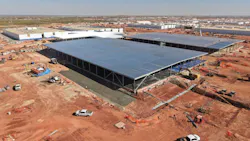
The global data center industry is approaching a potentially historic test of its ability to turn artificial intelligence investment into operational infrastructure.
In a provocative new forecast, semiconductor and AI infrastructure research firm SemiAnalysis predicts that approximately 51.2 gigawatts of net data center IT capacity will be added globally, excluding China, during 2027. That would represent more than double the 25 GW the firm expects to be added in 2026.
Published October 19, the report, Datacenters 2027: The Year of Acceleration, +50GW in a Single Year, makes a forceful argument that much of this unprecedented expansion is already visible in the industry's construction pipeline.
Authored by Jeremie Eliahou Ontiveros, Reyk Knuhtsen and Dylan Patel, the analysis draws on SemiAnalysis' proprietary tracking of construction starts, individual buildings, hyperscale leasing commitments, equipment procurement and project financing.
Its researchers identify more than 60 GW of data center capacity under construction. Among the 40 largest campuses they examined, more than 24 GW is reportedly in advanced stages of development, with much of that capacity expected to be delivered in 2027.
The forecast is not entirely composed of projects already under construction, however. SemiAnalysis' capacity chart includes approximately 11.9 GW of 2027 additions associated with projects still classified as planned. The remainder is associated with facilities already operating or under construction, according to the model's building-status categories.
SemiAnalysis argues that the volume and maturity of projects already underway make a dramatic acceleration increasingly likely, despite well-documented constraints involving electricity, construction labor, equipment and capital.
But the prediction has also become the subject of a revealing industry debate, with competing forecasts and new corporate disclosures raising questions about how much infrastructure can actually be delivered on schedule.
The disagreement is no longer principally about whether AI infrastructure demand is real. It is about whether the industrial systems supporting that demand can expand quickly enough to satisfy it.
The 50-Gigawatt Forecast Meets Its Skeptics
One of the most prominent public challenges came from Altimeter Capital founder Brad Gerstner, who questioned an earlier SemiAnalysis estimate of approximately 43 GW of capacity additions in 2027.
Speaking on the September 17 episode of the All-In podcast, Gerstner suggested that approximately 25 GW was a more realistic expectation.
"Atoms and energy are hard," Gerstner observed, pointing to permitting delays, local opposition, grid interconnection requirements, skilled labor shortages and backlogs for power equipment.
His skepticism was directed at the physical limitations of the buildout, not necessarily at the underlying growth of AI demand.
There is also a geographic distinction worth recognizing. Gerstner discussed SemiAnalysis' earlier projection in the context of U.S. computing capacity, while the firm's latest published forecast covers global additions outside China. Those are not interchangeable measurements, and the precise geographic scope of Gerstner's 25-GW counterestimate was not established in his remarks.
Nevertheless, the central disagreement is clear: Gerstner doubts that the industry can deliver computing infrastructure at the pace SemiAnalysis anticipates.
The researchers responded by increasing their forecast rather than reducing it.
Their October report emphasizes the distinction between broad infrastructure forecasts and models built from individual construction projects. SemiAnalysis contends that its forecasts already incorporate expected delays, financing difficulties and the gradual commissioning of new facilities.
In an October 20 episode of the SemiAnalysis Weekly podcast, the researchers elaborated on their methodology, describing building-level tracking of construction progress, power allocations, permits and delivery schedules.
Their argument is that applying another blanket discount to the resulting estimates risks counting execution delays that the underlying model has already incorporated. This is a consequential methodological distinction.
A campus under construction may represent substantial committed capital and a high probability of eventual completion. But its physical progress does not automatically establish when each phase will have permanent power, commissioned cooling infrastructure, installed computing equipment and operational capacity.
Whether those milestones can converge during 2027 is central to evaluating the forecast.
A Trillion-Dollar Leasing Boom Underwrites the Forecast
The financial foundation of SemiAnalysis' projection is nearly as remarkable as its construction forecast.
The report's subtitle cites approximately $1.3 trillion in data center lease contracts signed during 2026. In its introductory discussion, the firm separately identifies slightly less than $1 trillion in binding, noncancelable leases. Later, it describes more than $1 trillion in lease value signed and closed year to date.
These are not presented with a fully reconciled methodology in the publicly available report, and the different figures should not be treated as interchangeable. The larger point is the extraordinary value of long-term commitments now supporting the construction pipeline.
SemiAnalysis estimates that major hyperscale preleases commonly run 15 to 20 years, with total contract values of approximately $30 billion to $50 billion per gigawatt. These figures represent the aggregate value of multiyear obligations, not cash expenditures in a single year.
The researchers argue that such agreements provide critical support for project financing. Developers typically limit early capital exposure before securing an anchor customer, then use long-term contractual commitments to support debt financing and further construction. That mechanism helps explain why lease activity is an important leading indicator.
The expansion has also broadened beyond the traditional hyperscale cloud providers. SemiAnalysis identifies Meta, AWS, Microsoft, Google, NVIDIA, AMD, Anthropic and OpenAI among companies pursuing gigawatt-scale leasing commitments, alongside neocloud operators securing smaller but still substantial deployments.
The implications extend beyond construction demand. If these commitments are fulfilled, they will require enormous spending on electrical distribution, thermal management, networking, servers, accelerators and supporting power infrastructure.
But signed contracts are not equivalent to delivered megawatts. Their predictive value depends on the financial durability of counterparties, construction execution and the availability of the equipment and electricity necessary to fulfill them.
Vertiv and ABB Offer Evidence of an Infrastructure Supercycle
Some of the strongest independent evidence supporting the scale of SemiAnalysis' forecast is emerging from the companies supplying the data center construction boom.
On October 28, Vertiv reported third-quarter 2026 revenue of $4.31 billion, a 61% increase from the corresponding period in 2025.
Organic orders grew more than 100% year over year, reflecting extraordinary demand for critical power, thermal management and integrated infrastructure systems.
"We are in the middle of the largest infrastructure buildout and it's accelerating," said CEO Giordano Albertazzi in the company's earnings announcement.
Albertazzi also described how Vertiv is compressing product development schedules and industrializing increasingly integrated infrastructure systems to meet growing demand.
The company's performance was accompanied by an increase in full-year revenue guidance.
ABB reported a similarly striking demand signal in its third-quarter results, with orders reaching approximately $12.1 billion, up 40% year over year.
CEO Morten Wierod identified data centers as a particularly strong contributor, reporting a triple-digit increase in orders from that market.
ABB also emphasized manufacturing capacity expansion, automation and new electrical architectures designed for the increasingly demanding power requirements of AI computing.
These disclosures do not independently validate SemiAnalysis' 51.2-GW forecast. Equipment orders can support projects scheduled across multiple years, and manufacturers may accumulate substantial backlogs before customers receive or install equipment.
Nevertheless, the results provide concrete evidence that the industrial supply chain is experiencing the demand conditions on which the forecast depends.
The same pattern is visible in the financial commitments of major technology companies.
On October 21, Meta narrowed its expected 2026 capital expenditure range to $135 billion to $145 billion, including principal payments on finance leases. The company said it expected to continue investing aggressively in 2027, although its detailed budget and capacity plans remained under development.
For the infrastructure industry, these announcements reinforce the central reality behind the SemiAnalysis thesis.
Demand is translating into purchase orders, financing commitments and construction activity. What remains uncertain is how rapidly those investments can become operational capacity.
Microsoft's Latest Results Expose the Delivery Gap
Microsoft's October 28 earnings offer a particularly timely illustration of the execution risk underlying the debate.
During the company's fiscal first-quarter 2027 earnings call, CFO Amy Hood reported capital expenditures of $45.2 billion, below the level previously anticipated because some third-party data center capacity deliveries had been delayed.
Microsoft continued to report strong demand, with Azure revenue increasing 48% year over year. The company expects the delayed capacity deliveries to move into the second half of its fiscal year, contributing to an acceleration in capital spending.
The distinction is important. Microsoft was not describing a deterioration in demand for computing capacity. It was describing a delay in the infrastructure needed to support that demand.
An even more concrete example emerged earlier in October, when Reuters reported that Microsoft had withdrawn from an agreement to anchor an Nscale data center project in Loughton, Essex.
Electricity grid connection delays had reportedly pushed expected power availability into the 2030s. The facility had been intended to support approximately 50 MW of Microsoft capacity.
Both companies emphasized that the decision was specific to the project and did not end their broader partnership.
Nevertheless, the setback demonstrates why development commitments cannot be treated as equivalent to operational capacity. The wider financial industry is reaching a similar conclusion.
In a May assessment, Goldman Sachs Research identified approximately 36.3 GW of U.S. data center capacity scheduled for addition in 2027, based on project-level development data.
But its researchers also estimated that only about 50% to 60% of capacity scheduled over the following one to two years would actually enter service on time.
Goldman Sachs subsequently revised its U.S. capacity forecast in October, raising its projected year-end 2026 total to 64 GW while reducing its year-end 2027 estimate to 90 GW.
That implies approximately 26 GW of additional U.S. capacity between those year-end estimates, although the methodology and capacity definitions differ from those used by SemiAnalysis.
The figures should not be presented as a direct apples-to-apples comparison with SemiAnalysis' global IT-capacity forecast. They do, however, demonstrate the extent to which delivery assumptions influence the industry's competing projections.
On October 23, S&P Global Ratings added a financing perspective, launching a North American data center dashboard covering 32 rated digital infrastructure transactions and $105.3 billion in debt issuance.
The agency continues to expect strong demand, but cautions that power availability, permitting challenges, public opposition and regulatory intervention could delay or constrain development.
The emerging industry picture is therefore not one of weak demand confronting excess construction. It is one of exceptional demand confronting the increasingly difficult mechanics of infrastructure delivery.
Modular Construction and Private Power Change the Equation
SemiAnalysis argues that conventional assumptions about construction timelines are becoming less relevant as hyperscalers and developers redesign data centers around standardization, prefabrication and simplified infrastructure.
Its report describes Google's increasing use of prefabricated electrical modules, Meta's alternative building structures and AWS initiatives to reduce the complexity of data center shells and installed infrastructure.
The researchers also highlight Singapore-based developer DayOne, which they say has reduced construction timelines from more than 18 months to approximately nine months through standardized approaches.
Some modular construction techniques can reduce portions of onsite mechanical, electrical and plumbing labor requirements by as much as 63%, according to the SemiAnalysis research.
These claims are consistent with a broader architectural transition already visible across the industry.
At the 2026 Open Compute Project Global Summit, Meta outlined the use of engineered fabric structures at its Prometheus AI campus in Ohio, while major technology vendors presented increasingly integrated approaches to racks, electrical systems, networking and facilities.
More recently, DCF examined NVIDIA's DSX POD initiative and the movement toward factory-built AI infrastructure.
NVIDIA's approach aims to move substantial portions of computing, networking, power and liquid-cooling integration into factories, reducing installation and validation work at prepared sites.
The company envisions deployment periods as short as 14 days under defined site-readiness conditions.Such approaches could materially alter how quickly new facilities become revenue-producing assets.
But they cannot eliminate the need for prepared sites, substations, generation capacity, high-voltage electrical connections and dependable cooling infrastructure.
The power question is especially consequential. SemiAnalysis takes the aggressive position that the expansion of behind-the-meter generation has broadly resolved the industry's power-generation bottleneck, pointing to fuel cells, gas turbines, refurbished equipment and engine-based power solutions.
The underlying market shift is real. Developers are increasingly assuming responsibility for obtaining generation capacity rather than relying exclusively on conventional utility delivery.
But private generation does not eliminate the requirements for permits, fuel infrastructure, emissions compliance, operating reserves and, in many cases, continued utility support.
As DCF's recent examination of behind-the-meter regulation explains, private power arrangements create a new set of engineering and regulatory responsibilities rather than simply bypassing the traditional grid.
The significance for the 2027 forecast is straightforward. The availability of new construction methods and alternative power supplies expands the number of projects that might be technically feasible within a compressed timeline. Whether those projects can be financed, permitted, completed and commissioned at the necessary pace is another matter.
Could Chips Become the Next Infrastructure Bottleneck?
Perhaps the most consequential argument in the SemiAnalysis report concerns what happens if its researchers are broadly correct.
For much of the AI infrastructure expansion, the dominant industry concern has been the inability to secure enough electricity and physical data center capacity to accommodate accelerating demand for computing equipment. SemiAnalysis suggests that relationship could begin to reverse during 2027 and 2028.
If data center development accelerates sharply, new buildings and associated power infrastructure might become available faster than semiconductor manufacturers can supply the accelerators, logic chips and memory required to populate them.
That would shift the limiting factor from facilities and electricity toward semiconductor manufacturing capacity, advanced packaging and high-bandwidth memory. The implications would extend throughout the investment chain.
Developers could find themselves with commissioned or nearly completed facilities awaiting computing equipment. Hyperscalers might face more complicated decisions about when to populate new sites, how to sequence hardware deployments and which workloads justify available infrastructure.
Conversely, additional computing supply could lower the cost of AI services and accelerate adoption, stimulating further infrastructure demand. This prospect makes the distinction between temporary mismatches and structural oversupply increasingly important.
JLL's 2026 Global Data Center Market Outlook anticipates approximately 100 GW of additional data center capacity between 2026 and 2030, with AI inference becoming an increasingly important driver of demand.
SemiAnalysis' latest forecast envisions a much more concentrated burst of near-term construction.
The estimates differ in geographic coverage, methodology, time horizon and potentially their treatment of IT versus facility capacity, limiting direct comparison. Nevertheless, their contrasting trajectories illustrate how much uncertainty remains over the timing and ultimate shape of the expansion.
The industry's transition from training-dominated infrastructure toward increasingly diverse inference workloads adds another layer of complexity.
As DCF reported in its coverage of the 2026 OCP Global Summit, AI infrastructure is evolving toward coordinated chip-to-grid designs in which processors, networking, cooling, electrical distribution and facility architecture increasingly determine one another.
A shortage in any one part of that system can affect the practical value of capacity elsewhere.
Even if SemiAnalysis proves correct about the construction acceleration, the composition and utilization of the computing systems ultimately installed will help determine its economic consequences.
The Real Test Comes at Commissioning
The significance of SemiAnalysis' latest forecast is not that it settles the question of how much data center capacity will be added in 2027. It is that the debate has moved beyond whether AI infrastructure demand is real.
The industry's order books, financing commitments, construction activity and technology roadmaps provide substantial evidence of a buildout already operating on an extraordinary scale.
The disagreement now concerns the rate at which developers can translate that momentum into functioning facilities. And that is where the competing narratives will be tested.
A completed building is not necessarily an energized data hall. An energized data hall is not necessarily a populated AI cluster. And a populated AI cluster is not necessarily an economically productive computing asset.
Each transition carries its own requirements for capital, equipment, labor, electricity and operational readiness.
SemiAnalysis may ultimately prove correct that the acceleration underway is far larger than many observers anticipate. Its site-by-site methodology offers a substantial case for taking that possibility seriously.
But the next phase of the AI infrastructure boom will be measured less by announced gigawatts than by the pace of commissioning, actual power delivery, computing equipment installation and commercial utilization.
For an industry increasingly organized around the promise of speed, 2027 could establish just how much of that acceleration can be delivered in the physical world.
At Data Center Frontier, we talk the industry talk and walk the industry walk. In that spirit, DCF Staff members may occasionally use AI tools to assist with content.
Keep pace with the fast-moving world of data centers and cloud computing by connecting with Data Center Frontier on LinkedIn, following us on X/Twitter and Facebook, as well as on BlueSky, and signing up for our weekly newsletters using the form below.
About the Author
 Matt Vincent
Matt Vincent is Editor in Chief of Data Center Frontier, where he leads editorial strategy and coverage focused on the infrastructure powering cloud computing, artificial intelligence, and the digital economy. A veteran B2B technology journalist with more than two decades of experience, Vincent specializes in the intersection of data centers, power, cooling, and emerging AI-era infrastructure. Since assuming the EIC role in 2023, he has helped guide Data Center Frontier’s coverage of the industry’s transition into the gigawatt-scale AI era, with a focus on hyperscale development, behind-the-meter power strategies, liquid cooling architectures, and the evolving energy demands of high-density compute, while working closely with the Digital Infrastructure Group at Endeavor Business Media to expand the brand’s analytical and multimedia footprint. Vincent also hosts The Data Center Frontier Show podcast, where he interviews industry leaders across hyperscale, colocation, utilities, and the data center supply chain to examine the technologies and business models reshaping digital infrastructure. Since its inception he serves as Head of Content for the Data Center Frontier Trends Summit. Before becoming Editor in Chief, he served in multiple senior editorial roles across Endeavor Business Media’s digital infrastructure portfolio, with coverage spanning data centers and hyperscale infrastructure, structured cabling and networking, telecom and datacom, IP physical security, and wireless and Pro AV markets. He began his career in 2005 within PennWell’s Advanced Technology Division and later held senior editorial positions supporting brands such as Cabling Installation & Maintenance, Lightwave Online, Broadband Technology Report, and Smart Buildings Technology. Vincent is a frequent moderator, interviewer, and keynote speaker at industry events including the HPC Forum, where he delivers forward-looking analysis on how AI and high-performance computing are reshaping digital infrastructure. He graduated with honors from Indiana University Bloomington with a B.A. in English Literature and Creative Writing and lives in southern New Hampshire with his family, remaining an active musician in his spare time.


Voices of the Industry
 Source: Rob Byron/Shutterstock.com
 Source: Shutterstock, courtesy of nVent Data Solutions